Review
. 2020 May 31;10(6):1083.
doi: 10.3390/nano10061083.

Green Plasmonic Nanoparticles and Bio-Inspired Stimuli-Responsive Vesicles in Cancer Therapy Application

Affiliations
Review

Green Plasmonic Nanoparticles and Bio-Inspired Stimuli-Responsive Vesicles in Cancer Therapy Application

Valeria De Matteis et al. Nanomaterials (Basel). .

Abstract

: In the past years, there is a growing interest in the application of nanoscaled materials in cancer therapy because of their unique physico-chemical properties. However, the dark side of their usability is limited by their possible toxic behaviour and accumulation in living organisms. Starting from this assumption, the search for a green alternative to produce nanoparticles (NPs) or the discovery of green molecules, is a challenge in order to obtain safe materials. In particular, gold (Au NPs) and silver (Ag NPs) NPs are particularly suitable because of their unique physico-chemical properties, in particular plasmonic behaviour that makes them useful as active anticancer agents. These NPs can be obtained by green approaches, alternative to conventional chemical methods, owing to the use of phytochemicals, carbohydrates, and other biomolecules present in plants, fungi, and bacteria, reducing toxic effects. In addition, we analysed the use of green and stimuli-responsive polymeric bio-inspired nanovesicles, mainly used in drug delivery applications that have revolutionised the way of drugs supply. Finally, we reported the last examples on the use of metallic and Au NPs as self-propelling systems as new concept of nanorobot, which is able to respond and move towards specific physical or chemical stimuli in biological entities.

Keywords: bio-inspired NPs; cancer therapy; green synthesis; nanomedicine; noble metals NPs.


Conflict of interest statement

The authors declare no conflict of interest.

Figures
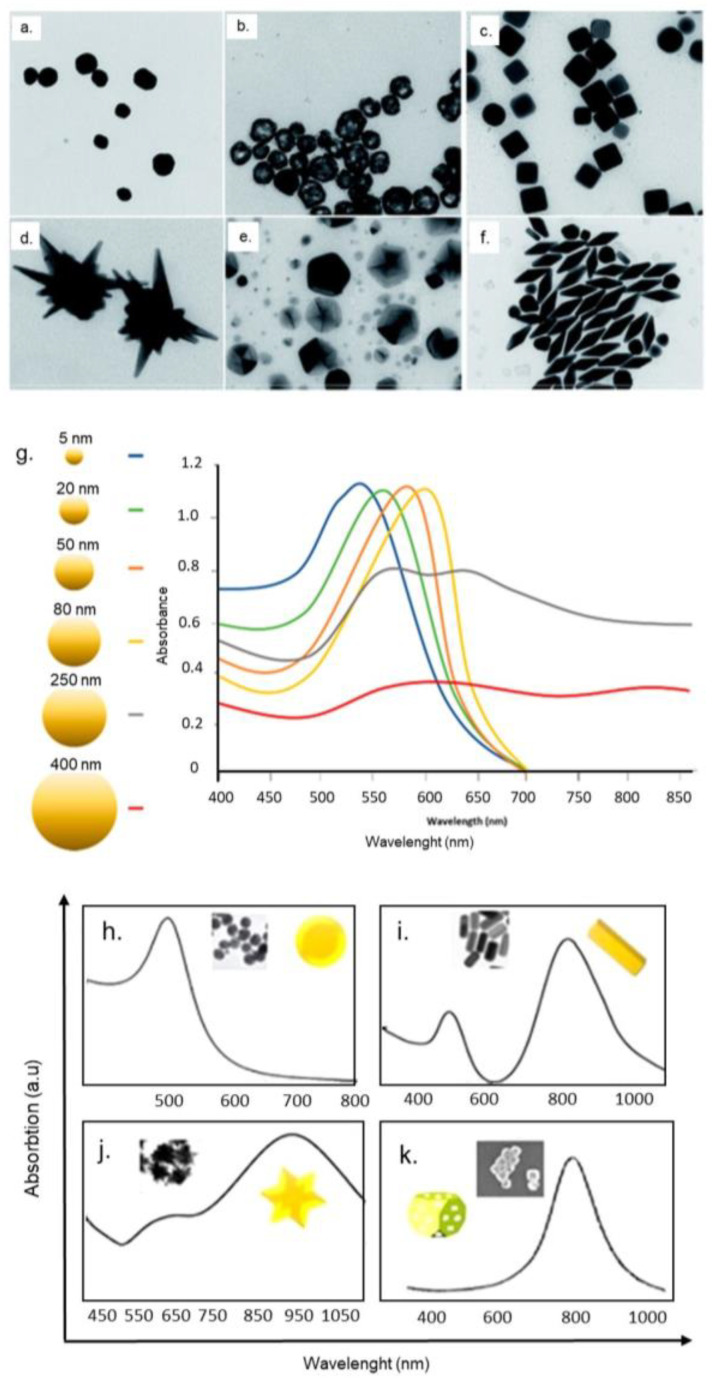
Figure 1
Figure 1
(af) Representative TEM images of Au nanomaterials having different shapes. Reproduced with permission from [22], Copyright, The Royal Society of Chemistry, 2017. (g) Different localised surface plasmon resonance (LSPR) tuning the size of Au NPs [36] and shape (hk). Reproduced with permission from [37], Copyright Elsevier, 2019.
Figure 2
Figure 2
Schematic representation of Au NPs and Ag NPs synthesis using plant extracts.
Figure 3
Figure 3
Schematic illustration of spiky Au NPs coated with Polydopamine (PDA) (SGNP@PDA) and photothermal properties. The combination of chemo-photothermal therapy triggered potent anti-cancer immunity in vivo and anti-tumour efficacy against local primary tumours/untreated and distal tumours. In addition, long-term immunity against tumour recurrence was found. Reproduced with permission from [110], Copyright Nature, 2018.
Figure 4
Figure 4
DNA origami capsule. (A) At high pH the nanocapsule is at an open state while upon pH drop the locks (hairpin in orange and ss DNA in green) establish a triplex DNA motive that holds the capsule halves together. (B) Depiction of the capsule stages. At the open state the cargo (yellow sphere) can be anchored to the capsule interior. The cargo is encapsulated by dropping the pH and revealed at high pH. The cycle of capsule function can be monitored by introducing a FRET pair (red and green dyes). (C) TEM data shows that the open nanocapsules can exhibit a number of opening angles. Representative open structures are shown with their corresponding angles depicted in different colours. (D) TEM data of the nanocapsules at a close state with zoomed in frames of representative structures. (Scale bar at C and D is 50 nm. Width of the zoomed in images is 60 nm). Reproduced with permission from [150] Copyright American Chemistry Society, 2019.
Figure 5
Figure 5
(A). Schematic representation of GFP/RCA-AuNW penetration in HEK293-GFP cell due to the nanomotor movement stimulated by ultrasound (US)-powered propulsion, and (B) gene-mRNA silencing in living cells. (C) Time-lapse images illustrating the penetration of a GFP/ RCA-AuNW (black dots) into a HEK293-GFP cell (light spheres) at 10 s intervals, (D) 4 s intervals and (E) 1 s intervals. The blue arrows indicate the direction of the motion. Reproduced with permission from [179], Copyright American Chemical Society, 2016.
Figure 6
Figure 6
(AD). Schematic illustration of in vivo drug delivery by the propulsion of Mg-based micromotors polymer-coated in a mouse stomach and time lapse images of the micromotor navigation in simulated gastric fluids. Reproduced with permission from [189], Copyright Nature, 2017. (EG) Schematic illustration of CNT-DOX-Fe3O4-mAb nanomotors propulsion mechanisms, tumour penetration and fate of 3D HCT116 cells spheroid. Reproduced with permission from [190] Copyright Nature, 2020. (HJ) TEM micrographs of asymmetric 9:1 PMPC-PDPA/PEO-PBO and POEGMA-PDPA/PEO-PBO polymersomes in positive and negative staining. Reproduced with permission from [193], Copyright American Association for the Advancement of Science, 2018. (K) Schematic representation and transmission electron microscopy (TEM) micrograph of Janus mesoporous silica nanomotor half coated with SiO2 and half functionalised with the enzyme catalase. Reproduced with permission from [195] Copyright Elsevier, 2017.

References

    1. Jeevanandam J., Barhoum A., Chan Y.S., Dufresne A., Danquah M.K. Review on nanoparticles and nanostructured materials: History, sources, toxicity and regulations. Beilstein J. Nanotechnol. 2018;2:1050–1074. doi: 10.3762/bjnano.9.98. - DOI - PMC - PubMed
    1. Marzo J.L., Jornet J.M., Pierobon M. Nanotechnology Derived Nanotools in Biomedical Perspectives: An Update. Curr. Drug Targets. 2019;2:800–807. doi: 10.2174/1389450120666190115152613. - DOI - PubMed
    1. Fathi-Achachelouei M., Knopf-Marques H., Riberio de Silva C.E., Barthès JG D., Bat E., Tezcaner A., Vrana N.E. Use of Nanoparticles in Tissue Engineering and Regenerative Medicine. Front. Bioeng. Biotechnol. 2019;2:1–22. doi: 10.3389/fbioe.2019.00113. - DOI - PMC - PubMed
    1. Anselmo A.C., Mitragotri S. Nanoparticles in the clinic: An update. Bioeng. Transl. Med. 2019:1–16. doi: 10.1002/btm2.10143. - DOI - PMC - PubMed
    1. De Matteis V., Rizzello L. Noble Metals and Soft Bio-Inspired Nanoparticles in Retinal Diseases Treatment: A Perspective. Cells. 2020;9:679. doi: 10.3390/cells9030679. - DOI - PMC - PubMed
