. 2020 Jun 10;287(1928):20192978.
doi: 10.1098/rspb.2019.2978. Epub 2020 Jun 3.

Global determinants of prey naiveté to exotic predators

Affiliations

Global determinants of prey naiveté to exotic predators

Andrea Anton et al. Proc Biol Sci. .

Abstract

Prey naiveté-the failure of prey to recognize novel predators as threats-is thought to exacerbate the impact that exotic predators exert on prey populations. Prey naiveté varies under the influence of eco-evolutionary mediating factors, such as biogeographic isolation and prey adaptation, although an overall quantification of their influence is lacking. We conducted a global meta-analysis to test the effects of several hypothesized mediating factors on the expression of prey naiveté. Prey were overall naive towards exotic predators in marine and freshwater systems but not in terrestrial systems. Prey naiveté was most pronounced towards exotic predators that did not have native congeneric relatives in the recipient community. Time since introduction was relevant, as prey naiveté declined with the number of generations since introduction; on average, around 200 generations may be required to erode naiveté sufficiently for prey to display antipredator behaviour towards exotic predators. Given that exotic predators are a major cause of extinction, the global predictors and trends of prey naiveté presented here can inform efforts to meet conservation targets.

Keywords: invasive species; meta-analysis; naive prey; predator archetype; prey behaviour; prey naiveté.


Conflict of interest statement

We declare we have no competing interests.

Figures
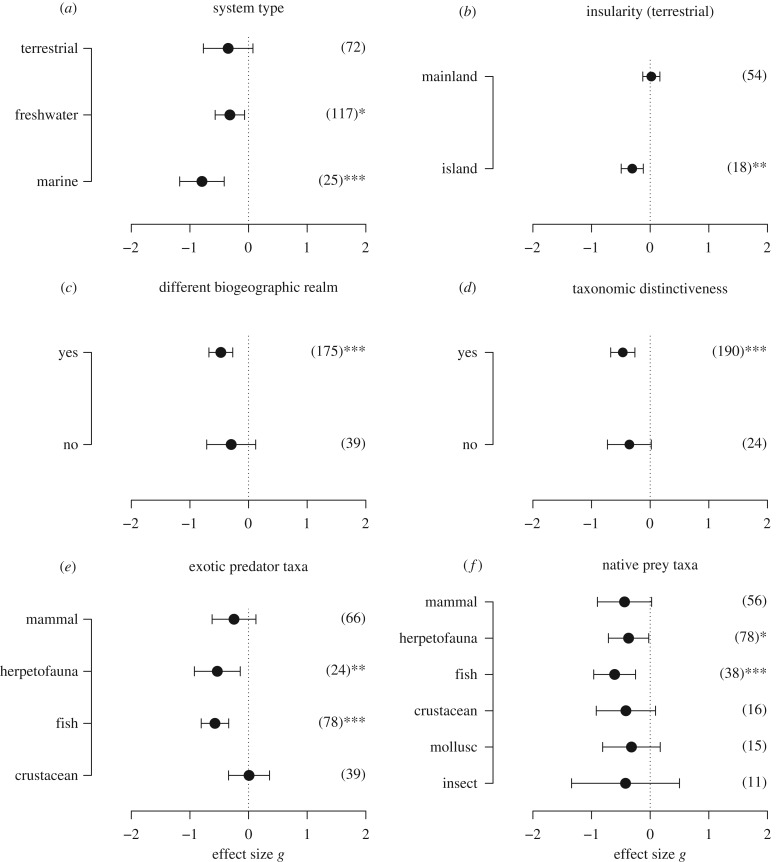
Figure 1.
Figure 1.
Determinants of prey naiveté. Influence of (a) system type, (b) insularity on terrestrial systems, (c) distinctiveness of the biogeographic realm, (d) taxonomic distinctiveness of the exotic predator (i.e. a congeneric species of the exotic predator does not exist within the recipient community), (e) exotic predator taxa, and (f) native prey taxa, which was assessed by comparing the behavioural response of native prey towards native and novel predators. Points indicate the mean effect sizes bracketed by 95% CIs estimated using mixed-effects models. Effect sizes less than zero indicate less antipredator response to a novel predator than to a native predator, and the opposite for effect sizes higher than zero. Effect sizes are considered significant if their 95% CIs do not overlap with zero. Number of observations used to calculate the effect sizes are indicated in parentheses.
Figure 2.
Figure 2.
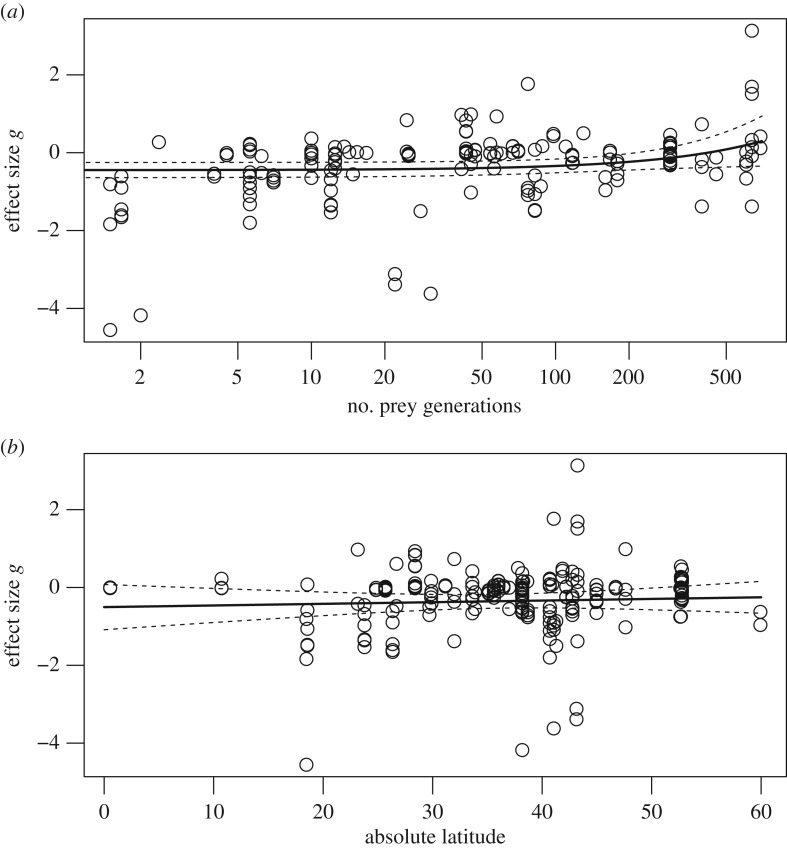
Determinants of prey naiveté. Influence of two continuous predictors: (a) number of prey generations and (b) absolute latitude of the introduction on prey naiveté. Solid line indicates the mean predicted effect sizes bracketed by 95% CIs (dashed lines) estimated using mixed-effects models.

References

    1. Doherty TS, Glen AS, Nimmo DG, Ritchie EG, Dickman CR. 2016. Invasive predators and global biodiversity loss. Proc. Natl Acad. Sci. USA 113, 11 261–11 265. ( 10.1073/pnas.1602480113) - DOI - PMC - PubMed
    1. Medina FM, et al. 2011. A global review of the impacts of invasive cats on island endangered vertebrates. Glob. Change Biol. 17, 3503–3510. ( 10.1111/j.1365-2486.2011.02464.x) - DOI
    1. Anton A, et al. 2019. Global ecological impacts of marine exotic species. Nat. Ecol. Evol. 3, 787–800. ( 10.1038/s41559-019-0851-0) - DOI - PubMed
    1. Seebens H, et al. 2017. No saturation in the accumulation of alien species worldwide. Nat. Commun. 8, 14435 ( 10.1038/ncomms14435) - DOI - PMC - PubMed
    1. Seebens H, et al. 2018. Global rise in emerging alien species results from increased accessibility of new source pools. Proc. Natl Acad. Sci. USA 115, E2264–E2273. ( 10.1073/pnas.1719429115) - DOI - PMC - PubMed

Publication types