


Histologic subtyping affecting outcome of triple negative breast cancer: a large Sardinian population-based analysis
- PMID: 32487046
- PMCID: PMC7268380
- DOI: 10.1186/s12885-020-06998-9
Histologic subtyping affecting outcome of triple negative breast cancer: a large Sardinian population-based analysis
Abstract
Background: Triple Negative breast cancer (TNBC) includes a heterogeneous group of tumors with different clinico-pathological features, molecular alterations and treatment responsivity. Our aim was to evaluate the clinico-pathological heterogeneity and prognostic significance of TNBC histologic variants, comparing "special types" to high-grade invasive breast carcinomas of no special type (IBC-NST).
Methods: This study was performed on data obtained from TNBC Database, including pathological features and clinical records of 1009 TNBCs patients diagnosed between 1994 and 2015 in the four most important Oncology Units located in different hospitals in Sardinia, Italy. Kaplan-Meier analysis, log-rank test and multivariate Cox proportional-hazards regression were applied for overall survival (OS) and disease free survival (DFS) according to TNBC histologic types.
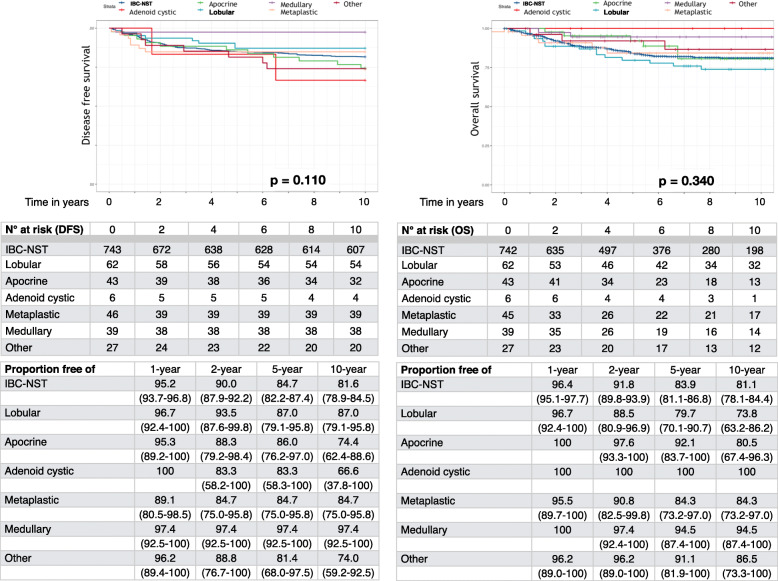
Results: TNBC "special types" showed significant differences for several clinico-pathological features when compared to IBC-NST. We observed that in apocrine carcinomas as tumor size increased, the number of metastatic lymph nodes manifestly increased. Adenoid cystic carcinoma showed the smallest tumor size relative to IBC-NST. At five-year follow-up, OS was 92.1, 100.0, and 94.5% for patients with apocrine, adenoid cystic and medullary carcinoma, respectively; patients with lobular and metaplastic carcinoma showed the worst OS, with 79.7 and 84.3%, respectively. At ten-years, patients with adenoid cystic (100.0%) and medullary (94.5%) carcinoma showed a favourable prognosis, whereas patients with lobular carcinoma showed the worst prognosis (73.8%). TNBC medullary type was an independent prognostic factor for DFS compared to IBC-NST.
Conclusions: Our study confirms that an accurate and reliable histopathologic definition of TNBC subtypes has a significant clinical utility and is effective in the therapeutic decision-making process, with the aim to develop innovative and personalized treatments.
Keywords: Clinico-pathological features; Histologic special type; Metastatic lymph node; Prognosis; Triple negative breast cancer; Tumor size.
Conflict of interest statement
The authors declare that they have no competing interests.
Figures
References
-
- Perez EA. Breast cancer management: opportunities and barriers to an individualized approach. Oncologist. 2011;16:20–22. - PubMed
-
- Perou CM, Sørlie T, Eisen MB, van de Rijn M, Jeffrey SS, Rees CA, et al. Molecular portraits of human breast tumours. Nature. 2000;406:747–752. - PubMed
-
- De Abreu FB, Wells WA, Tsongalis GJ. The emerging role of the molecular diagnostics laboratory in breast cancer personalized medicine. Am J Pathol. 2013;183(4):1075–1083. - PubMed
-
- Stingl J, Caldas C. Molecular heterogeneity of breast carcinomas and the cancer stem cell hypothesis. Nat Rev Cancer. 2007;7(10):791–799. - PubMed
Publication types
MeSH terms
Grants and funding
LinkOut - more resources
Full Text Sources
