Cutaneous Involvement in Waldenström's Macroglobulinaemia
- PMID: 32488284
- PMCID: PMC9207641
- DOI: 10.2340/00015555-3535
Cutaneous Involvement in Waldenström's Macroglobulinaemia
Abstract
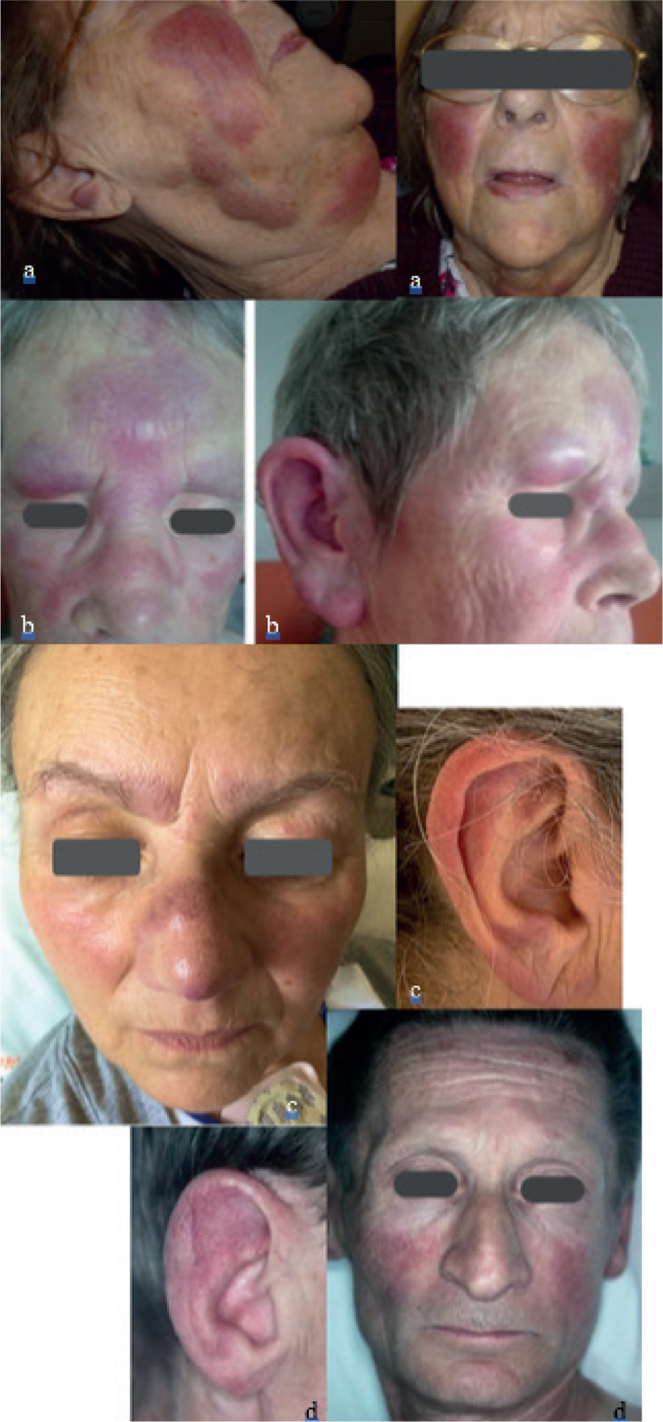
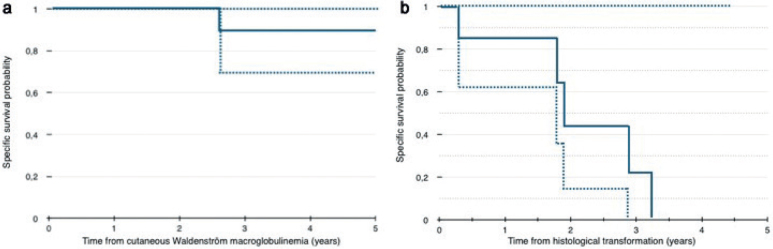
Cutaneous involvement in Waldenström's macroglobulinaemia (WM) has been poorly characterized. To describe this involvement, a retrospective study of 19 patients with WM and cutaneous involvement of tumour B cells was performed. Twelve patients (group 1) had lymphoplasmacytic, non-transformed cutaneous proliferation, while in 7 cases (group 2) cutaneous involvement corresponded to histological transformation. In group 1, skin involvement was inaugural in 6 cases. The lesions were infiltrated plaques (83%), papules (25%) and tumours (42%). Four patients had a similar clinical picture (purplish, bilateral and symmetrical infiltration on the face). MYD88 L265P mutation was detected in the skin biopsy in all 6 cases tested. The 3-year specific survival rate was 88%. In group 2, cutaneous transformation occurred during the follow-up of the WM (71%). Lesions presented as ulcerated tumours (86%) of the trunk (57%) and lower limbs (57%). The 3-year specific survival rate was 22%. Skin involvement in WM has distinctive characteristics (e.g. clinical, histological, immunohistochemical, MYD88 L265P mutation).
Keywords: MYD88 L265P mutation; cutaneous lymphoma; diffuse large B-cell lymphoma; extranodal involvement; histological transformation; Waldenström’s macroglobulinaemia.
Conflict of interest statement
Figures
References
-
- Chigrinova E, Andres M, Schmitt Kurrer AM, Bacher U, Rovó A, Angelillo-Scherrer A. La maladie de Waldenström. Forum Médicale Suisse 2018; 18: 1006–1013.
-
- Lüftl M, Sauter-Jenne B, Gramatzki M, Eckert F, Jenne L. Cutaneous macroglobulinosis deposits in a patient with IgM paraproteinemia/incipient Waldenström macroglobulinemia. J Dtsch Dermatol Ges 2010; 8: 1000–1003. - PubMed
-
- Durot E, Tomowiak C, Michallet AS, Dupuis J, Hivert B, Leprêtre S, et al. . Transformed Waldenström macroglobulinaemia: clinical presentation and outcome. A multiinstitutional retrospective study of 77 cases from the French Innovative Leukemia Organization (FILO). Br J Haematol 2017; 179: 439–448. - PubMed
-
- Gressier L, Hotz C, Lelièvre JD, Agnès C, Marc B, Pierre W, et al. . Cutaneous macroglobulinosis: a report of 2 cases. Arch Dermatol 2010; 146: 165–169. - PubMed