


Identification of biomarkers for physical frailty and sarcopenia through a new multi-marker approach: results from the BIOSPHERE study
- PMID: 32488674
- PMCID: PMC8110636
- DOI: 10.1007/s11357-020-00197-x
Identification of biomarkers for physical frailty and sarcopenia through a new multi-marker approach: results from the BIOSPHERE study
Abstract
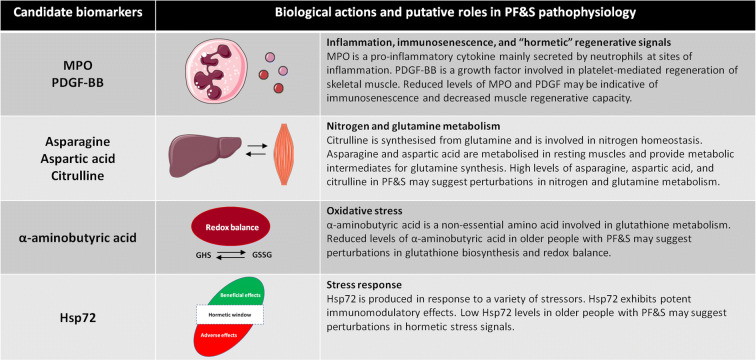
Physical frailty and sarcopenia (PF&S) is a prototypical geriatric condition characterized by reduced physical function and low muscle mass. The aim of the present study was to provide an initial selection of biomarkers for PF&S using a novel multivariate analytic strategy. Two-hundred community-dwellers, 100 with PF&S and 100 non-physically frail, non-sarcopenic (nonPF&S) controls aged 70 and older were enrolled as part of the BIOmarkers associated with Sarcopenia and Physical frailty in EldeRly pErsons (BIOSPHERE) study. A panel of 74 serum analytes involved in inflammation, muscle growth and remodeling, neuromuscular junction damage, and amino acid metabolism was assayed. Biomarker selection was accomplished through sequential and orthogonalized covariance selection (SO-CovSel) analysis. Separate SO-CovSel models were constructed for the whole study population and for the two genders. The model with the best prediction ability obtained with the smallest number of variables was built using seven biomolecules. This model allowed correct classification of 80.6 ± 5.3% PF&S participants and 79.9 ± 5.1% nonPF&S controls. The PF&S biomarker profile was characterized by higher serum levels of asparagine, aspartic acid, and citrulline. Higher serum concentrations of platelet-derived growth factor BB, heat shock protein 72 (Hsp72), myeloperoxidase, and α-aminobutyric acid defined the profile of nonPF&S participants. Gender-specific SO-CovSel models identified a "core" biomarker profile of PF&S, characterized by higher serum levels of aspartic acid and Hsp72 and lower concentrations of macrophage inflammatory protein 1β, with peculiar signatures in men and women.SO-CovSel analysis allowed identifying a set of potential biomarkers for PF&S. The adoption of such an innovative multivariate approach could help address the complex pathophysiology of PF&S, translate biomarker discovery from bench to bedside, and unveil novel targets for interventions.
Keywords: Amino acids; Cytokines; Geroscience; Inflammation; Multivariate; Muscle.
Conflict of interest statement
A.P., E.M., F.L., M.C., and R.C. are partners of the SPRINTT consortium, which is partly funded by the European Federation of Pharmaceutical Industries and Associations (EFPIA).
E.M. served as a consultant for Abbott, Biophytis, Nutricia, and Nestlè. R.C. served as a consultant for Abbott and Nutricia. M.C. served as a consultant for and/or received honoraria for scientific presentations from Nestlé and received a research grant from Pfizer.
Figures
References
-
- Berghella AM, Contasta I, Marulli G, D’Innocenzo C, Garofalo F, Gizzi F, Bartolomucci M, Laglia G, Valeri M, Gizzi M, Friscioni M, Barone M, del Beato T, Secinaro E, Pellegrini P. Ageing gender-specific “Biomarkers of Homeostasis”, to protect ourselves against the diseases of the old age. Immun Ageing. 2014;11:3. doi: 10.1186/1742-4933-11-3. - DOI - PMC - PubMed
-
- Biancolillo A, Måge I, Næs T. Combining SO-PLS and linear discriminant analysis for multi-block classification. Chemom Intell Lab Syst. 2015;141:58–67. doi: 10.1016/J.CHEMOLAB.2014.12.001. - DOI
-
- Biancolillo A, Marini F, Roger JM. SO-CovSel: a novel method for variable selection in a multi-block framework. J Chemom. 2020;34:e3120. doi: 10.1002/cem.3120. - DOI
Publication types
MeSH terms
Substances
LinkOut - more resources
Full Text Sources
Research Materials
