


Consumer-grade biosensor validation for examining stress in healthcare professionals
- PMID: 32489016
- PMCID: PMC7267044
- DOI: 10.14814/phy2.14454
Consumer-grade biosensor validation for examining stress in healthcare professionals
Abstract
Introduction: A high prevalence of stress and burnout has been reported among healthcare professionals; however, the current tools utilized to quantify such metrics are not in keeping with doctors' busy lifestyles, and moreover do not comply with infection prevention policies. Given that increased stress can subsequently impact both the healthcare profession and the patient in care, this study aimed to assess the validity of a wearable biosensor to monitor and manage stress experienced by healthcare professionals.
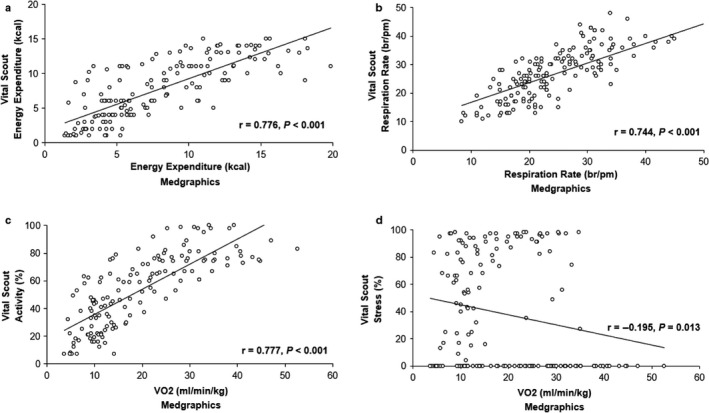
Methods: In all, 12 healthy, male volunteers completed an incremental exercise protocol to volitional exhaustion, which aimed to induce physiological stress in a graded manner. A wearable consumer-grade biosensor (Vital Scout, VivaLNK, Inc.) was used to measure stress, energy expenditure, respiration rate, and activity throughout the exercise protocol. These variables were validated against online breath-by-breath analysis (MedGraphics Ultima Series).
Results: When compared against online "gold standard" measurements, the Vital Scout biosensor demonstrated a high level of accuracy to measure energy expenditure (r = .776, p < .001) and respiration rate (r = .744, p < .001). The increase observed during the incremental exercise test was associated with the Vital Scout biosensor's measurement of activity (r = .777, p < .001). In contrast, there was a poor relationship between the changes in and the Vital Scout biosensor's ability to detect stress (r = -.195, p = .013).
Conclusion: The Vital Scout biosensor provided an accurate assessment of energy expenditure and respiration when compared to the "gold standard" assessment of these parameters. Biosensors have the potential to measure stress and deserve further research in the peri-hospital environment.
Keywords: biosensor; exercise; physiological; stress; validation.
© 2020 The Authors. Physiological Reports published by Wiley Periodicals, Inc. on behalf of The Physiological Society and the American Physiological Society.
Conflict of interest statement
The authors declare no conflict of interest.
Figures
References
-
- Coleman, J. J. , Robinson, C. K. , Zarzaur, B. L. , Timsina, L. , Rozycki, G. S. , & Feliciano, D. V. (2019). To sleep, perchance to dream: Acute and chronic sleep deprivation in acute care surgeons. Journal of the American College of Surgeons, 229(2), 166–174. 10.1016/j.jamcollsurg.2019.03.019 - DOI - PubMed
Publication types
MeSH terms
LinkOut - more resources
Full Text Sources
Medical
