Review
. 2020 Apr 30:23:38-52.
doi: 10.1016/j.jot.2020.04.002. eCollection 2020 Jul.

Sarcopenia: Current treatments and new regenerative therapeutic approaches

Affiliations
Review

Sarcopenia: Current treatments and new regenerative therapeutic approaches

Jessica Hiu-Tung Lo et al. J Orthop Translat. .

Abstract

Sarcopenia is characterized by loss of muscle and reduction in muscle strength that contributes to higher mortality rate and increased incidence of fall and hospitalization in the elderly. Mitochondria dysfunction and age-associated inflammation in muscle are two of the main attributors to sarcopenia progression. Recent clinical trials on sarcopenia therapies such as physical exercise, nutraceutical, and pharmaceutical interventions have revealed that exercise is the only effective strategy shown to alleviate sarcopenia. Unlike nutraceutical and pharmaceutical interventions that showed controversial results in sarcopenia alleviation, exercise was found to restore mitochondria homeostasis and dampen inflammatory responses via a complex exchange of myokines and osteokines signalling between muscle and bone. However, as exercise have limited benefit to immobile patients, the use of stem cells and their secretome are being suggested to be novel therapeutics that can be catered to a larger patient population owing to their mitochondria restoration effects and immune modulatory abilities. As such, we reviewed the potential pros and cons associated with various stem cell types/secretome in sarcopenia treatment and the regulatory and production barriers that need to be overcome to translate such novel therapeutic agents into bedside application. Translational potential: This review summarizes the causes underlying sarcopenia from the perspective of mitochondria dysfunction and age-associated inflammation, and the progress of clinical trials for the treatment of sarcopenia. We also propose therapeutic potential of stem cell therapy and bioactive secretome for sarcopenia.

Keywords: Clinical trial; Exercise; Inflammation; Mesenchymal stem/stromal cells; Mitochondria; Sarcopenia.


Conflict of interest statement

The authors have no conflicts of interest to disclose in relation to this article.

Figures

Figure 1
Figure 1
Factors contributing to ageing include mitochondrial fusion/fission failure, replicative senescence, unresponsive to changes in microenvironment, telomere shortening, ROS accumulation and loss of antioxidants. Mitochondria fusion/fission failure gives rise to the gradual build up in mitochondria DNA mutation owing to the inability of the cells to minimize the mutation ratio of mitochondria DNA via mitochondria fusion and the inability of the cells to produce new mitochondria to replace the dysfunctional ones. With the build up of defective mitochondria, prolonged division of cells and the build up of ROS, cellular senescence take place that ultimately results in stem cell depletion.
Figure 2
Figure 2
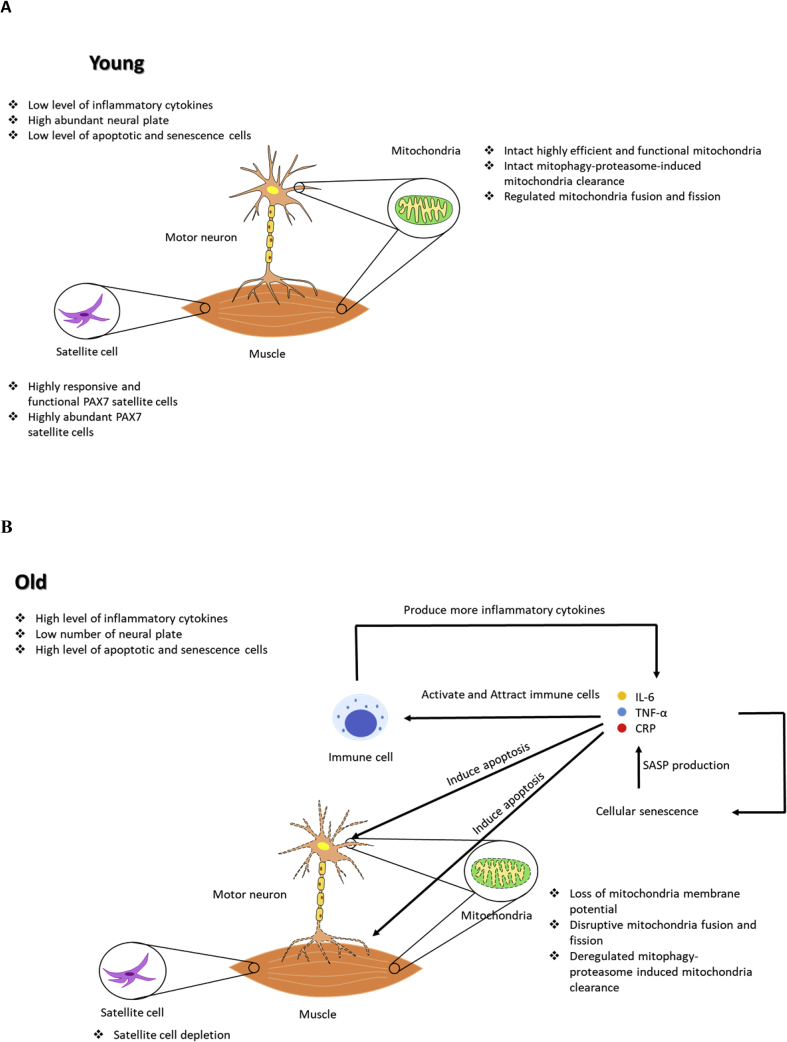
Schematic diagram illustrating the microenvironmental and intracellular changes in young and old muscular microenvironment. (A) In the physiological microenvironment of young individual, low level of inflammatory cytokines is present with highly abundant neural plates and low level of apoptotic and senescence cells in the muscle. Pax 7 satellite cells are abundant and responsive to external stimulation such as physical activities and nutritional stimulation that facilitate muscle building. The mitochondria within the muscle cells, neurons and satellite cells are intact and highly functional and efficient in energy (ATP) production. Proper clearance of dysfunctional mitochondria and properly regulated mitochondria fusion and fission are in place to ensure mitochondria homeostasis in the cells. This ensures cellular viability and function that are essential in muscular function and muscle building. (B) In the physiological microenvironment of aged/old individual, dysfunction mitochondria are in high abundance owing to deregulated mitophagy–proteasome–induced mitochondria clearance and disruptive mitochondria fusion and fission. This results in the accumulation of ROS the trigger cellular senescence in muscle cells, neurons and satellite cells. Senescent cells will release SASP that will initiate an inflammatory cascade that causes more cells to undergo senescence and apoptosis that ultimately results in denervation of muscle and muscle loss in sarcopenia. SASP, senescence-associated secretory phenotype.
Figure 3
Figure 3
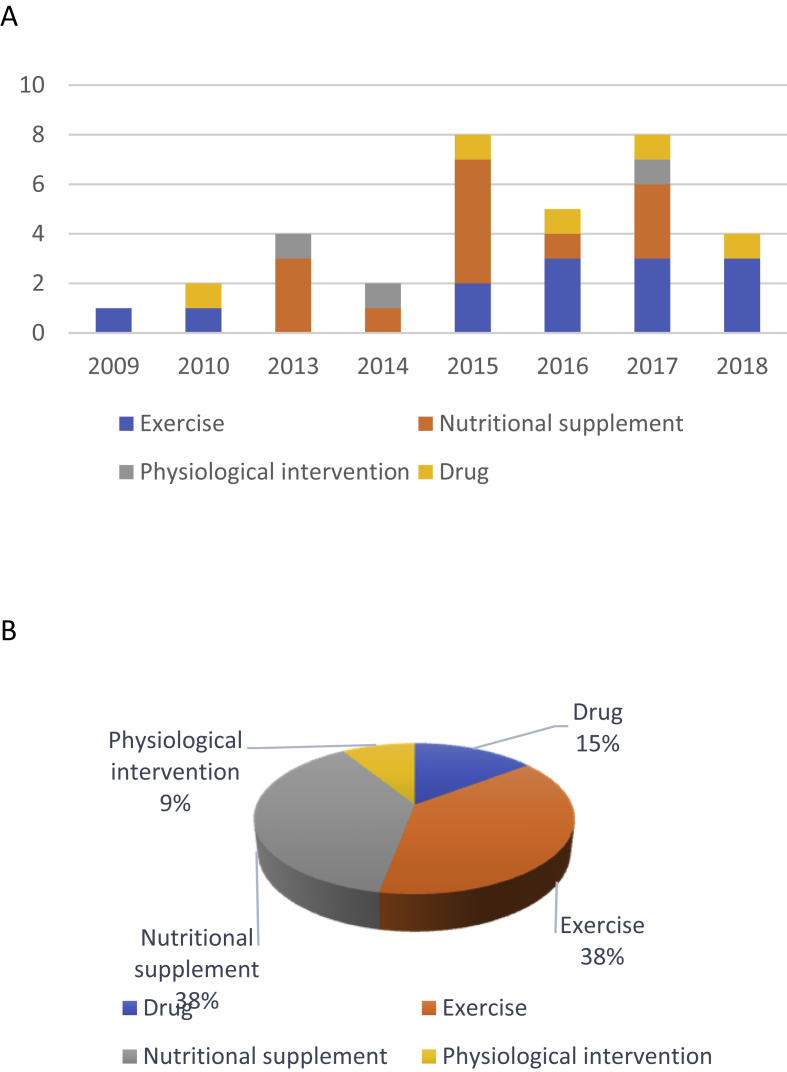
A) Comparison of a number of clinical trials on sarcopenia interventions in accordance with a year of development. Each colour-coded part of the bar depicts the corresponding interventions by year. (B) Percentage of treatments developed relative to the total number of studies.
Figure 4
Figure 4
A schematic illustration of alleviating sarcopenia via exercise. Exercise stimulates muscular contraction which in turn stimulate myocytes to produce myokines that can enhance muscle innervation, stimulate angiogenesis in muscle, and stimulate satellite cell proliferation and differentiation. Exercise also stimulates the bones directly via mechanical loading or indirectly via muscular contraction. Stimulation of the bones by exercise activates osteocytes to produce osteokines that can promote satellite cells proliferation and differentiation, promote muscle growth and induce mitochondria biogenesis. The overall effects of myokines and osteokines switch the microenvironment towards an anti-inflammatory spectrum that supports angiogenesis, neurogenesis, and myogenesis.

References

    1. Beard J.R., Officer A.M., Cassels A.K. The World report on ageing and health. Gerontol. 2016;56(Suppl 2):S163–S166. - PubMed
    1. Lexell J., Taylor C.C., Sjostrom M. What is the cause of the ageing atrophy? Total number, size and proportion of different fiber types studied in whole vastus lateralis muscle from 15- to 83-year-old men. J Neurol Sci. 1988;84(2–3):275–294. - PubMed
    1. Rosenberg I.H. Sarcopenia: origins and clinical relevance. J Nutr. 1997;127(5 Suppl) 990S-1S. - PubMed
    1. Beaudart C., Zaaria M., Pasleau F., Reginster J.Y., Bruyere O. Health outcomes of sarcopenia: a systematic review and meta-analysis. PloS One. 2017;12(1) e0169548. - PMC - PubMed
    1. Sayer A.A., Dennison E.M., Syddall H.E., Gilbody H.J., Phillips D.I., Cooper C. Type 2 diabetes, muscle strength, and impaired physical function: the tip of the iceberg? Diabetes Care. 2005;28(10):2541–2542. - PubMed