Recombinant anti-D for prevention of maternal-foetal Rh(D) alloimmunization: a randomized multi-centre clinical trial
- PMID: 32489976
- PMCID: PMC7231934
- DOI: 10.5468/ogs.2020.63.3.315
Recombinant anti-D for prevention of maternal-foetal Rh(D) alloimmunization: a randomized multi-centre clinical trial
Abstract
Objective: To compare the efficacy and safety of recombinant anti-D (R-anti-D) with conventional polyclonal anti-D (Poly anti-D) in preventing maternal-fetal rhesus D (RhD) alloimmunization and to investigate the immunogenicity of R-anti-D.
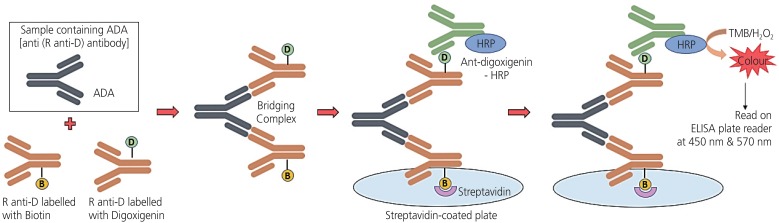
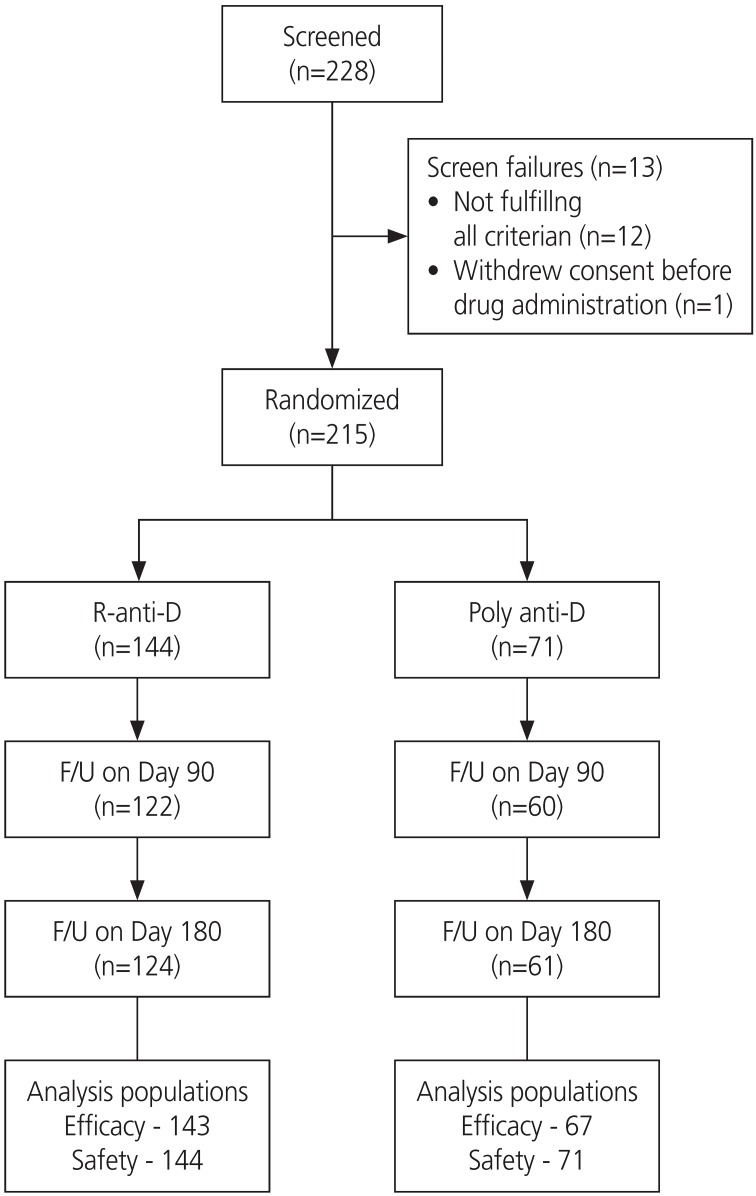
Methods: This was a randomized, open-label, multi-center clinical trial conducted in RhD-negative pregnant women who did not receive antenatal anti-D who delivered RhD-positive babies and showed negative indirect Coombs tests (ICTs) at baseline. The women were randomized in a 2:1 ratio to R-anti-D or Poly anti-D groups and were administered 300 mcg (IM) of the corresponding drug within 72 hours of delivery. ICT was performed 72 hours, 90 days, and 180 days after anti-D injection. Serum samples were collected to check for the development of antibodies against R-anti-D at days 90 and 180, using bridging enzyme-linked immunosorbent assay. The proportion of subjects who had positive ICT results at days 90 and 180 were compared between the groups using Fisher's exact test.
Results: A total of 144 women were randomized to the R-anti-D group and 71 to the Poly anti-D group. Three women in the R-anti-D and none in the Poly anti-D group had a positive ICT result at day 90. No woman in either group had positive ICT result at day 180. Both drugs were well tolerated with only 4 reports of adverse events in each group-all were mild, non-serious, and resolved without sequelae. No subject developed antibodies against R-anti-D.
Conclusion: The studied R-anti-D is comparable in efficacy to conventional Poly anti-D and is safe and non-immunogenic.Trial Registration: Clinical Trials Registry of India Identifier: Trial Registration: Clinical Trials Registry of India Identifier: CTRI/2017/03/008101.
Keywords: Newborn hemolytic disease; Recombinant proteins; Rh isoimmunization; Rho(D) immune globulin.
Copyright © 2020 Korean Society of Obstetrics and Gynecology.
Conflict of interest statement
Conflict of Interest: The author Gautam Vinod Daftary is the managing director at Bharat Serums and Vaccines Limited. The authors James John and Ganesh Harishchandra Divekar are full-time paid employees of Bharat Serums and Vaccines Limited.
Figures
References
-
- Bennardello F, Coluzzi S, Curciarello G, Todros T, Villa S Italian Society of Transfusion Medicine and Immunohaematology (SIMTI) and Italian Society of Gynaecology and Obstetrics (SIGO) working group. Recommendations for the prevention and treatment of haemolytic disease of the foetus and newborn. Blood Transfus. 2015;13:109–134. - PMC - PubMed
-
- Agarwal K, Rana A, Ravi AK. Treatment and prevention of Rh isoimmunization. J Fetal Med. 2014;1:81–88.
-
- Delaney M, Matthews DC. Hemolytic disease of the fetus and newborn: managing the mother, fetus, and newborn. Hematology Am Soc Hematol Educ Program. 2015;2015:146–151. - PubMed
-
- Qureshi H, Massey E, Kirwan D, Davies T, Robson S, White J, et al. BCSH guideline for the use of anti-D immunoglobulin for the prevention of haemolytic disease of the fetus and newborn. Transfus Med. 2014;24:8–20. - PubMed
LinkOut - more resources
Full Text Sources