


Nonalcoholic Fatty Liver Disease and Alcoholic Liver Disease are Major Drivers of Liver Mortality in the United States
- PMID: 32490324
- PMCID: PMC7262283
- DOI: 10.1002/hep4.1510
Nonalcoholic Fatty Liver Disease and Alcoholic Liver Disease are Major Drivers of Liver Mortality in the United States
Abstract
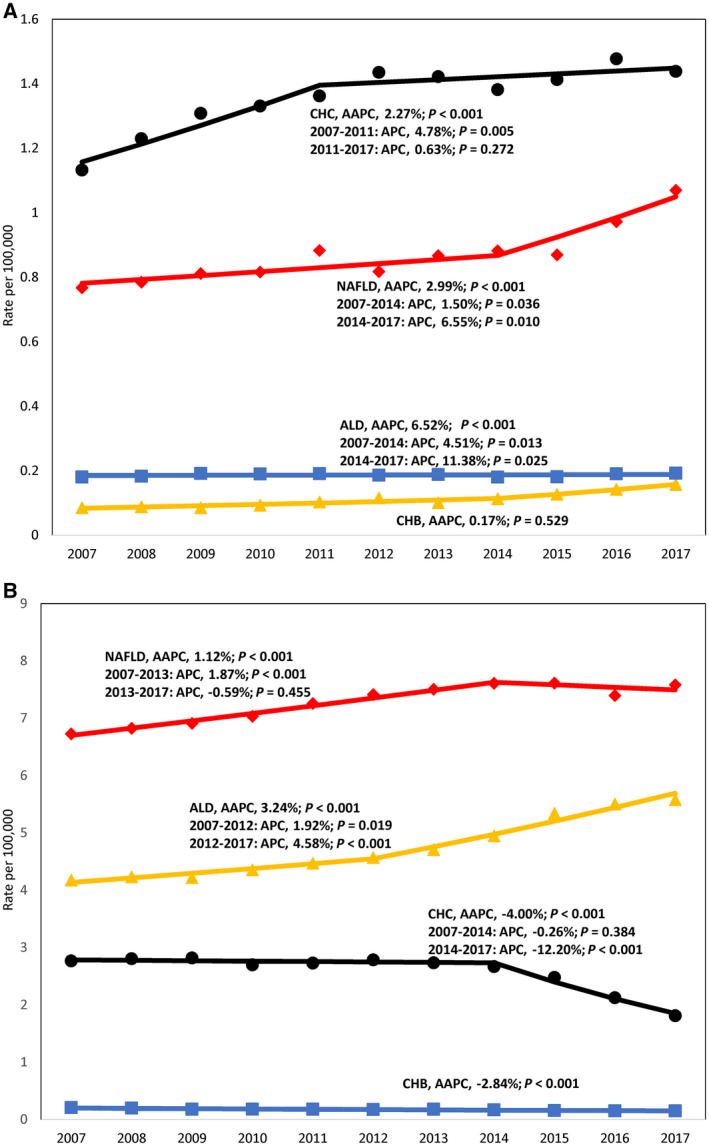
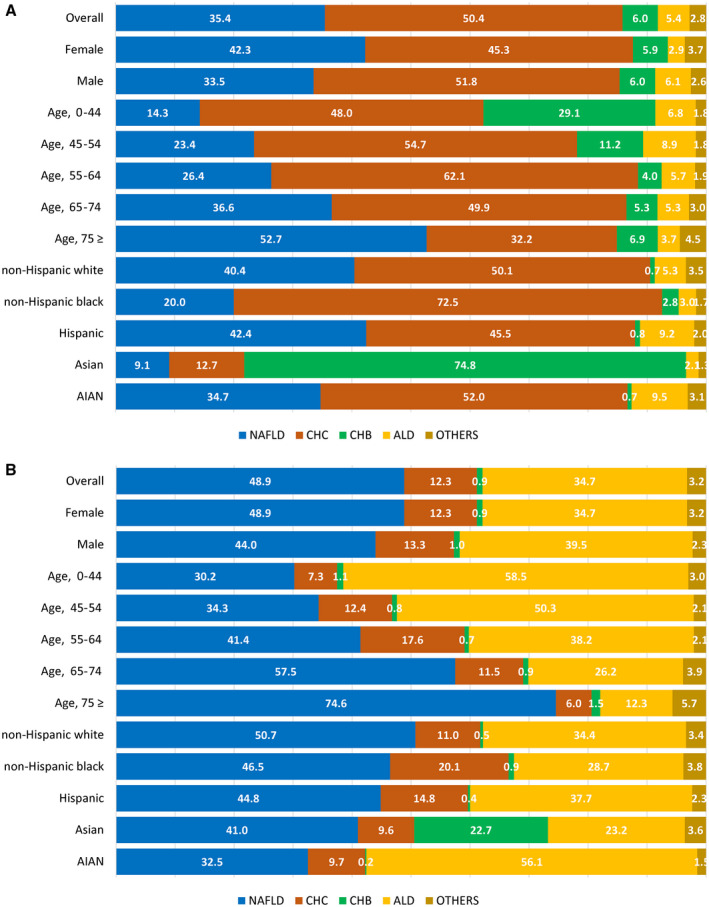
In the United States, chronic viral hepatitis B and C (CHB and CHC), nonalcoholic fatty liver disease (NAFLD), and alcohol-related liver disease (ALD) are the main causes of liver deaths attributable to hepatocellular carcinoma (HCC) and cirrhosis. Our aim was to assess the changes in the rates of mortality and years of potential life lost (YLL) for HCC and cirrhosis due to different liver diseases. We used multiple-cause mortality data (2007-2017) from the National Center for Health Statistics. Annual percentage change (APC) in age-standardized death rate per 100,000 (ASDR) and age-standardized years of life lost per 100,000 (ASYLLR) were calculated. In the United States in 2017, there were 2,797,265 deaths with 73,424 liver deaths, contributing to 1,467,742 of YLL. Of the liver deaths, HCC was noted in 12,169 (16.6%) and cirrhosis in 60,111 (82.0%). CHC was responsible for 50.4% of HCC deaths; NAFLD, 35.4%; HBV, 6.0%; ALD, 5.4%; and others, 2.8%. NAFLD was responsible for 48.9% of cirrhosis deaths; ALD, 34.7%; CHC, 12.3%; CHB, 0.9%; and others, 3.2%. Between 2007 and 2017, the increase in ASDR for HCC due to ALD and NAFLD accelerated after 2014 (APC, 11.38% and 6.55%, respectively) whereas CHC stabilized (APC, 0.63%; P = 0.272) after 2011. The increase in ASYLLR of HCC escalated after 2014 for ALD and NAFLD (APC, 12.12% and 6.15%, respectively) and leveled out for CHC after 2012 (APC, -1.05%; P = 0.056). Furthermore, the highest annual increase in ASDR and ASYLLR for cirrhosis was due to ALD (APC, 3.24% and 3.34%, respectively) followed by NAFLD (APC, 1.23% and 0.49%, respectively). Conclusion: Over the past decade, ASDR and ASYLLR due to ALD and NAFLD have been increasing in the United States. The rising burden of HCC and cirrhosis are primarily driven by NAFLD and ALD.
© 2020 The Authors. Hepatology Communications published by Wiley Periodicals, Inc., on behalf of the American Association for the Study of Liver Diseases.
Figures
References
-
- Asrani SK, Devarbhavi H, Eaton J, Kamath PS. Burden of liver diseases in the world. J Hepatol 2019;70:151‐171. - PubMed
-
- Younossi Z, Henry L. Contribution of alcoholic and nonalcoholic fatty liver disease to the burden of liver‐related morbidity and mortality. Gastroenterology 2016;150:1778‐1785. - PubMed
-
- Trimble G, Zheng L, Mishra A, Kalwaney S, Mir HM, Younossi ZM. Mortality associated with alcohol‐related liver disease. Aliment Pharmacol Ther 2013;38:596‐602. - PubMed
-
- Sayiner M, Wymer M, Golabi P, Ford J, Srishord I, Younossi ZM. Presence of hepatitis C (HCV) infection in baby boomers with Medicare is independently associated with mortality and resource utilisation. Aliment Pharmacol Ther 2016;43:1060‐1068. - PubMed
LinkOut - more resources
Full Text Sources
Miscellaneous
