Association of OPRM1 Functional Coding Variant With Opioid Use Disorder: A Genome-Wide Association Study
- PMID: 32492095
- PMCID: PMC7270886
- DOI: 10.1001/jamapsychiatry.2020.1206
Association of OPRM1 Functional Coding Variant With Opioid Use Disorder: A Genome-Wide Association Study
Erratum in
-
Errors in Results in Abstract and Text and in Figure 2.JAMA Psychiatry. 2021 Feb 1;78(2):224. doi: 10.1001/jamapsychiatry.2020.3485. JAMA Psychiatry. 2021. PMID: 33052379 Free PMC article. No abstract available.
Abstract
Importance: With the current opioid crisis, it is important to improve understanding of the biological mechanisms of opioid use disorder (OUD).
Objectives: To detect genetic risk variants for OUD and determine genetic correlations and causal association with OUD and other traits.
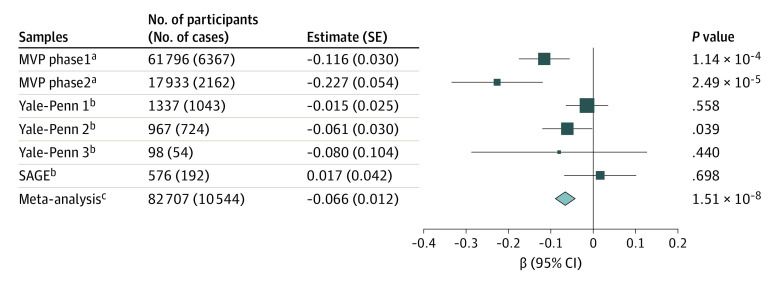
Design, setting, and participants: A genome-wide association study of electronic health record-defined OUD in the Million Veteran Program sample was conducted, comprising 8529 affected European American individuals and 71 200 opioid-exposed European American controls (defined by electronic health record trajectory analysis) and 4032 affected African American individuals and 26 029 opioid-exposed African American controls. Participants were enrolled from January 10, 2011, to May 21, 2018, with electronic health record data for OUD diagnosis from October 1, 1999, to February 7, 2018. Million Veteran Program results and additional OUD case-control genome-wide association study results from the Yale-Penn and Study of Addiction: Genetics and Environment samples were meta-analyzed (total numbers: European American individuals, 10 544 OUD cases and 72 163 opioid-exposed controls; African American individuals, 5212 cases and 26 876 controls). Data on Yale-Penn participants were collected from February 14, 1999, to April 1, 2017, and data on Study of Addiction: Genetics and Environment participants were collected from 1990 to 2007. The key result was replicated in 2 independent cohorts: proxy-phenotype buprenorphine treatment in the UK Biobank and newly genotyped Yale-Penn participants. Genetic correlations between OUD and other traits were tested, and mendelian randomization analysis was conducted to identify potential causal associations.
Main outcomes and measures: Main outcomes were International Classification of Diseases, Ninth Revision-diagnosed OUD or International Statistical Classification of Diseases and Related Health Problems, Tenth Revision-diagnosed OUD (Million Veteran Program), and DSM-IV-defined opioid dependence (Yale-Penn and Study of Addiction: Genetics and Environment).
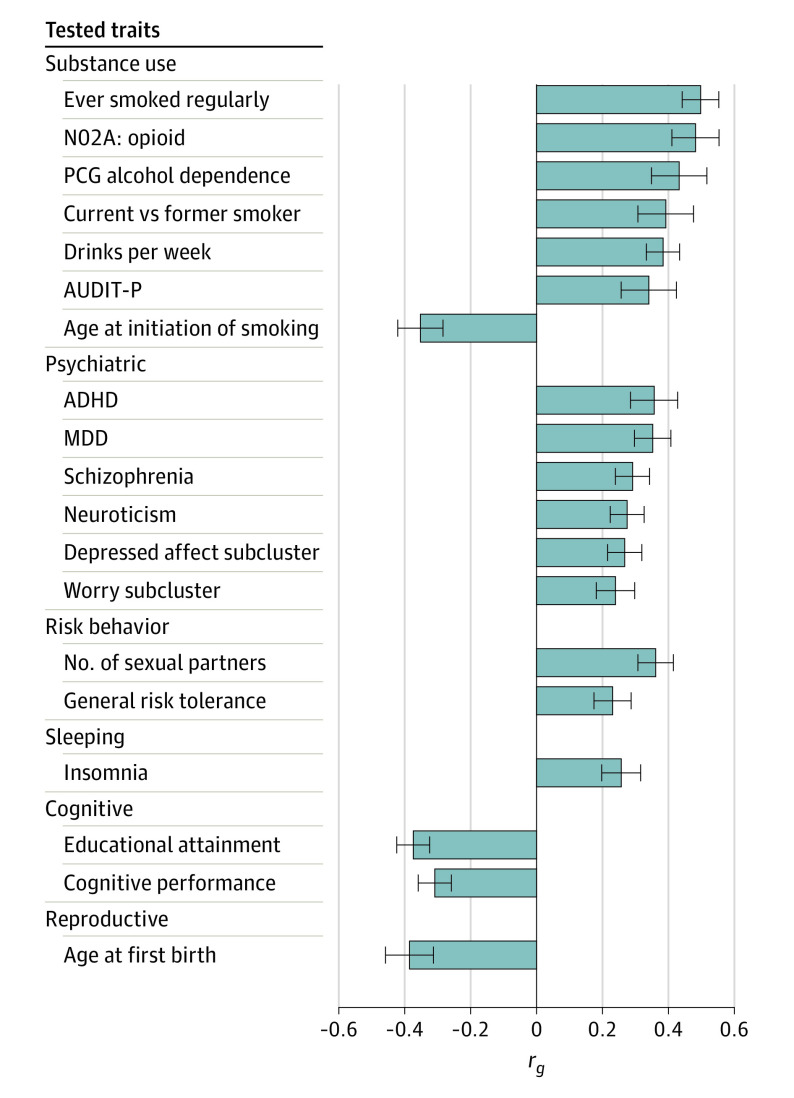
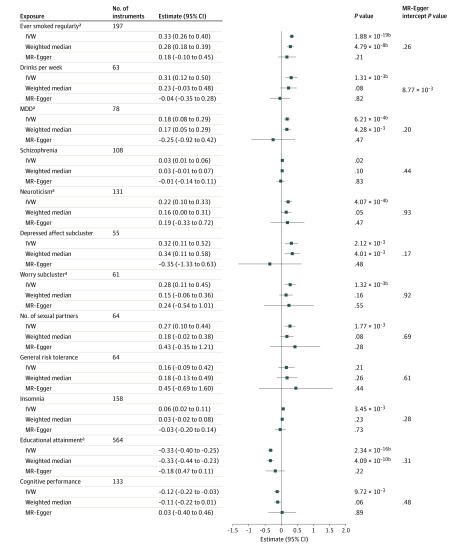
Results: A total of 114 759 individuals (101 016 men [88%]; mean [SD] age, 60.1 [12.8] years) were included. In 82 707 European American individuals, a functional coding variant (rs1799971, encoding Asn40Asp) in OPRM1 (μ-opioid receptor gene, the main biological target for opioid drugs; OMIM 600018) reached genome-wide significance (G allele: β = -0.066 [SE = 0.012]; P = 1.51 × 10⁻⁸). The finding was replicated in 2 independent samples. Single-nucleotide polymorphism-based heritability of OUD was 11.3% (SE = 1.8%). Opioid use disorder was genetically correlated with 83 traits, including multiple substance use traits, psychiatric illnesses, cognitive performance, and others. Mendelian randomization analysis revealed the following associations with OUD: risk of tobacco smoking, depression, neuroticism, worry neuroticism subcluster, and cognitive performance. No genome-wide significant association was detected for African American individuals or in transpopulation meta-analysis.
Conclusions and relevance: This genome-wide meta-analysis identified a significant association of OUD with an OPRM1 variant, which was replicated in 2 independent samples. Post-genome-wide association study analysis revealed associated pleiotropic characteristics. Recruitment of additional individuals with OUD for future studies-especially those of non-European ancestry-is a crucial next step in identifying additional significant risk loci.
Conflict of interest statement
Figures
References
-
- Schwantes-An TH, Zhang J, Chen LS, et al. Association of the OPRM1 variant rs1799971 (A118G) with non-specific liability to substance dependence in a collaborative de novo meta-analysis of European-ancestry cohorts. Behav Genet. 2016;46(2):151-169. doi: 10.1007/s10519-015-9737-3 - DOI - PMC - PubMed
Publication types
MeSH terms
Substances
Grants and funding
LinkOut - more resources
Full Text Sources
Medical
Molecular Biology Databases
Research Materials
Miscellaneous