Review
. 2020 Jun 1;9(6):703.
doi: 10.3390/plants9060703.

An Updated Overview on the Regulation of Seed Germination

Affiliations
Review

An Updated Overview on the Regulation of Seed Germination

Gerardo Carrera-Castaño et al. Plants (Basel). .

Abstract

The ability of a seed to germinate and establish a plant at the right time of year is of vital importance from an ecological and economical point of view. Due to the fragility of these early growth stages, their swiftness and robustness will impact later developmental stages and crop yield. These traits are modulated by a continuous interaction between the genetic makeup of the plant and the environment from seed production to germination stages. In this review, we have summarized the established knowledge on the control of seed germination from a molecular and a genetic perspective. This serves as a "backbone" to integrate the latest developments in the field. These include the link of germination to events occurring in the mother plant influenced by the environment, the impact of changes in the chromatin landscape, the discovery of new players and new insights related to well-known master regulators. Finally, results from recent studies on hormone transport, signaling, and biophysical and mechanical tissue properties are underscoring the relevance of tissue-specific regulation and the interplay of signals in this crucial developmental process.

Keywords: ABA/GA; environmental signals; epigenetics; hormone signaling and dynamics; post-transcriptional regulation; seed dormancy and germination; spatio-temporal regulation.; transcription factors.


Conflict of interest statement

The authors declare no conflict of interest.

Figures
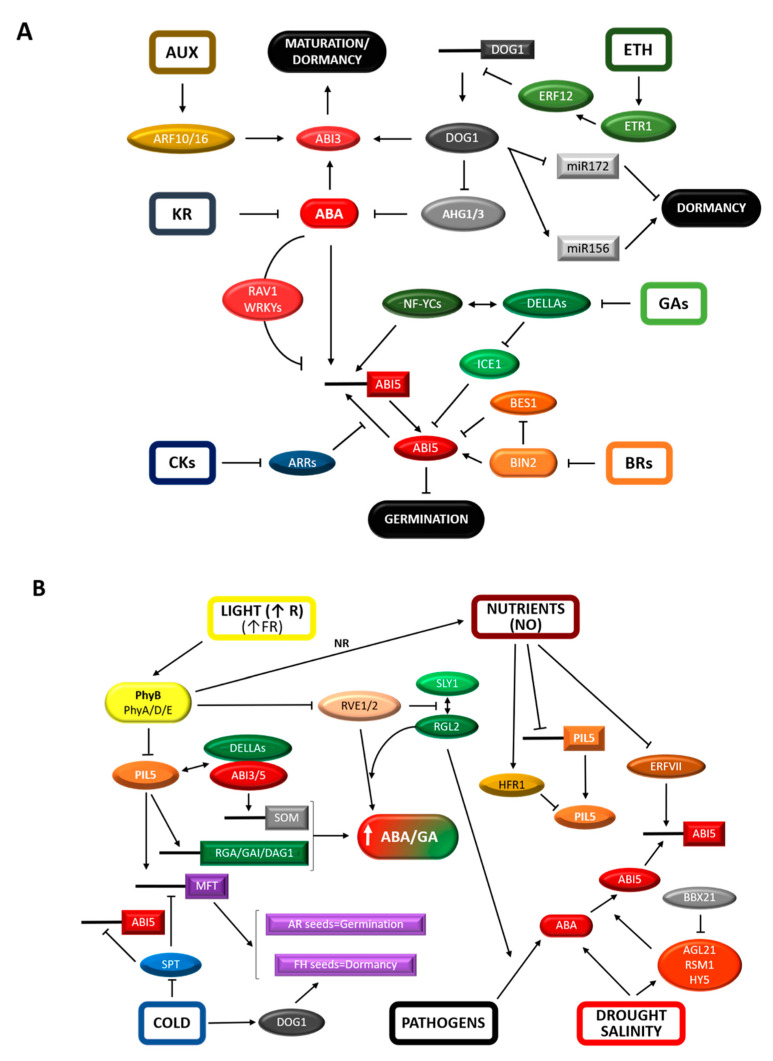
Figure 1
Figure 1
Interplay between core components of molecular mechanisms controlling seed dormancy and germination with hormones and environmental signals. (A) Hormonal and molecular regulatory networks involved in dormancy and germination. DOG1 increases abscisic acid (ABA) sensitivity through sequestration of PP2Cs (AHG1/3) and genetically interacts with ABI3 to ensure ABA signaling during seed maturation and the establishment of dormancy. DOG1 expression is regulated by ethylene (ETH) signaling through the ETR1/ERF12 pathway and has an impact on dormancy release through the control of two antagonistic miRNAs. Other hormones such as auxin (AUX) by the ARF10/16 pathway and karrikins (KR) have a role in dormancy by altering ABA content or signaling. ABI5 plays a key role in ABA signaling to repress germination. ABI5 expression is upregulated under conditions unfavorable for germination by several TFs (ABA-related TFs or NF-YC3/4/9). Negative feedback by RAV1 and WRKY18/40/60 or conditions promoting germination counteract this upregulation. Also, other hormonal signaling pathways (gibberellins, GAs; brassinosteroids, BRs; cytokinins, CKs) interfere with ABI5-mediated transcription or stability through several regulatory proteins (DELLAs, ICE1, BES1, BIN2 or ARR4/5/6). (B) Effects of environmental factors on the regulation of seed dormancy and germination. PIL5 represses germination in the absence of light. It increases the ABA/GA balance partly through direct upregulation of SOM, DELLAs (RGA/GAI) and DAG1 transcription. ABI3/5 and DELLAs also participate in the upregulation of SOM gene transcription. Upon light perception, PIL5 activity is counteracted by different mechanisms mostly mediated by phytochromes (PhyB): increased degradation and reduced transcription in response to higher NO levels and reduced function through HFR1 competitive interaction. NO has also an effect on the stability of class VII ERFs, mediating their degradation and thus reducing ABI5 expression. In addition, activated Phys also reduce DELLA (RGL2) expression and increases its degradation by reducing the expression of circadian genes (RVE1/2). DOG1 integrates temperature cues to regulate dormancy release in fresh-harvested seeds. In dry seeds, SPT negatively regulates germination in the absence of low temperatures. SPT activates ABI5 and represses MFT expression. MFT induces dormancy in fresh seeds but promotes germination in AR seeds, and it is a convergence point between PIL5 and SPT regulation. Pathogen perception triggers DELLA-dependent and GA-independent ABI5 expression to block germination in anticipation of potential seedling damage. Drought and salinity stimulate ABA biosynthesis and induce ABI5 expression, a response mediated by HY5, RSM1 and AGL21 and counteracted by BBX21.
Figure 2
Figure 2
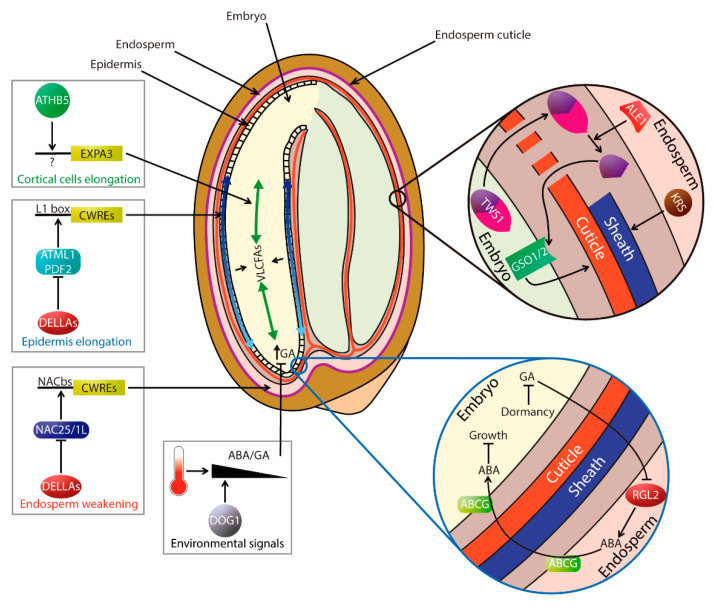
Spatial and mechanical regulation of seed germination. The seed coat protects living tissues from mechanical and oxidative damage. In addition, a cuticle layer associated with the outer surface of the endosperm regulates permeability, modulating seed physiology. Despite these seed coverings, embryo inner cells are able to continuously sense the environment and decide when to germinate. A specific area within the embryonic radicle acts as a decision-making center inducing changes in ABA/GA in response to variable temperature. In the endosperm, DOG1 couples temperature with the regulation of GA metabolism to control CWRE gene expression required for the weakening of cell walls. Endosperm also controls embryo growth in dormant seeds by RGL2-dependent release of ABA and seed specific ABCG transporters. Once germination is triggered, there is an interplay of mechanical forces as the embryo pushes against its surrounding tissues. GA biosynthetic and expansion-promoting gene expression is induced very early in the radicle tip upon imbibition. Due to mechanical constraints, cell expansion is observed mainly in the upper limits of the radicle, extending afterward along the embryonic axis. This expansion is required for germination and depends on GA-responsive epidermis-specific gene expression mediated by two HD-ZIP proteins, ATML1 and PDF2. They activate CWRE and VLCFA genes to coordinate epidermal cell expansion with that of inner tissues. ATHB5 also controls cell expansion, but mainly in cortical cell layers of the upper embryonic axis. Cell expansion along the embryonic axis contributes to testa rupture and germination. Endosperm cells elongate at different rates to accommodate embryo growth. This process is controlled mainly by GA signaling mediated by NAC25 and NAC1L, which upon the perception of an unknown embryonic signal activates CWRE expression. Communication between embryo and endosperm to coordinate germination also occurs during seed development by two mechanisms: (1) A peptide-mediated bidirectional signaling controls the deposition of an embryo cuticle to minimize water loss (embryo secreted TWS1 peptide; endosperm-specific ALE1 subtilase; GSO1/GSO2 receptor-like kinases); (2) An endosperm-derived peptide triggers deposition of the embryo sheath, which facilitates coat shedding and seedling establishment (KRS endosperm-specific peptide).

References

    1. Bewley J.D., Bradford K., Hilhorst H., Nonogaki H. Seeds, Physiology of Development, Germination and Dormancy. 3rd ed. Springer; New York, NY, USA: 2013. Dormancy and the control of germination; pp. 247–297.
    1. Willis C.G., Baskin C., Baskin J.M., Auld J.R., Venable D.L., Cavender-Bares J., Donohue K., De Casas R.R. The nescent germination working group the evolution of seed dormancy: Environmental cues, evolutionary hubs, and diversification of the seed plants. New Phytol. 2014;203:300–309. doi: 10.1111/nph.12782. - DOI - PubMed
    1. Holdsworth M., Bentsink L., Soppe W.J.J. Molecular networks regulating Arabidopsis seed maturation, after-ripening, dormancy and germination. New Phytol. 2008;179:33–54. doi: 10.1111/j.1469-8137.2008.02437.x. - DOI - PubMed
    1. Koorneef M., Elgersma A., Hanhart C.J., Rijn L., Zeevaart J.A.D., Loenen-Martinet E.P. A gibberellin insensitive mutant of Arabidopsis thaliana. Physiol. Plant. 1985;65:33–39. doi: 10.1111/j.1399-3054.1985.tb02355.x. - DOI
    1. Koornneef M., Van Der Veen J.H. Induction and analysis of gibberellin sensitive mutants in Arabidopsis thaliana (L.) heynh. Theor. Appl. Genet. 1980;58:257–263. doi: 10.1007/BF00265176. - DOI - PubMed

LinkOut - more resources