


The challenges of colposcopy for cervical cancer screening in LMICs and solutions by artificial intelligence
- PMID: 32493320
- PMCID: PMC7271416
- DOI: 10.1186/s12916-020-01613-x
The challenges of colposcopy for cervical cancer screening in LMICs and solutions by artificial intelligence
Abstract
Background: The World Health Organization (WHO) called for global action towards the elimination of cervical cancer. One of the main strategies is to screen 70% of women at the age between 35 and 45 years and 90% of women managed appropriately by 2030. So far, approximately 85% of cervical cancers occur in low- and middle-income countries (LMICs). The colposcopy-guided biopsy is crucial for detecting cervical intraepithelial neoplasia (CIN) and becomes the main bottleneck limiting screening performance. Unprecedented advances in artificial intelligence (AI) enable the synergy of deep learning and digital colposcopy, which offers opportunities for automatic image-based diagnosis. To this end, we discuss the main challenges of traditional colposcopy and the solutions applying AI-guided digital colposcopy as an auxiliary diagnostic tool in low- and middle- income countries (LMICs).
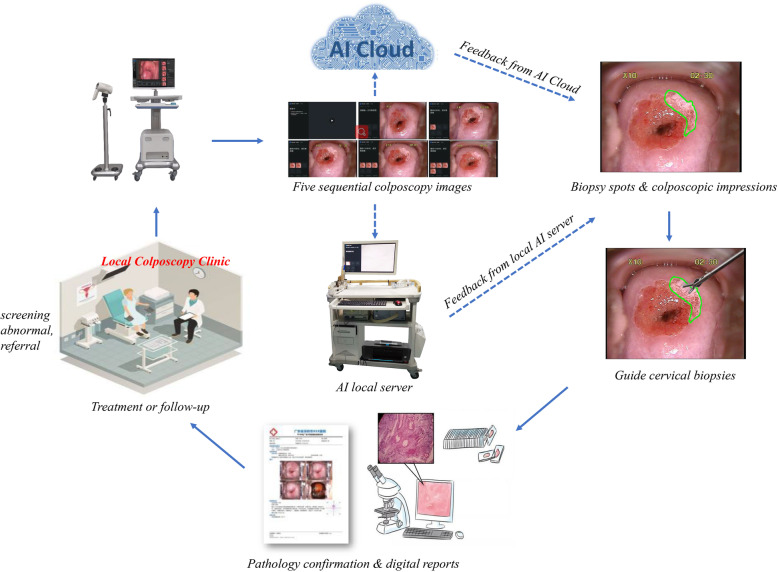
Main body: Existing challenges for the application of colposcopy in LMICs include strong dependence on the subjective experience of operators, substantial inter- and intra-operator variabilities, shortage of experienced colposcopists, consummate colposcopy training courses, and uniform diagnostic standard and strict quality control that are hard to be followed by colposcopists with limited diagnostic ability, resulting in discrepant reporting and documentation of colposcopy impressions. Organized colposcopy training courses should be viewed as an effective way to enhance the diagnostic ability of colposcopists, but implementing these courses in practice may not always be feasible to improve the overall diagnostic performance in a short period of time. Fortunately, AI has the potential to address colposcopic bottleneck, which could assist colposcopists in colposcopy imaging judgment, detection of underlying CINs, and guidance of biopsy sites. The automated workflow of colposcopy examination could create a novel cervical cancer screening model, reduce potentially false negatives and false positives, and improve the accuracy of colposcopy diagnosis and cervical biopsy.
Conclusion: We believe that a practical and accurate AI-guided digital colposcopy has the potential to strengthen the diagnostic ability in guiding cervical biopsy, thereby improves cervical cancer screening performance in LMICs and accelerates the process of global cervical cancer elimination eventually.
Keywords: Artificial intelligence; Cervical cancer screening; Colposcopy diagnosis; Global elimination of cervical cancer.
Conflict of interest statement
YLQ is an Editorial Board Member of the Journal. Rest of the authors declare that they have no conflicts of interest
Figures
References
-
- Bray F, Ferlay J, Soerjomataram I, Siegel RL, Torre LA, Jemal A. Global cancer statistics 2018: GLOBOCAN estimates of incidence and mortality worldwide for 36 cancers in 185 countries. CA: A Cancer Journal for Clinicians. 2018;68(6):394–424. - PubMed
-
- Schiffman M, Doorbar J, Wentzensen N, de Sanjosé S, Fakhry C, Monk BJ, et al. Carcinogenic human papillomavirus infection. Nat Rev Dis Primers. 2016;2:16086. - PubMed
