


Inequalities in access to water and soap matter for the COVID-19 response in sub-Saharan Africa
- PMID: 32493409
- PMCID: PMC7267763
- DOI: 10.1186/s12939-020-01199-z
Inequalities in access to water and soap matter for the COVID-19 response in sub-Saharan Africa
Abstract
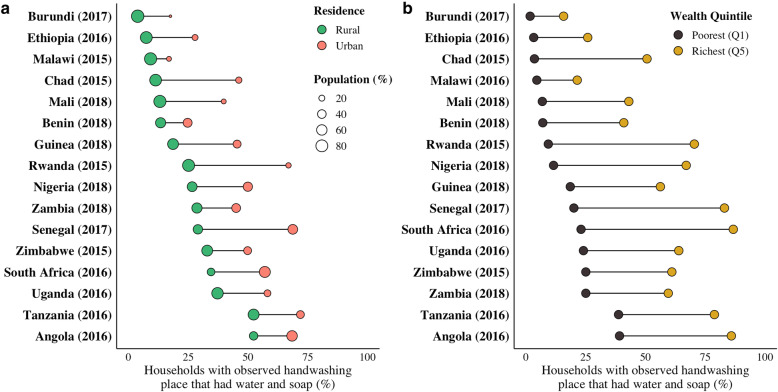
The COVID-19 pandemic has spread rapidly since the first case notification of the WHO in December 2019. Lacking an effective treatment, countries have implemented non-pharmaceutical interventions including social distancing measures and have encouraged maintaining adequate and frequent hand hygiene to slow down the disease transmission. Although access to clean water and soap is universal in high-income settings, it remains a basic need many do not have in low- and middle-income settings.We analyzed data from Demographic and Health Surveys (DHS) of 16 countries in sub-Saharan Africa, using the most recent survey since 2015. Differences in the percentage of households with an observed handwashing place with water and soap were estimated by place of residence and wealth quintiles. Equiplots showed wide within-country disparities, disproportionately affecting the poorest households and rural residents, who represent the majority of the population in most of the countries.Social inequalities in access to water and soap matter for the COVID-19 response in sub-Saharan Africa. Interventions such as mass distribution of soap and ensuring access to clean water, along with other preventive strategies should be scaled up to reach the most vulnerable populations.
Keywords: COVID-19; Hand hygiene; Inequalities; Sub-Saharan Africa; Water and soap.
Conflict of interest statement
The authors declare that they have no competing interests.
Figures
References
-
- Johns Hopkins University. COVID-19 dashboard by the Center for Systems Science and Engineering (CSSE) at Johns Hopkins University. https://coronavirus.jhu.edu/map.html (Accessed 12 Apr 2020).
-
- World Health Organization . Coronavirus disease (COVID-2019) situation report-113. Geneva: WHO; 2020.
-
- Atamanov A, Castaneda Aguilar RA, Diaz-Bonilla C, et al. Global poverty monitoring technical note 10: September 2019 PovcalNet update what’s new. Washington, D. C.: World Bank Group; 2019.
-
- Media L, Jonelis AW, Cangul M. The informal economy in sub-Saharan Africa: size and determinants. Washington, D. C.: International Monetary Fund; 2017.
-
- UN Department of Social Affairs and Economics, Population Division . Patterns and trends in household size and composition: evidence from a United Nations dataset. 2019.
MeSH terms
Substances
LinkOut - more resources
Full Text Sources
