


Nocturnal blood pressure dipping as a marker of endothelial function and subclinical atherosclerosis in pediatric-onset systemic lupus erythematosus
- PMID: 32493472
- PMCID: PMC7268394
- DOI: 10.1186/s13075-020-02224-w
Nocturnal blood pressure dipping as a marker of endothelial function and subclinical atherosclerosis in pediatric-onset systemic lupus erythematosus
Abstract
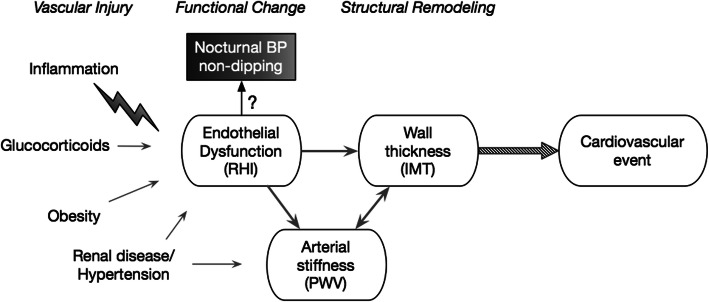
Background: Loss of the normal nocturnal decline in blood pressure (BP), known as non-dipping, is a potential measure of cardiovascular risk identified by ambulatory blood pressure monitoring (ABPM). We sought to determine whether non-dipping is a useful marker of abnormal vascular function and subclinical atherosclerosis in pediatric-onset systemic lupus erythematosus (pSLE).
Methods: Twenty subjects 9-19 years of age with pSLE underwent ABPM, peripheral endothelial function testing, carotid-femoral pulse wave velocity/analysis for aortic stiffness, and carotid intima-media thickness. We assessed the prevalence of non-dipping and other ABPM abnormalities. Pearson or Spearman rank correlation tests were used to evaluate relationships between nocturnal BP dipping, BP load (% of abnormally elevated BPs over 24-h), and vascular outcome measures.
Results: The majority (75%) of subjects had inactive disease, with mean disease duration of 3.2 years (± 2.1). The prevalence of non-dipping was 50%, which occurred even in the absence of nocturnal or daytime hypertension. Reduced diastolic BP dipping was associated with poorer endothelial function (r 0.5, p = 0.04). Intima-media thickness was significantly greater in subjects with non-dipping (mean standard deviation score of 3.0 vs 1.6, p = 0.02). In contrast, higher systolic and diastolic BP load were associated with increased aortic stiffness (ρ 0.6, p = 0.01 and ρ 0.7, p < 0.01, respectively), but not with endothelial function or intima-media thickness.
Conclusion: In a pSLE cohort with low disease activity, isolated nocturnal BP non-dipping is prevalent and associated with endothelial dysfunction and atherosclerotic changes. In addition to hypertension assessment, ABPM has a promising role in risk stratification and understanding heterogeneous mechanisms of cardiovascular disease in pSLE.
Keywords: Ambulatory blood pressure monitoring; Cardiovascular diagnostic techniques; Cardiovascular disease; Pediatric systemic lupus erythematosus; Systemic lupus erythematosus.
Conflict of interest statement
The authors declare that they have no competing interests.
Figures
References
-
- Björnådal L, Yin L, Granath F, Klareskog L, Ekbom A. Cardiovascular disease a hazard despite improved prognosis in patients with systemic lupus erythematosus: results from a Swedish population based study 1964-95. J Rheumatol. 2004;31:713–719. - PubMed
-
- Schanberg LE, Sandborg C, Barnhart HX, Ardoin SP, Yow E, Evans GW, et al. Premature atherosclerosis in pediatric systemic lupus erythematosus: risk factors for increased carotid intima-media thickness in the atherosclerosis prevention in pediatric lupus erythematosus cohort. Arthritis Rheum. 2009;60:1496–1507. - PMC - PubMed
Publication types
MeSH terms
Grants and funding
LinkOut - more resources
Full Text Sources
Medical
