


Biennial Upsurge and Molecular Epidemiology of Enterovirus D68 Infection in New York, USA, 2014 to 2018
- PMID: 32493783
- PMCID: PMC7448634
- DOI: 10.1128/JCM.00284-20
Biennial Upsurge and Molecular Epidemiology of Enterovirus D68 Infection in New York, USA, 2014 to 2018
Abstract
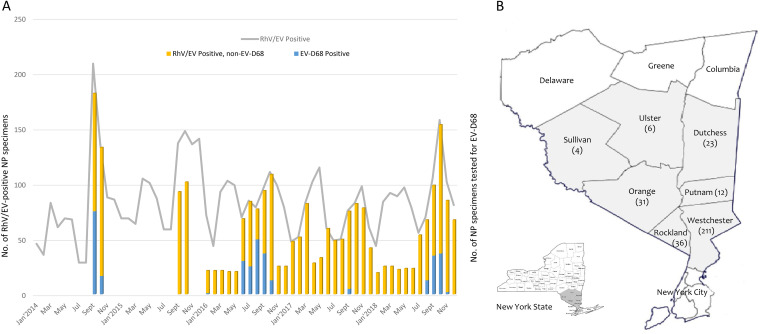
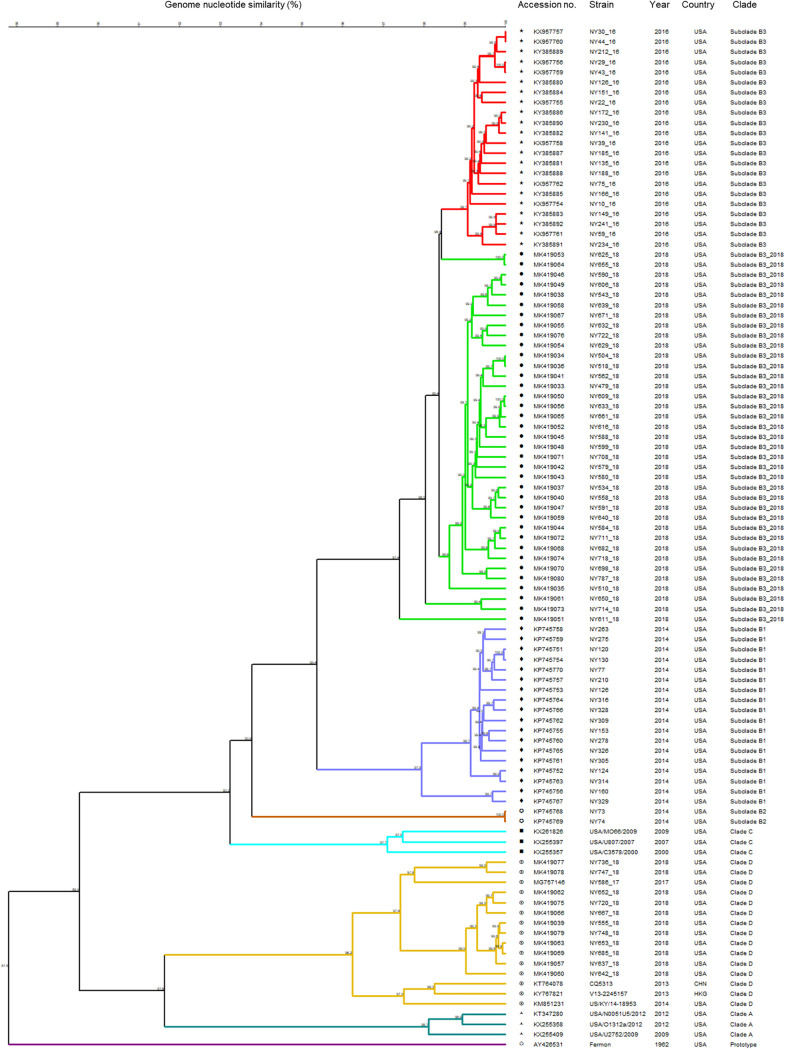
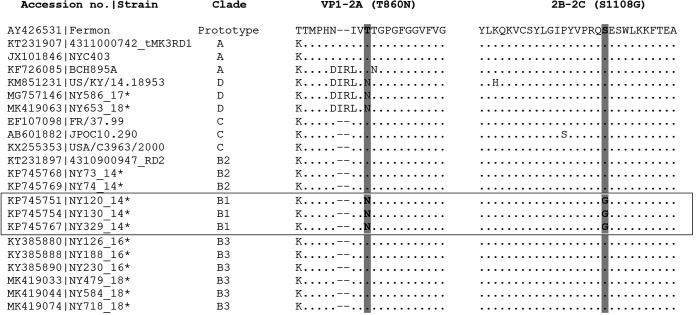
Enterovirus D68 (EV-D68) infection has been associated with outbreaks of severe respiratory illness and increased cases of nonpolio acute flaccid myelitis. The patterns of EV-D68 circulation and molecular epidemiology are not fully understood. In this study, nasopharyngeal (NP) specimens collected from patients in the Lower Hudson Valley, New York, from 2014 to 2018 were examined for rhinovirus/enterovirus (RhV/EV) by the FilmArray respiratory panel. Selected RhV/EV-positive NP specimens were analyzed using two EV-D68-specific real-time RT-PCR assays, Sanger sequencing and metatranscriptomic next-generation sequencing. A total of 2,398 NP specimens were examined. EV-D68 was detected in 348 patients with NP specimens collected in 2014 (n = 94), 2015 (n = 0), 2016 (n = 160), 2017 (n = 5), and 2018 (n = 89), demonstrating a biennial upsurge of EV-D68 infection in the study area. Ninety-one complete or nearly complete EV-D68 genome sequences were obtained. Genomic analysis of these EV-D68 strains revealed dynamics and evolution of circulating EV-D68 strains since 2014. The dominant EV-D68 strains causing the 2014 outbreak belonged to subclade B1, with a few belonging to subclade B2. New EV-D68 subclade B3 strains emerged in 2016 and continued in circulation in 2018. Clade D strains that are rarely detected in the United States also arose and spread in 2018. The establishment of distinct viral strains and their variable circulation patterns provide essential information for future surveillance, diagnosis, vaccine development, and prediction of EV-D68-associated disease prevalence and potential outbreaks.
Keywords: enterovirus; enterovirus D68; molecular epidemiology; next-generation sequencing; outbreak investigation; real-time RT-PCR; viral evolution.
Copyright © 2020 American Society for Microbiology.
Figures
References
-
- ICTV. 2015. Virus taxonomy, 2015 release. http://www.ictvonline.org/virustaxonomy.asp.
-
- CDC. 2011. Clusters of acute respiratory illness associated with human enterovirus 68—Asia, Europe, and United States, 2008–2010. MMWR Morb Mortal Wkly Rep 60:1301–1304. - PubMed
Publication types
MeSH terms
LinkOut - more resources
Full Text Sources
Other Literature Sources
Miscellaneous
