


Newly Named Klebsiella aerogenes (formerly Enterobacter aerogenes) Is Associated with Poor Clinical Outcomes Relative to Other Enterobacter Species in Patients with Bloodstream Infection
- PMID: 32493786
- PMCID: PMC7448666
- DOI: 10.1128/JCM.00582-20
Newly Named Klebsiella aerogenes (formerly Enterobacter aerogenes) Is Associated with Poor Clinical Outcomes Relative to Other Enterobacter Species in Patients with Bloodstream Infection
Abstract
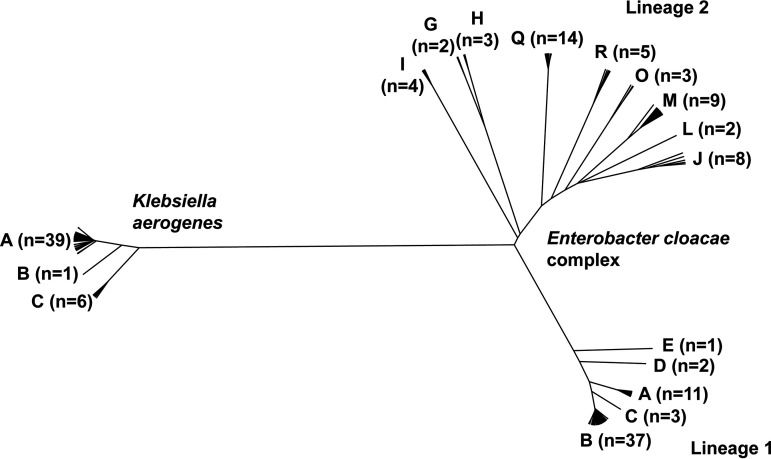
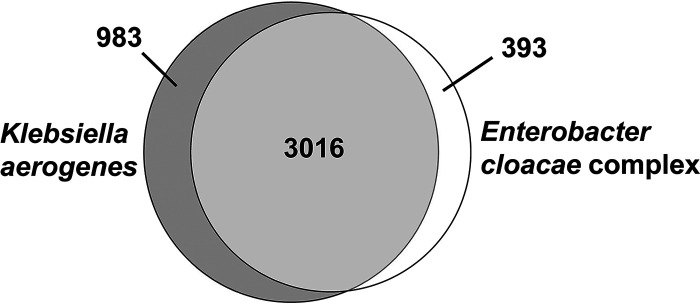
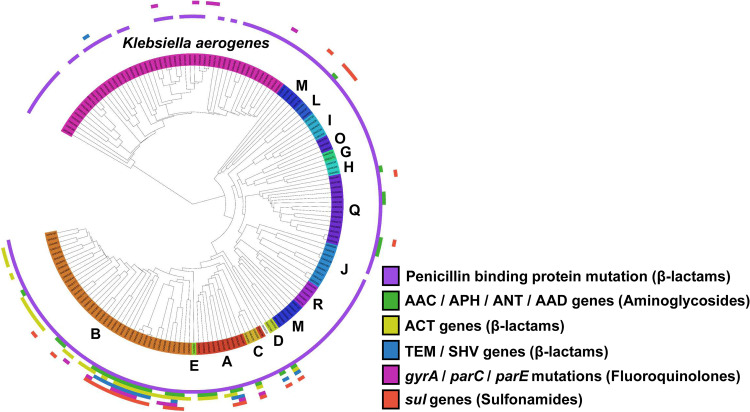
Enterobacter aerogenes was recently renamed Klebsiella aerogenes This study aimed to identify differences in clinical characteristics, outcomes, and bacterial genetics among patients with K. aerogenes versus Enterobacter species bloodstream infections (BSI). We prospectively enrolled patients with K. aerogenes or Enterobacter cloacae complex (Ecc) BSI from 2002 to 2015. We performed whole-genome sequencing (WGS) and pan-genome analysis on all bacteria. Overall, 150 patients with K. aerogenes (46/150 [31%]) or Ecc (104/150 [69%]) BSI were enrolled. The two groups had similar baseline characteristics. Neither total in-hospital mortality (13/46 [28%] versus 22/104 [21%]; P = 0.3) nor attributable in-hospital mortality (9/46 [20%] versus 13/104 [12%]; P = 0.3) differed between patients with K. aerogenes versus Ecc BSI, respectively. However, poor clinical outcome (death before discharge, recurrent BSI, and/or BSI complication) was higher for K. aerogenes than Ecc BSI (32/46 [70%] versus 42/104 [40%]; P = 0.001). In a multivariable regression model, K. aerogenes BSI, relative to Ecc BSI, was predictive of poor clinical outcome (odds ratio 3.3; 95% confidence interval 1.4 to 8.1; P = 0.008). Pan-genome analysis revealed 983 genes in 323 genomic islands unique to K. aerogenes isolates, including putative virulence genes involved in iron acquisition (n = 67), fimbriae/pili/flagella production (n = 117), and metal homeostasis (n = 34). Antibiotic resistance was largely found in Ecc lineage 1, which had a higher rate of multidrug resistant phenotype (23/54 [43%]) relative to all other bacterial isolates (23/96 [24%]; P = 0.03). K. aerogenes BSI was associated with poor clinical outcomes relative to Ecc BSI. Putative virulence factors in K. aerogenes may account for these differences.
Keywords: Enterobacter cloacae complex; Gram-negative bacteremia; Klebsiella aerogenes; bloodstream infection.
Copyright © 2020 American Society for Microbiology.
Figures
References
-
- Chavda KD, Chen L, Fouts DE, Sutton G, Brinkac L, Jenkins SG, Bonomo RA, Adams MD, Kreiswirth BN. 2016. Comprehensive genome analysis of carbapenemase-Pproducing Enterobacter spp.: new insights into phylogeny, population structure, and resistance mechanisms. mBio 7:e02093-16. doi: 10.1128/mBio.02093-16. - DOI - PMC - PubMed
-
- Tindall BJ, Sutton G, Garrity GM. 2017. Enterobacter aerogenes Hormaeche and Edwards 1960 (Approved Lists 1980) and Klebsiella mobilis Bascomb et al. 1971 (Approved Lists 1980) share the same nomenclatural type (ATCC 13048) on the 4 Approved Lists and are homotypic synonyms, with consequences for the name Klebsiella mobilis Bascomb et al. 1971 (Approved Lists 1980.). Int J Syst Evol Microbiol 67:502–504. doi: 10.1099/ijsem.0.001572. - DOI - PubMed
-
- Sutton GG, Brinkac LM, Clarke TH, Fouts DE. 2018. Enterobacter hormaechei subsp. hoffmannii subsp. nov., Enterobacter hormaechei subsp. xiangfangensis comb. nov., Enterobacter roggenkampii sp. nov., and Enterobacter muelleri is a later heterotypic synonym of Enterobacter asburiae based on computational analysis of sequenced Enterobacter genomes. F1000Res 7:521. doi: 10.12688/f1000research.14566.2. - DOI - PMC - PubMed
Publication types
MeSH terms
Substances
Grants and funding
LinkOut - more resources
Full Text Sources
Other Literature Sources
Medical
