


Size Matters: Ultra-small and Filterable Microorganisms in the Environment
- PMID: 32493880
- PMCID: PMC7308576
- DOI: 10.1264/jsme2.ME20025
Size Matters: Ultra-small and Filterable Microorganisms in the Environment
Abstract
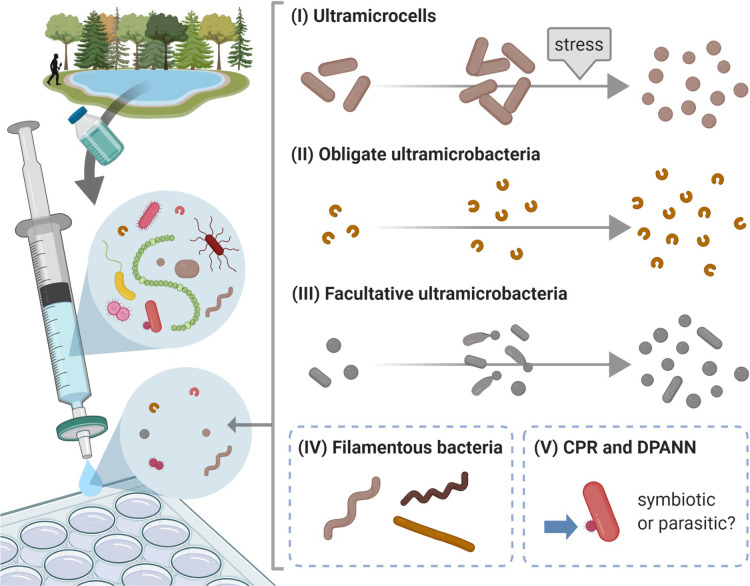
Ultra-small microorganisms are ubiquitous in Earth's environments. Ultramicrobacteria, which are defined as having a cell volume of <0.1 μm3, are often numerically dominant in aqueous environments. Cultivated representatives among these bacteria, such as members of the marine SAR11 clade (e.g., "Candidatus Pelagibacter ubique") and freshwater Actinobacteria and Betaproteobacteria, possess highly streamlined, small genomes and unique ecophysiological traits. Many ultramicrobacteria may pass through a 0.2-μm-pore-sized filter, which is commonly used for filter sterilization in various fields and processes. Cultivation efforts focusing on filterable small microorganisms revealed that filtered fractions contained not only ultramicrocells (i.e., miniaturized cells because of external factors) and ultramicrobacteria, but also slender filamentous bacteria sometimes with pleomorphic cells, including a special reference to members of Oligoflexia, the eighth class of the phylum Proteobacteria. Furthermore, the advent of culture-independent "omics" approaches to filterable microorganisms yielded the existence of candidate phyla radiation (CPR) bacteria (also referred to as "Ca. Patescibacteria") and ultra-small members of DPANN (an acronym of the names of the first phyla included in this superphyla) archaea. Notably, certain groups in CPR and DPANN are predicted to have minimal or few biosynthetic capacities, as reflected by their extremely small genome sizes, or possess no known function. Therefore, filtered fractions contain a greater variety and complexity of microorganisms than previously expected. This review summarizes the broad diversity of overlooked filterable agents remaining in "sterile" (<0.2-μm filtered) environmental samples.
Keywords: candidate phyla radiation; filterable microorganisms; minimal cell; ultramicrobacteria; ultramicrocells.
Figures
References
-
- Brown C.T., Hug L.A., Thomas B.C., Sharon I., Castelle C.J., Singh A., et al. (2015) Unusual biology across a group comprising more than 15% of domain Bacteria. Nature 523: 208–211. - PubMed
-
- Castelle C.J., Brown C.T., Anantharaman K., Probst A.J., Huang R.H., and Banfield J.F. (2018) Biosynthetic capacity, metabolic variety and unusual biology in the CPR and DPANN radiations. Nat Rev Microbiol 16: 629–645. - PubMed
