. 2020 Sep;14(9):2361-2365.
doi: 10.1038/s41396-020-0687-2. Epub 2020 Jun 3.

Depth-dependent mycoplankton glycoside hydrolase gene activity in the open ocean-evidence from the Tara Oceans eukaryote metatranscriptomes

Affiliations

Depth-dependent mycoplankton glycoside hydrolase gene activity in the open ocean-evidence from the Tara Oceans eukaryote metatranscriptomes

Nathan Chrismas et al. ISME J. 2020 Sep.

Abstract

Mycoplankton are widespread components of marine ecosystems, yet the full extent of their functional role remains poorly known. Marine mycoplankton are likely functionally analogous to their terrestrial counterparts, including performing saprotrophy and degrading high-molecular weight organic substrates using carbohydrate-active enzymes (CAZymes). We investigated the prevalence of transcribed oceanic fungal CAZyme genes using the Marine Atlas of Tara Ocean Unigenes database. We revealed an abundance of unique transcribed fungal glycoside hydrolases in the open ocean, including a particularly high number that act upon cellulose in surface waters and the deep chlorophyll maximum (DCM). A variety of other glycoside hydrolases acting on a range of biogeochemically important polysaccharides including β-glucans and chitin were also found. This analysis demonstrates that mycoplankton are active saprotrophs in the open ocean and paves the way for future research into the depth-dependent roles of marine fungi in oceanic carbon cycling, including the biological carbon pump.


Conflict of interest statement

The authors declare that they have no conflict of interest.

Figures
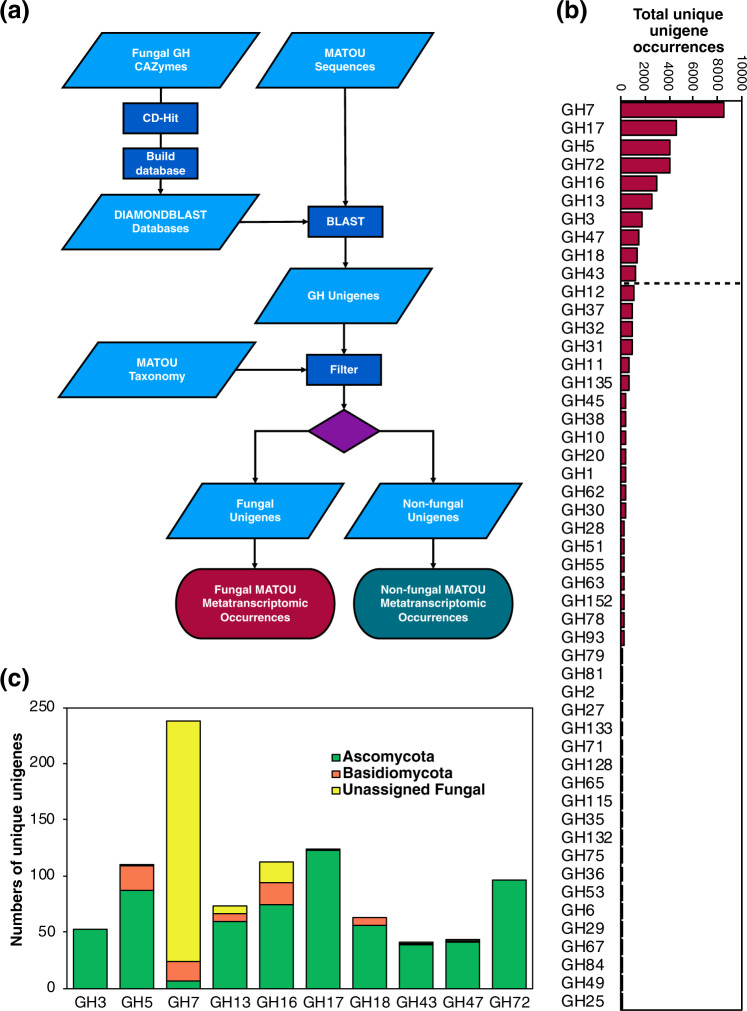
Fig. 1
Fig. 1. Bioinformatics pipeline and glycoside hydrolase unigene abundance.
(a) Pipeline describing the steps involved in identifying fungal CAZymes within the Tara Oceans MATOU database. A fungal GH protein sequence reference database was created from all the 61 characterised GH subfamilies found in fungi. The database was consolidated by clustering sequences at 95 % identity using CD-Hit before Diamond BLAST databases were generated for each subfamily. Unigenes were searched against each of these 61 databases using the following thresholds: e value > 1e−30, score > 1, subject Cov > 75%, keeping only the best alignments. Positive matches were then screened using the MATOU taxonomy to discriminate between fungal and non-fungal unigenes. Occurrences of each unigene within the Tara Oceans transcriptomes were returned. (b) Fungal GH groups found in the MATOU database ranked by abundance over all Tara Oceans samples. (c) Total numbers and taxonomy (including Ascomycota (green), Basdiomycota (orange), and Unassigned (yellow)) of unique fungal unigenes from the ten most abundant GH groups.
Fig. 2
Fig. 2. Depth distribution of fungal glycoside hydrolases in the global oceans.
(a) Global map indicating Tara Oceans stations searched for fungal GH unigenes in the surface, deep chlorophyll maximum (DCM) and mesopelagic. (b) Mean unique unigenes/station for each of the major oceanic regions sampled. (c) Depth-dependent partitioning of fungal GH unigenes in the surface (SUR), DCM and mesopelagic (MES).

References

    1. Amend A, Burgaud G, Cunliffe M, Edgcomb VP, Ettinger CL, Gutiérrez MH, et al. Fungi in the marine environment: open questions and unsolved problems. mBio. 2019;10:e01189–18. doi: 10.1128/mBio.01189-18. - DOI - PMC - PubMed
    1. Grossart H-P, Wyngaert SV den, Kagami M, Wurzbacher C, Cunliffe M, Rojas-Jimenez K. Fungi in aquatic ecosystems. Nat Rev Microbiol. 2019;1:339–354. doi: 10.1038/s41579-019-0175-8. - DOI - PubMed
    1. Frąc M, Hannula SE, Bełka M, Jędryczka M. Fungal biodiversity and their role in soil health. Front Microbiol. 2018;9:707. doi: 10.3389/fmicb.2018.00707. - DOI - PMC - PubMed
    1. Cunliffe M, Hollingsworth A, Bain C, Sharma V, Taylor JD. Algal polysaccharide utilisation by saprotrophic planktonic marine fungi. Fungal Ecol. 2017;30:135–8. doi: 10.1016/j.funeco.2017.08.009. - DOI

    1. Lombard V, Golaconda Ramulu H, Drula E, Coutinho PM, Henrissat B. The carbohydrate-active enzymes database (CAZy) in 2013. Nucleic Acids Res. 2014;42:D490–5. doi: 10.1093/nar/gkt1178. - DOI - PMC - PubMed

Publication types