. 2020 Jun;582(7810):60-66.
doi: 10.1038/s41586-020-2330-9. Epub 2020 Jun 3.

Selective prebiotic formation of RNA pyrimidine and DNA purine nucleosides

Affiliations

Selective prebiotic formation of RNA pyrimidine and DNA purine nucleosides

Jianfeng Xu et al. Nature. 2020 Jun.

Abstract

The nature of the first genetic polymer is the subject of major debate1. Although the 'RNA world' theory suggests that RNA was the first replicable information carrier of the prebiotic era-that is, prior to the dawn of life2,3-other evidence implies that life may have started with a heterogeneous nucleic acid genetic system that included both RNA and DNA4. Such a theory streamlines the eventual 'genetic takeover' of homogeneous DNA from RNA as the principal information-storage molecule, but requires a selective abiotic synthesis of both RNA and DNA building blocks in the same local primordial geochemical scenario. Here we demonstrate a high-yielding, completely stereo-, regio- and furanosyl-selective prebiotic synthesis of the purine deoxyribonucleosides: deoxyadenosine and deoxyinosine. Our synthesis uses key intermediates in the prebiotic synthesis of the canonical pyrimidine ribonucleosides (cytidine and uridine), and we show that, once generated, the pyrimidines persist throughout the synthesis of the purine deoxyribonucleosides, leading to a mixture of deoxyadenosine, deoxyinosine, cytidine and uridine. These results support the notion that purine deoxyribonucleosides and pyrimidine ribonucleosides may have coexisted before the emergence of life5.


Conflict of interest statement

Competing interests: The authors declare no competing financial interests.

Figures

Extended Data Fig. 1
Extended Data Fig. 1. A summary of the main findings of the work.
Previously, a prebiotically plausible synthesis of beta-ribopyrimdines C and U has been identified using α–-thiocytidine. Herein, we demonstrate that the same intermediate can undergo a distinct prebiotically plausible process that could have happened in a similar, or the same, environment. The new process furnishes β–D-N 9-deoxyribopurine nucleosides, dA and dI, alongside the pyrimidines. Remarkable selectivity enforced by UV irradiation and hydrolysis operates throughout the reported ribosylpyrimidine synthesis and the newly discovered deoxyribosylpurine synthesis, resulting in a set of nucleosides with only the canonical regio- and stereochemistry. The coexistence in one location of a set of nucleosides similar to this is thought by many to be a precondition for the spontaneous emergence of life on Earth.
Extended Data Fig. 2
Extended Data Fig. 2. 1H NMR spectra of conversion of α-anhydrouridine 15 from α-thiouridine 14.
a) 1H NMR spectrum of α-anhydrouridine 15; b) 1H NMR spectrum of the reaction mixture after heating α-thiouridine 14 in H2O; c) 1H NMR spectrum of the reaction mixture after heating α-thiouridine 14 in formamide.
Extended Data Fig. 3
Extended Data Fig. 3. 1H NMR spectra of photoreduction of N 7-8,2'-anhydro-thioadenosine 18 and N 9-8,2'-anhydro-thioadenosine 19 mixture with bisulfite.
a) 1H NMR spectrum of the crude mixture before irradiation (the ratio of N 7 : N 9 isomer was 4 : 5); b) 1H NMR spectrum of the mixture after irradiation for 7 hrs (the N 9 isomers dA 7 and 26 are the only detectable products).
Extended Data Fig. 4
Extended Data Fig. 4. Potential energy surfaces and S1/S0 state crossings of the key photochemical steps in deoxyadenosine synthesis calculated at the ADC(2)/madef2-TZVP level (see the SI for more details).
a) C-S bond opening may spontaneously occur in 18 leading to a peaked S1/S0 state crossing, however, a reducing agent is necessary to maintain that geometry after reaching the S0 state; b) N7-C8 bond rupture is the lowest energy photochemical process in 19 and results in destruction of the purine ring; c) and d) encounter complexes of 18 and 19 with HS-, which readily undergo photochemical C–S bond rupture induced by charge transfer from HS- to chromophore.
Extended Data Fig. 5
Extended Data Fig. 5. Equilibrium geometries of C2, S8 radical anion 31 and C8, N9 radical anion 32 radical anions which may be formed after accepting a hydrated electron from the environment and the adiabatic electron affinities calculated at the ωB97X-D/IEFPCM/ma-def2-TZVP.
Extended Data Fig. 6
Extended Data Fig. 6. 1H NMR spectra for the reactions of deoxyadenosine 7 and cytidine 1 with nitrous acid.
a) 1H NMR spectrum of the mixture of deoxyadenosine 7 and cytidine 1; b) 1H NMR spectrum of the reaction mixture after 4 days, showing the ratio of all four (deoxy)nucleosides deoxyadenosine 7, deoxyinosine 9, cytidine 1, and uridine 2 is 30:17:42:11.
Extended Data Fig. 7
Extended Data Fig. 7. 1H NMR spectra for stability study of cytidine 1 and uridine 2 at 254 nm irradiation with bisulfite.
a) 1H NMR spectrum of the mixture of cytidine 1, bisulfite and K4Fe(CN)6 in the dark; b) as a), 1H NMR spectrum after 10 hours of irradiation; c) 1H NMR spectrum of the mixture of uridine 2, bisulfite and K4Fe(CN)6 in the dark; d) as c), 1H NMR spectrum after 10 hours of irradiation; e) 1H NMR spectrum of the mixture of cytidine 1, uridine 2, N 9-thioanhydroadenosine 18, bisulfite and K4Fe(CN)6 in the dark; f) as e), 1H NMR spectrum after 10 hours of irradiation.
Extended Data Fig. 8
Extended Data Fig. 8. 1H NMR spectra for sequential reactions with the mixture of α-anhydrouridine 15, cytidine 1 and uridine 2.
a) 1H NMR spectrum of the mixture after heating with 8-mercaptoadenine 16 and magnesium chloride at 150 °C for 1.5 days; b) 1H NMR spectrum of the same mixture after irradiation with hydrogen sulfide at 254 nm; c) 1H NMR spectrum of the same mixture after reacting with nitrous acid for 2 days (dA 7: dI 9: C 1: U 2= 14: 14: 44: 28).
Fig. 1
Fig. 1. Previous synthesis of RNA pyrimidine nucleosides 1 (C), 2 (U) and a deoxypyrimidine nucleoside 5, and the present work.
RAO 10 is a starting point in the network since it crystallises in enantiopure form from minimally enantio-enriched solutions, . It can be elaborated via 12 and 3 to the pyrimidine nucleosides. Although we had developed a low-yielding route to deoxyadenosine 7 (dA) from 6 via 5 , we recognized that 12 and 15 are ideal candidates for tethered glycosylation with 16. The products, thioanhydropurines 18 and 19, are reduced photochemically in a similar way to 6, providing an efficient route to deoxynucleosides. Critically, once produced, pyrimidines 1 (C) and 2 (U) survive the sequence that produces purines 7 (dA) and 9 (dI), and we show that the four nucleosides 1 (C), 2 (U), 7 (dA) and 9 (dI) can be produced alongside one another.
Fig. 2
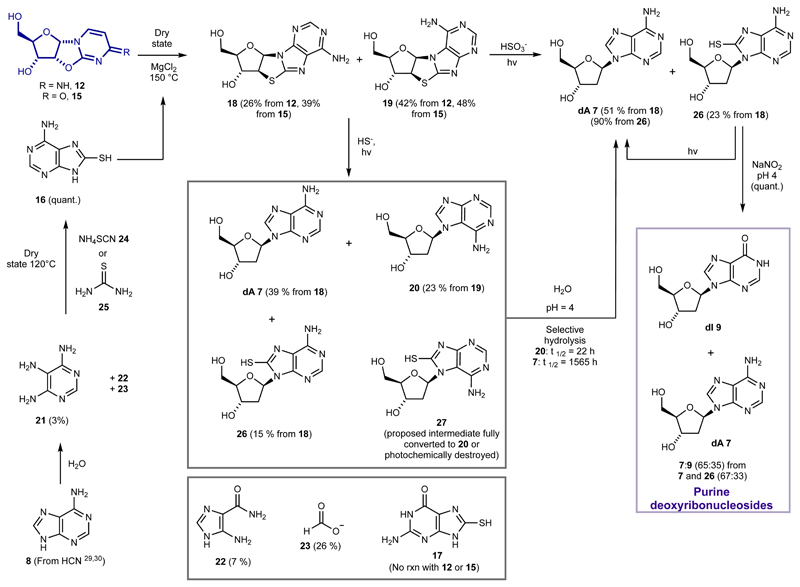
Fig. 2. Prebiotic route to purine deoxyribonucleosides, 7 (dA) and 9 (dI).
The route starts with α-anhydropyrimidines 12 and 15, which are intermediates in the RNA pyrimidine synthesis, and 8-mercaptoadenine 16, which is available from adenine 8 via hydrolysis and reaction with ammonium thiocyanate or thiourea. Dry state tethered glycosylation of 16 and 12 or 15 provides thioanhydropurines 18 and 19, which can be photochemically reduced by two routes. If bisulfite is the reductant, only N 9-configured products 7 (dA) and 26 are formed. 26 can be converted to 7 by further irradiation, or by nitrosation. If hydrosulfide is used as the reductant, both N 9-configured 7 (dA) and 26 as well as N 7-configured 20 is formed. 20 has a half-time of hydrolysis nearly two orders of magnitude lower than 7 (dA) and so is selectively degraded. To generate deoxyinosine 9 (dI) alongside deoxyadenosine 7 (dA), the products of either photoreduction are treated with nitrous acid at pH 4.
Fig. 3
Fig. 3. Proposed mechanism of photoreduction of N 7-8,2'-anhydro-thioadenosine 18 and N 9-8,2'-anhydro-thioadenosine 19 nucleosides.
a) Potential mechanism involving bisulfite proceeding with initial photoexcitation of the thioanhydronucleosides to 28, followed by reduction of C2', sulfur, and C8. Photoexcitation of the N 7 isomer 19 to 30 leads to decomposition. b) Potential mechanism involving bisulfite proceeding via intial reduction of ground state thioanhydronucleosides, followed by desulfurisation of 26. Reduction of 19 gives 32 which leads to decomposition. c) Distinct mechanism involving reduction of thioanhydronucleoside–hydrosulfide encounter complexes, 33 and 34, which both undergo charge transfer and concomitant C–S bond cleavage to produce 31 and 35. 31 and 35 undergo reduction at C2' and desulfurisation to furnish 7 (dA) and 20.
Fig. 4
Fig. 4. A systems-level approach to a potential primordial genetic alphabet composed of 1 (C), 2 (U), 7 (dA) and 9 (dI).
A mixture of the α– and β–epimers of 2-thiocytidine 13 and 3, which interconvert in UV light, can generate a mixture containing 1 (C), 2 (U), 7 (dA) and 9 (dI). A general route is shown at left. The thiopyrimidines are initially converted into the canonical pyrimidines (cytidine 1 and uridine 2) and the α-anhydropyrimidines 12 and 15. The latter undergo tethered glycosylation and then photoreduction to selectively provide purine deoxyribonucleosides 7 (dA) and 9 (dI) as depicted in Fig. 2. The pyrimidines 1 (C) and 2 (U) persist through each step of this sequence, ultimately generating a mixture of all four nucleosides. Specific conditions and yields for two possible particular routes (Routes A and B) are shown at right.

Comment in

References

    1. Samanta B, Joyce GF. A reverse transcriptase ribozyme. Elife. 2017;6 e31153. - PMC - PubMed
    1. Gilbert W. Origin of life: The RNA world. Nature. 1986;319:618.
    1. Joyce GF. The antiquity of RNA-based evolution. Nature. 2002;418:214–221. - PubMed
    1. Bhowmik S, Krishnamurthy R. The role of sugar-backbone heterogeneity and chimeras in the simultaneous emergence of RNA and DNA. Nat Chem. 2019;11:1009–1018. - PMC - PubMed
    1. Xu J, Green NJ, Gibard C, Krishnamurthy R, Sutherland JD. Prebiotic phosphorylation of 2-thiouridine provides either nucleotides or DNA building blocks via photoreduction. Nat Chem. 2019;11:457–462. - PMC - PubMed

Publication types