


Comparison of Effectiveness of Ropivacaine Infusion Regimens for Continuous Femoral Nerve Block for Recovery After Total Knee Arthroplasty: A Randomized Double-Blind Trial
- PMID: 32494188
- PMCID: PMC7229799
- DOI: 10.2147/JPR.S247158
Comparison of Effectiveness of Ropivacaine Infusion Regimens for Continuous Femoral Nerve Block for Recovery After Total Knee Arthroplasty: A Randomized Double-Blind Trial
Abstract
Purpose: Continuous femoral nerve block (cFNB) is effective for analgesia after total knee arthroplasty (TKA). However, it is not clear which low-dose regimen of ropivacaine infusion for cFNB provides adequate analgesia and enables rapid recovery. The aim of this study was to compare the effects of different cFNB regimens on rehabilitation of patients after TKA.
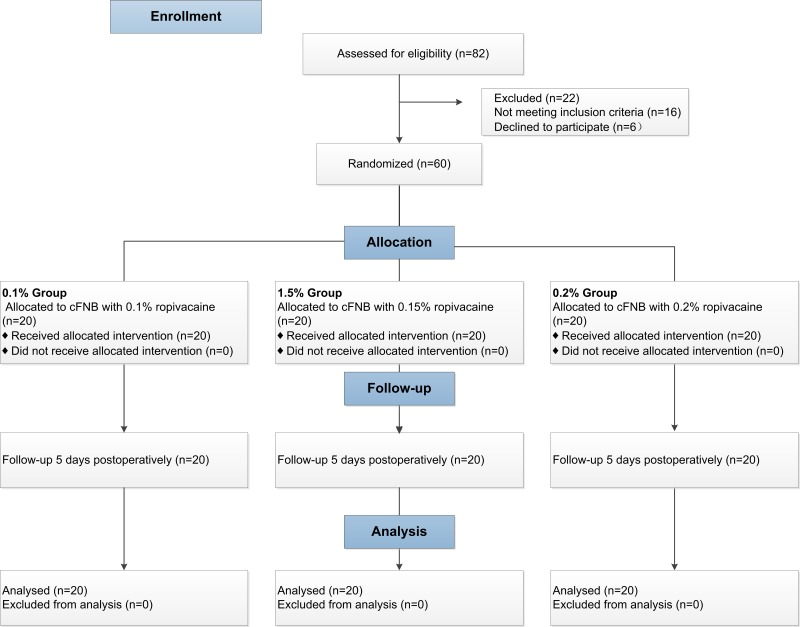
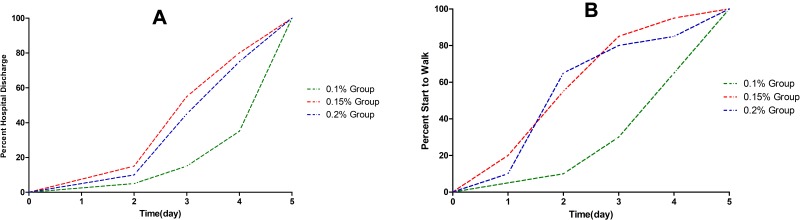
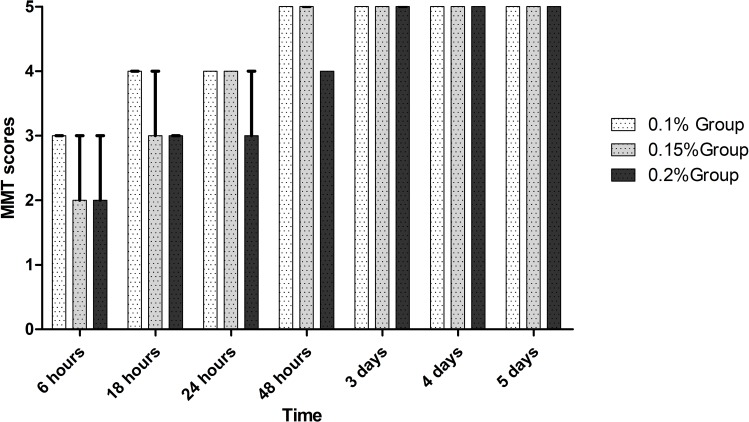
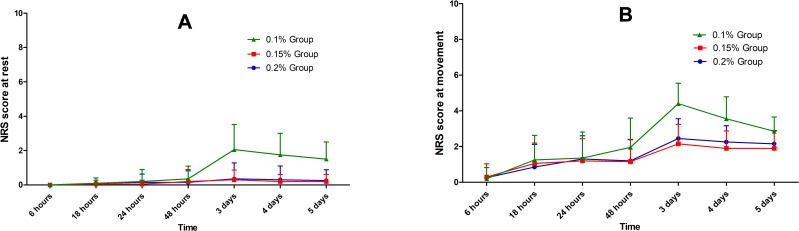
Patients and methods: Sixty patients scheduled for TKA were enrolled in this trial. After surgery, patients in the 0.1%, 0.15%, and 0.2% groups received infusion of 10 mL of 0.1%, 6.7 mL of 0.15%, and 5 mL of 0.2% ropivacaine per hour, respectively (n=20), at the dose of 10 mg/h for 48 h. The primary endpoint was time to readiness for discharge. The secondary endpoints were time to first walk, manual muscle testing (MMT) scores, numerical rating scale (NRS) scores at rest and movement, morphine consumption, rescue analgesia, and the incidence of adverse events.
Results: The time to readiness for discharge and the time to first walk of the 0.1% group were significantly longer than that of the 0.15% and 0.2% groups. MMT scores of the 0.2% group at 18 h after surgery were significantly lower than those of the 0.1% group. MMT scores of the 0.2% group at 24 and 48 h after surgery were also significantly lower than those of the 0.1% and 0.15% groups. NRS scores at rest and at movement in the 0.1% group were significantly higher than those in the 0.15% and 0.2% groups.
Conclusion: Patients administered the regimens of 0.15% and 0.2% ropivacaine infusion for cFNB were ready for discharge earlier than the 0.1% group after TKA, at the dose of 10 mg/h for 48 h. The regimen of 0.15% ropivacaine, which is associated with less quadriceps muscle strength weakness than 0.2%, is recommended for postoperative analgesia after TKA.
Keywords: analgesia; quadriceps muscle strength; regional anesthesia; ultrasound.
© 2020 Zhang et al.
Conflict of interest statement
The authors report no conflicts of interest in this work.
Figures
Similar articles
-
[Effects of two analgesic regimens on the postoperative analgesia and knee functional recovery after unilateral total knee arthroplasty-a randomized controlled trial].Zhonghua Wai Ke Za Zhi. 2015 Jul 1;53(7):522-7. Zhonghua Wai Ke Za Zhi. 2015. PMID: 26359076 Clinical Trial. Chinese.
-
Effectiveness of continuous versus single injection femoral nerve block for total knee arthroplasty: A double blinded, randomized trial.Knee. 2018 Aug;25(4):623-630. doi: 10.1016/j.knee.2018.04.001. Epub 2018 Apr 26. Knee. 2018. PMID: 29705075 Clinical Trial.
-
The Effect Of Dexmedetomidine As Adjuvant To Ropivacaine 0.1% For Femoral Nerve Block On Strength Of Quadriceps Muscle In Patients Undergoing Total Knee Arthroplasty: A Double-Blinded Randomized Controlled Trial.J Pain Res. 2019 Dec 17;12:3355-3363. doi: 10.2147/JPR.S217283. eCollection 2019. J Pain Res. 2019. PMID: 31908520 Free PMC article.
-
Comparison of continuous femoral nerve block (CFNB/SA) and continuous femoral nerve block with mini-dose spinal morphine (CFNB/SAMO) for postoperative analgesia after total knee arthroplasty (TKA): a randomized controlled study.BMC Anesthesiol. 2016 Jul 16;16(1):38. doi: 10.1186/s12871-016-0205-2. BMC Anesthesiol. 2016. PMID: 27422406 Free PMC article. Clinical Trial.
-
Adductor canal block versus continuous femoral nerve block in primary total knee arthroplasty: A meta-analysis.Int J Surg. 2016 Jul;31:17-24. doi: 10.1016/j.ijsu.2016.05.036. Epub 2016 May 19. Int J Surg. 2016. PMID: 27212592 Review.
Cited by
-
Sufentanil Improves the Analgesia Effect of Continuous Femoral Nerve Block After Total Knee Arthroplasty.J Pain Res. 2023 Dec 7;16:4209-4216. doi: 10.2147/JPR.S409668. eCollection 2023. J Pain Res. 2023. PMID: 38090025 Free PMC article.
-
A randomized trial: The safety, pharmacokinetics and preliminary pharmacodynamics of ropivacaine oil delivery depot in healthy subjects.PLoS One. 2023 Sep 19;18(9):e0291793. doi: 10.1371/journal.pone.0291793. eCollection 2023. PLoS One. 2023. PMID: 37725618 Free PMC article. Clinical Trial.
-
Minimum effective concentration 90 (EC90) of ropivacaine for Femoral nerve block: A biased-coin up-and-down sequential method study.Indian J Anaesth. 2025 Feb;69(2):214-219. doi: 10.4103/ija.ija_806_24. Epub 2025 Jan 29. Indian J Anaesth. 2025. PMID: 40160907 Free PMC article.
-
Simultaneous Determination of Ropivacaine and 3-Hydroxy Ropivacaine in Cerebrospinal Fluid by UPLC-MS/MS.Biomed Res Int. 2020 Dec 4;2020:8844866. doi: 10.1155/2020/8844866. eCollection 2020. Biomed Res Int. 2020. PMID: 33490261 Free PMC article.
-
Comparison of ropivacaine plus sufentanil and ropivacaine plus dexmedetomidine for labor epidural analgesia: A randomized controlled trial protocol.Medicine (Baltimore). 2020 Sep 4;99(36):e22113. doi: 10.1097/MD.0000000000022113. Medicine (Baltimore). 2020. PMID: 32899094 Free PMC article.
References
-
- Varacallo M, Luo TD, Johanson NA. Total Knee Arthroplasty (TKA) techniques In: Johanson N, ed. StatPearls. Treasure Island (FL); 2019.
LinkOut - more resources
Full Text Sources
