. 2020 Sep 3;30(10):5410-5419.
doi: 10.1093/cercor/bhaa122.

Neural Pattern Similarity Unveils the Integration of Social Information and Aversive Learning

Affiliations

Neural Pattern Similarity Unveils the Integration of Social Information and Aversive Learning

Irem Undeger et al. Cereb Cortex. .

Abstract

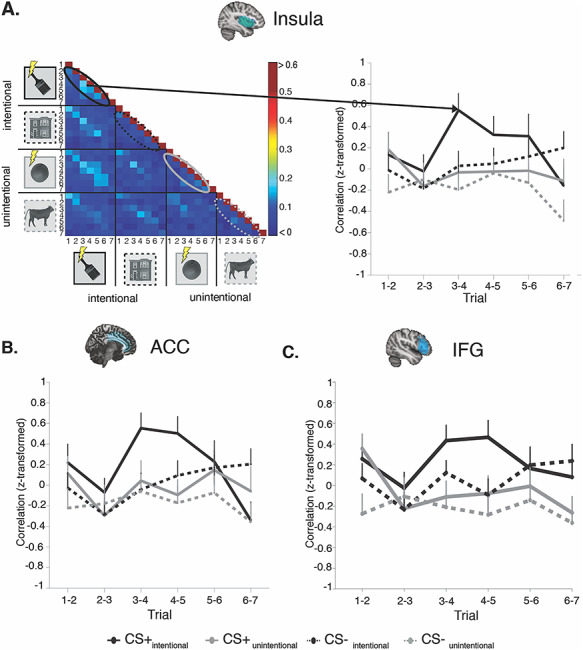
Attributing intentions to others' actions is important for learning to avoid their potentially harmful consequences. Here, we used functional magnetic resonance imaging multivariate pattern analysis to investigate how the brain integrates information about others' intentions with the aversive outcome of their actions. In an interactive aversive learning task, participants (n = 33) were scanned while watching two alleged coparticipants (confederates)-one making choices intentionally and the other unintentionally-leading to aversive (a mild shock) or safe (no shock) outcomes to the participant. We assessed the trial-by-trial changes in participants' neural activation patterns related to observing the coparticipants and experiencing the outcome of their choices. Participants reported a higher number of shocks, more discomfort, and more anger to shocks given by the intentional player. Intentionality enhanced responses to aversive actions in the insula, anterior cingulate cortex, inferior frontal gyrus, dorsal medial prefrontal cortex, and the anterior superior temporal sulcus. Our findings indicate that neural pattern similarities index the integration of social and threat information across the cortex.

Keywords: MVPA; RSA; aversive learning; conditioning; insula; intention.


Figures

Figure 1
Figure 1
Trial illustration. (A) On each trial, the subject passively observed a coparticipant make a choice between two images. The coparticipant’s face was always present on the screen and the window appeared when a connection has been made. A fixation cross was present on the coparticipant’s face on the early anticipation phase and moved to the choice that is made during the choice period. This ensured that the participant viewed either the face or the choice during these periods, respectively. If the coparticipant chose an image that would be preceded with the delivery of a shock, the shock was delivered for 200 ms and ended before the choice image presentation. (B) The 2 × 2 design.
Figure 2
Figure 2
Pupil dilation and behavioral responses. Postexperimental questionnaire answers to questions regarding the social interaction: (A) discomfort of shocks received from each coplayer, (B) number of shocks the participant reported to receive via the presentation of each choice image, (C) how many shocks the participant would like to deliver back if given the chance, (D) how angry the participant felt toward the coparticipants. (E) Change in participants’ evaluations of how likable each coparticipant was, from before the experiment to after the experiment. The number of shocks for both questions were open ended, the anger and likeability measures were reported out of a maximum point of 5, and a minimum 0. (F) Pupil dilation responses to CS+ (aversive) and CS− (safe) choice images during the social interaction. Error bars represent standard error of the mean (SEM).
Figure 3
Figure 3
RSA. A. Trial-by-trial pattern similarity correlations in the Insula. The 24 × 24 correlation matrix represents correlations of neural patterns during learning. The off diagonal represents correlations between consecutive trials. The upper diagonal has been removed as it is a mirror image of the lower. B. Trial-by-trial similarity correlations in the ACC and C. in the IFG. Error bars represent SEM.

References

    1. Ames DL, Fiske ST. 2015. Perceived intent motivates people to magnify observed harms. Proc Natl Acad Sci. 112(12):201501592. doi: 10.1073/pnas.1501592112. - DOI - PMC - PubMed
    1. Atlas LY, Wager TD. 2012. How expectations shape pain. Neurosci Lett. 520(2):140–148. doi: 10.1016/j.neulet.2012.03.039. - DOI - PubMed
    1. Baron-Cohen S, Wheelwright S, Skinner R, Martin J, Clubley E. 2001. The autism-spectrum quotient (AQ): evidence from Asperger syndrome/high-functioning autism, males and females, scientists and mathematicians. J Autism Dev Disord. 31(1):5–17. doi: 10.1023/A:1005653411471. - DOI - PubMed
    1. Benjamini Y, Hochberg Y. 1995. Controlling the false discovery rate: a practical and powerful approach to multiple testing. J R Stat Soc Ser B. 57:289–300. doi: 10.1111/j.2517-6161.1995.tb02031.x. - DOI
    1. Cushman F, Gray K, Gaffey A, Mendes WB. 2012. Simulating murder: the aversion to harmful action. Emotion. 12(1):2–7. doi: 10.1037/a0025071. - DOI - PubMed

Publication types