


Transition in Frailty State Among Elderly Patients After Vascular Surgery
- PMID: 32494998
- PMCID: PMC7458900
- DOI: 10.1007/s00268-020-05619-7
Transition in Frailty State Among Elderly Patients After Vascular Surgery
Abstract
Background: Frailty in the vascular surgical ward is common and predicts poor surgical outcomes. The aim of this study was to analyze transitions in frailty state in elderly patients after vascular surgery and to evaluate influence of patient characteristics on this transition.
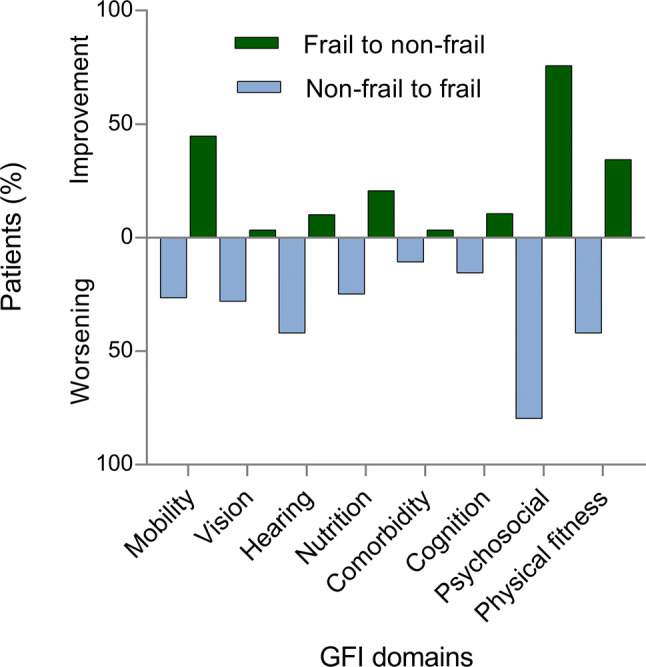
Methods: Between 2014 and 2018, 310 patients, ≥65 years and scheduled for elective vascular surgery, were included in this cohort study. Transition in frailty state between preoperative and follow-up measurement was determined using the Groningen Frailty Indicator (GFI), a validated tool to measure frailty in vascular surgery patients. Frailty is defined as a GFI score ≥4. Patient characteristics leading to a transition in frailty state were analyzed using multivariable Cox regression analysis.
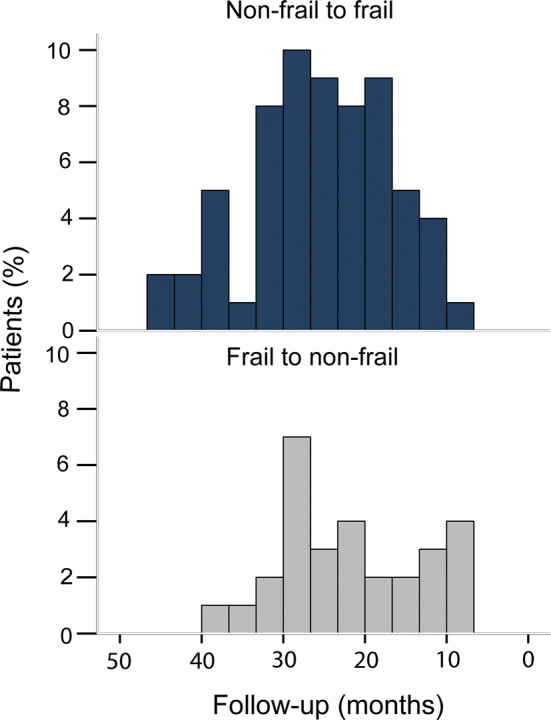
Results: Mean age was 72.7 ± 5.2 years, and 74.5% were male. Mean follow-up time was 22.7 ± 9.5 months. At baseline measurement, 79 patients (25.5%) were considered frail. In total, 64 non-frail patients (20.6%) shifted to frail and 29 frail patients (9.4%) to non-frail. Frail patients with a high Charlson Comorbidity Index (HR = 0.329 (CI: 0.133-0.812), p = 0.016) and that underwent a major vascular intervention (HR = 0.365 (CI: 0.154-0.865), p = 0.022) had a significantly higher risk to remain frail after the intervention.
Conclusions: The results of this study, showing that after vascular surgery almost 21% of the non-frail patients become frail, may lead to a more effective shared decision-making process when considering treatment options, by providing more insight in the postoperative frailty course of patients.
Conflict of interest statement
The authors declare that they have no conflict of interest.
Figures
References
MeSH terms
LinkOut - more resources
Full Text Sources
