Review
. 2021 Jun;33(23):e1906539.
doi: 10.1002/adma.201906539. Epub 2020 Jun 4.

Iron Oxide Nanoparticles as T1 Contrast Agents for Magnetic Resonance Imaging: Fundamentals, Challenges, Applications, and Prospectives

Affiliations
Review

Iron Oxide Nanoparticles as T1 Contrast Agents for Magnetic Resonance Imaging: Fundamentals, Challenges, Applications, and Prospectives

Mike Jeon et al. Adv Mater. 2021 Jun.

Abstract

Gadolinium-based chelates are a mainstay of contrast agents for magnetic resonance imaging (MRI) in the clinic. However, their toxicity elicits severe side effects and the Food and Drug Administration has issued many warnings about their potential retention in patients' bodies, which causes safety concerns. Iron oxide nanoparticles (IONPs) are a potentially attractive alternative, because of their nontoxic and biodegradable nature. Studies in developing IONPs as T1 contrast agents have generated promising results, but the complex, interrelated parameters influencing contrast enhancement make the development difficult, and IONPs suitable for T1 contrast enhancement have yet to make their way to clinical use. Here, the fundamental principles of MRI contrast agents are discussed, and the current status of MRI contrast agents is reviewed with a focus on the advantages and limitations of current T1 contrast agents and the potential of IONPs to serve as safe and improved alternative to gadolinium-based chelates. The past advances and current challenges in developing IONPs as a T1 contrast agent from a materials science perspective are presented, and how each of the key material properties and environment variables affects the performance of IONPs is assessed. Finally, some potential approaches to develop high-performance and clinically relevant T1 contrast agents are discussed.

Keywords: MRI contrast agents; T 1 contrast agents; gadolinium; iron oxide nanoparticles; magnetic resonance imaging; nanoparticles.


Figures

Figure 1.
Figure 1.
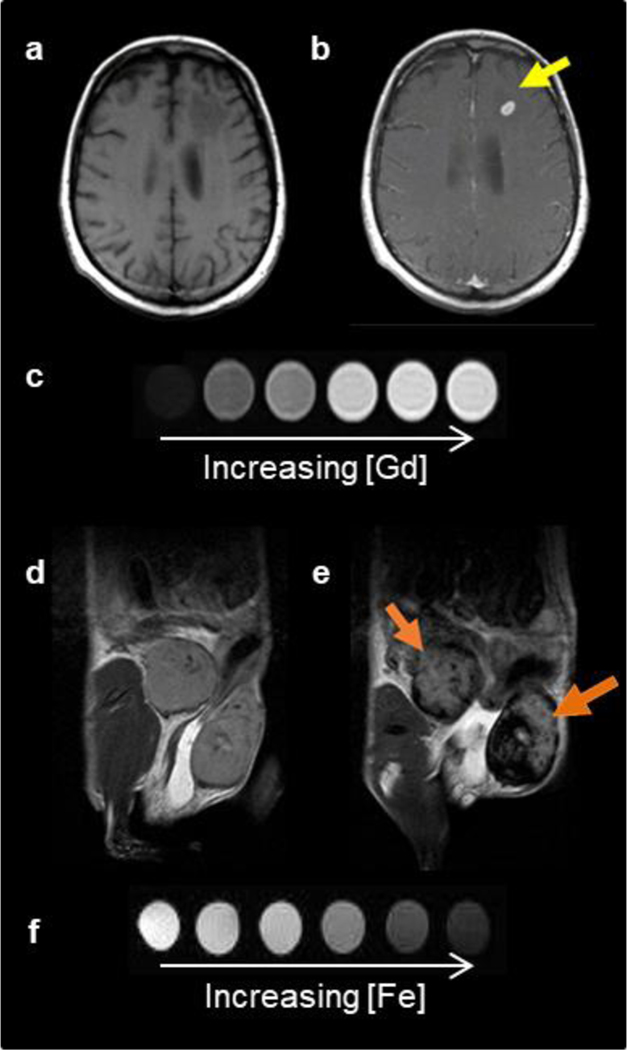
Two classes of MRI contrast agents. Pre- (a) and post- (b) GBCA T1-weighted MRI on a brain metastasis in a melanoma patient. (c) T1 contrast agents decrease the spin-lattice relaxation time, increasing signal with increasing agent concentration, and produce brighter contrast images. Pre- (d) and post- (e) IONP-based contrast agent T2-weighted MRI on inflamed mouse mammary gland tumors. (f) T2 contrast agents decrease the spin-spin relaxation time, decreasing signal with increased agent concentration, and produce darker contrast images. (Reproduced with permission from[–110], Copyright © 2017 Serkova, Copyright © 2016 Ivyspring International Publisher, Copyright © 2018 Elsevier Ltd.)
Figure 2.
Figure 2.
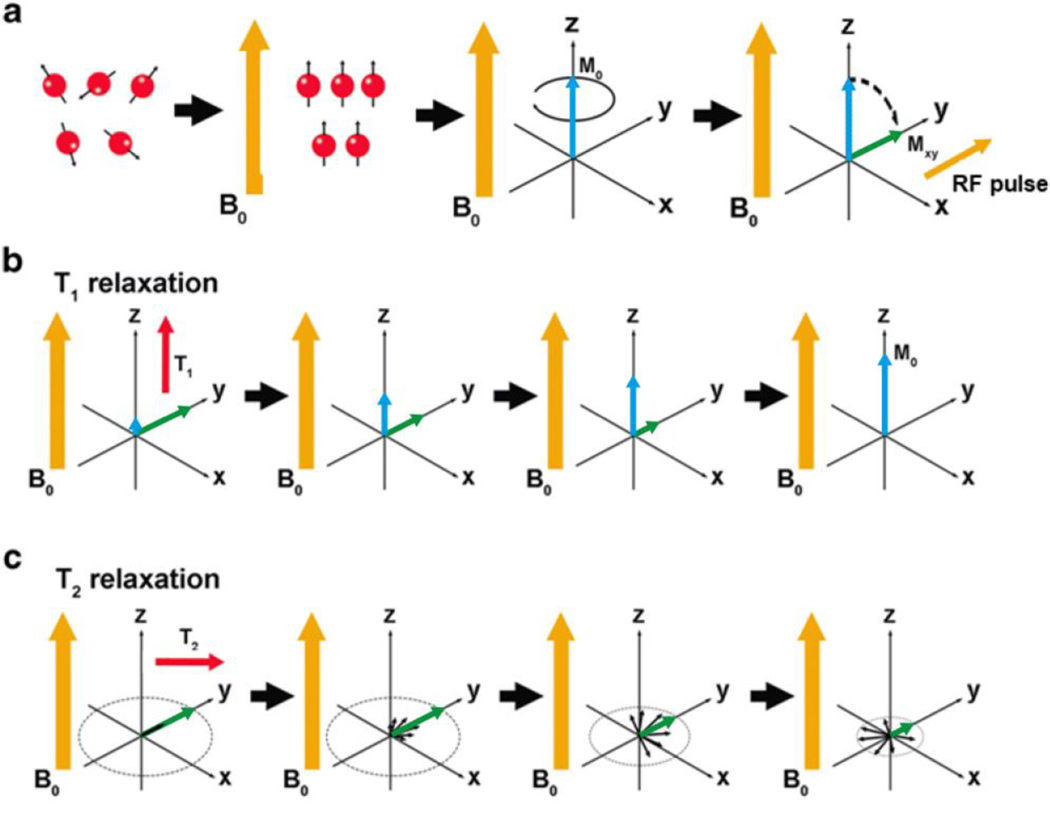
Schematic representation of the basic principles of MRI. (a) When an external magnetic field B0 (orange arrow) is applied (z-direction), protons (red spheres) tend to align with B0 (note that the depiction here unrealistically shows all protons aligned with B0, but there is actually only a slight preference for this alignment). This alignment results in a net magnetization vector (M0, blue arrow). When an orthogonal RF pulse is applied, M0 tilts 90° into the transverse (x-y) plane (Mxy, green arrow). The magnetization returns to equilibrium through two processes: T1 and T2 relaxation (b) T1 relaxation: T1 is a measure of the time it takes the initial longitudinal magnetic moment (M0) to recover. (c) T2 relaxation: T2 measures the loss of the transverse magnetic moment (Mxy) due to dephasing. (Reproduced with permission from[111], Copyright © 2019 Mastrogiacomo).
Figure 3.
Figure 3.
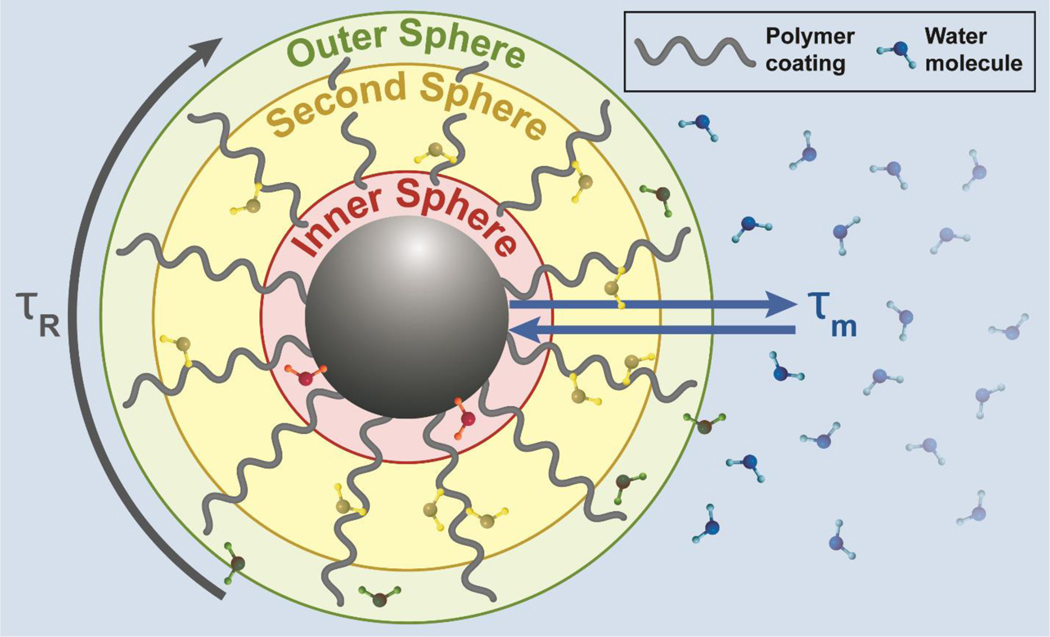
A depiction of time parameters and regions contributing to relaxivity. The time parameters are rotational correlation time (τR) and water residence time (τm for direct core interaction). The inner sphere consists of water molecules (red) interacting directly with metal ions of the IONP core (black sphere). The second sphere consists of water molecules (yellow) transiently bound to the polymer (gray wavy line). The outer sphere refers to water molecules (green) indirectly affected by magnetic field fluctuations at the surface of the IONP system. The motion of water molecules through these three spheres determines relaxivity.
Figure 4.
Figure 4.
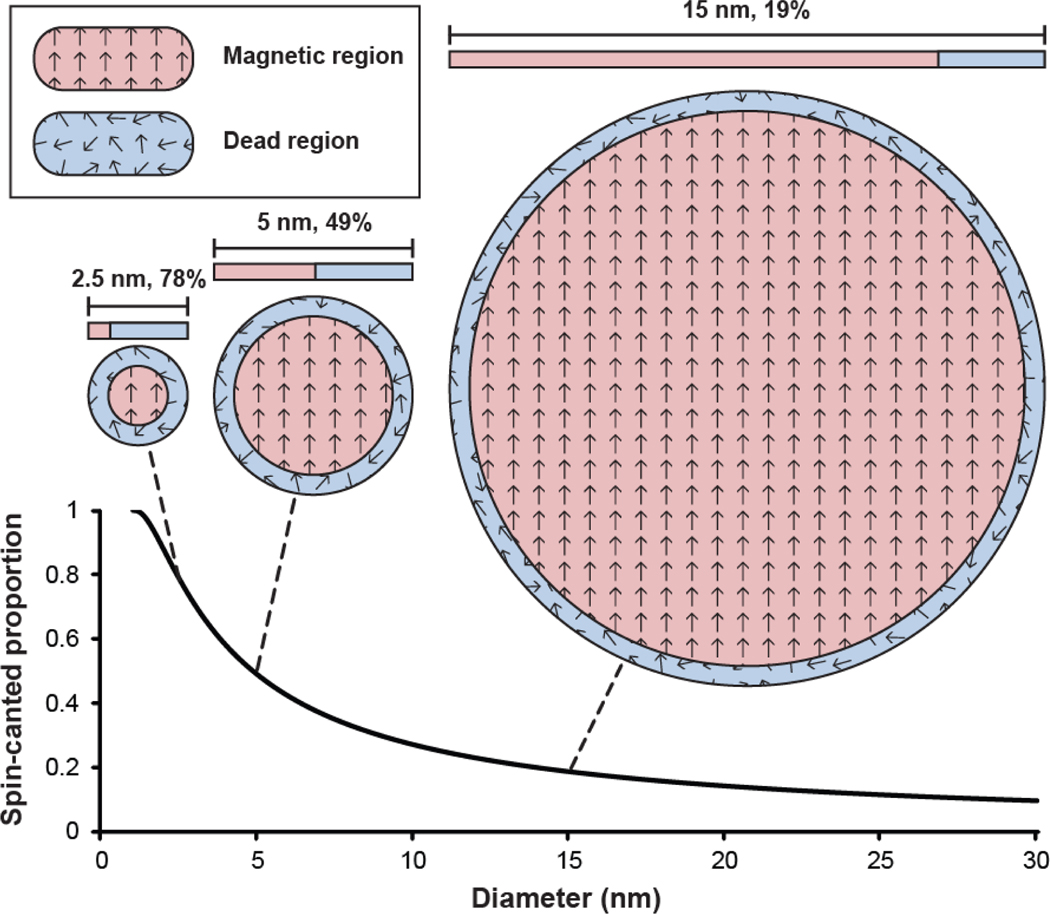
Spin-canted proportion (The proportion of IONP volume consisting of the magnetically dead spin-canted region (blue) as a function of IONP diameter (assuming a 0.5 nm spin-canted layer[–69,71]), with a depiction of representative IONP core cross-sections. The thickness of this region remains constant regardless of IONP size, therefore, comprises a greater proportion in smaller particles, leading to a decrease in magnetization, and thus r2, with decrease in IONP size.
Figure 5.
Figure 5.
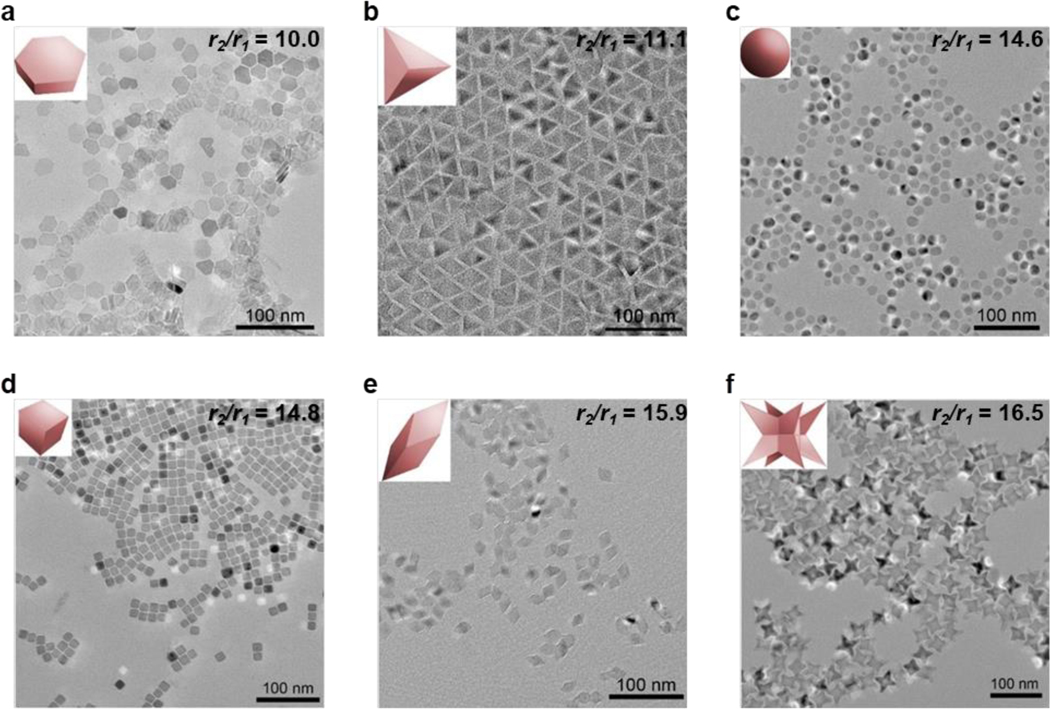
TEM images of Mn-IONPs with various morphologies, listed in order of increasing r2/r1 at 1.5 T: (a) hexagonal plate, (b) tetrahedron, (c) sphere, (d) cube, (e) rhombohedron, and (f) octapod. (Reproduced with permission from[75], Copyright © American Chemical Society 2018.)
Figure 6.
Figure 6.
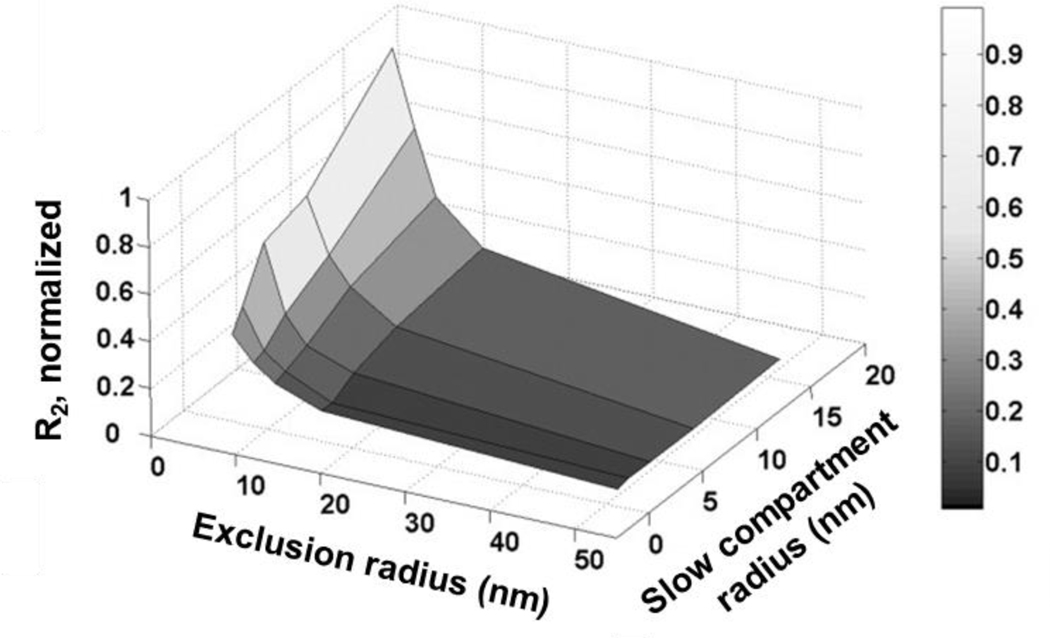
Modeling and computer simulation of IONP relaxivity. R2 (normalized r2) is plotted as a function of both exclusion radius (hydrophobic region around the core that excludes water molecules from direction interaction) and slow compartment radius (region where water molecule diffusion is slowed by the polymer coating), with high values of R2 represented by lighter shading. Note that a larger slow compartment radius can increase r1 but it also increases r2 as water molecules reside longer at the strongest region of the core’s magnetic field. (Reproduced with permission from[89], Copyright © Wiley-Liss, Inc. 2007.)
Figure 7.
Figure 7.
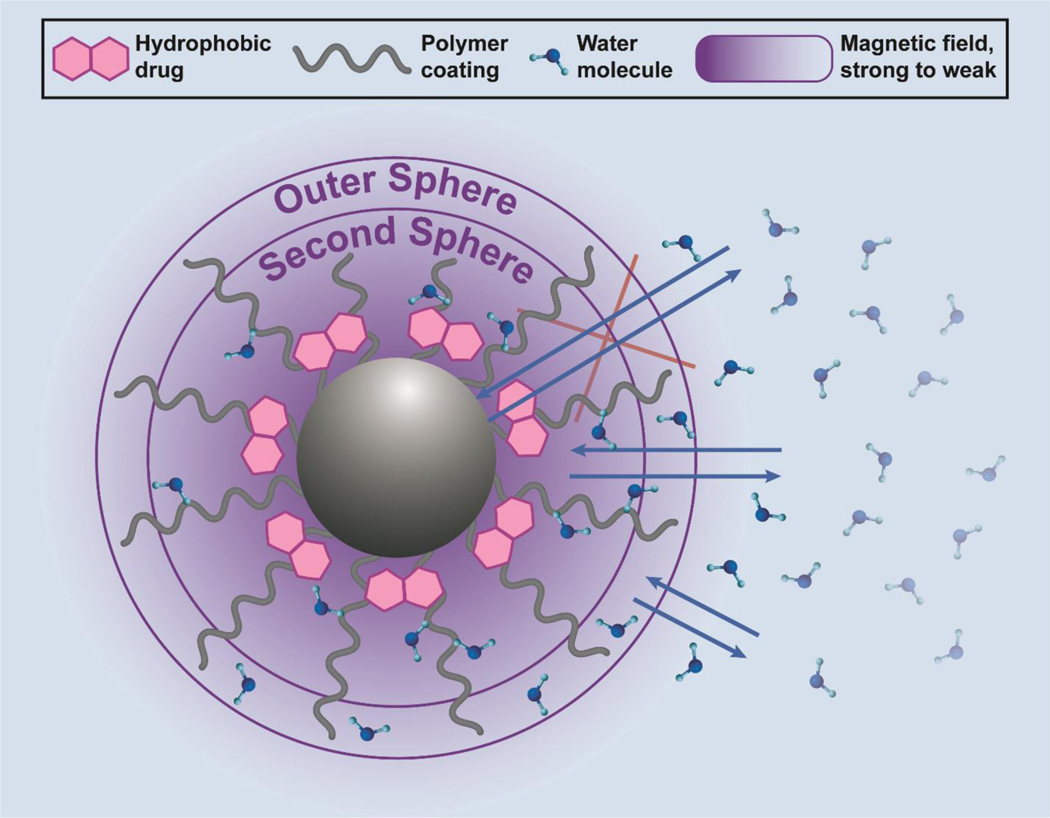
Illustration of the effect of the addition of hydrophobic drugs to the IONP system (black sphere: core, gray wavy lines: polymer). If bound near the core, hydrophobic drugs block water molecules (blue) from accessing the strongest regions of the IONP’s magnetic field, thus reducing r2. However, this also prevents inner-sphere effects from contributing to r1.
Figure 8.
Figure 8.
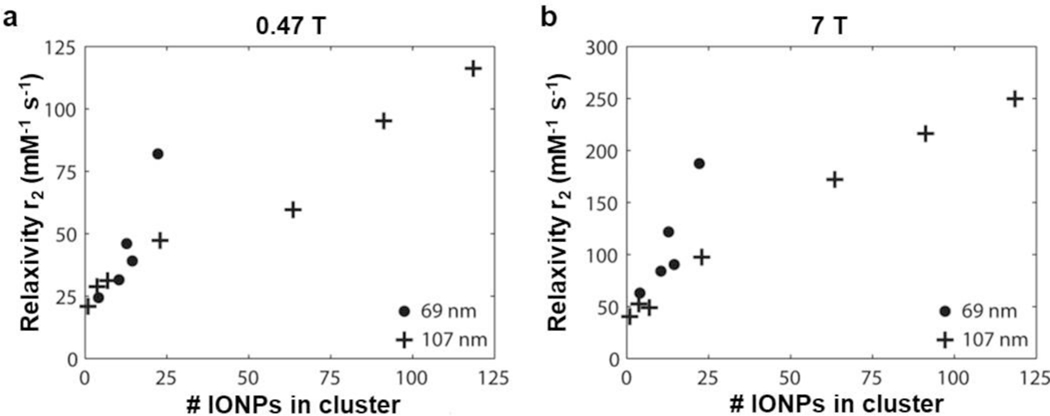
Effects of IONP clustering on transverse relaxivity. As the number of IONPs in a cluster grows larger, an increase in r2 is observed at both (a) 0.47 T and (b) 7 T, caused by the interaction of the induced magnetic fields of the iron oxide cores in the cluster. As these fields interact constructively or destructively, the inhomogeneity of the magnetic landscape is increased, increasing the rate of dephasing. (Reproduced from[104], Copyright © Wiley Periodicals, Inc., 2014.)

References

    1. Blasiak B, van Veggel FCJM, Tomanek B, Journal of Nanomaterials 2013, 2013, 12.
    1. Estelrich J, Sanchez-Martin MJ, Busquets MA, International journal of nanomedicine 2015, 10, 1727. - PMC - PubMed
    1. Kim J, Piao Y, Hyeon T, Chemical Society reviews 2009, 38, 372. - PubMed
    1. Lee SH, Kim BH, Na HB, Hyeon T, Wiley interdisciplinary reviews. Nanomedicine and nanobiotechnology 2014, 6, 196. - PubMed
    1. Terreno E, Castelli DD, Viale A, Aime S, Chemical reviews 2010, 110, 3019. - PubMed