


Perceptions About Technologies That Help Community-Dwelling Older Adults Remain at Home: Qualitative Study
- PMID: 32496197
- PMCID: PMC7303826
- DOI: 10.2196/17930
Perceptions About Technologies That Help Community-Dwelling Older Adults Remain at Home: Qualitative Study
Abstract
Background: The population of Europe is aging rapidly. Most community-dwelling older adults (CDOAs) want to remain in their homes, particularly those experiencing functional decline. Politicians and academics repeatedly praise technological instruments for being the preferred solution for helping older adults with deteriorating health to remain at home.
Objective: This study aimed to understand the perceptions of CDOAs and their informal caregivers (ICs) and professional caregivers (PCs) about technologies that can help keep older adults at home.
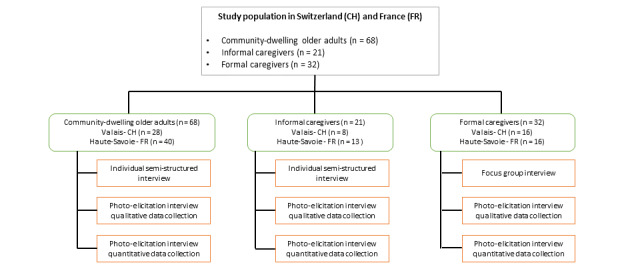
Methods: This qualitative study used personal interviews, focus groups, and photo-elicitation interviews to better understand the perceptions of a convenience sample of 68 CDOAs, 21 ICs, and 32 PCs.
Results: A fraction of CDOAs did not perceive technological instruments to be a very useful means of helping them remain at home. However, the ICs and PCs were more positive. The CDOAs preferred and were more willing to adopt technologies related to their mobility and safety and those that would help slow down their cognitive decline. The ICs preferred technological aids that assist in the activities of daily living as well as safety-related technologies for detecting falls and helping to locate disoriented older adults. The PCs preferred integrated communication and information systems to improve collaboration between all stakeholders, housing equipped with technologies to manage complex care, high-performance ancillary equipment to transfer people with reduced mobility, and surveillance systems to ensure safety at home.
Conclusions: Although our study reports that CDOAs have limited interest in innovative technologies to help them remain at home, their technological skills will undoubtedly improve in the future, as will those of ICs and PCs. Technological tools will play an increasingly important role in home health care.
Keywords: cognitive impairment; content analysis; focus groups; frailty; gerontechnology; informal caregivers; interviews; photo-elicitation; physical impairment; professional caregivers; technology.
©Henk Verloo, Thomas Kampel, Nicole Vidal, Filipa Pereira. Originally published in the Journal of Medical Internet Research (http://www.jmir.org), 04.06.2020.
Conflict of interest statement
Conflicts of Interest: None declared.
Figures
References
-
- OECD Factbook 2015-2016: Economic, Environmental and Social Statistics. Paris: OECD Publishing; 2016.
-
- Goldman DP, Chen C, Zissimopoulos J, Rowe JW, Research Network on an Aging Society Opinion: measuring how countries adapt to societal aging. Proc Natl Acad Sci USA. 2018 Jan 16;115(3):435–7. doi: 10.1073/pnas.1720899115. http://www.pnas.org/cgi/pmidlookup?view=long&pmid=29339547 - DOI - PMC - PubMed
-
- Pruchno RA, Smyer MA. Challenges of an Aging Society. Boston: Johns Hopkins University Press; 2007.
Publication types
MeSH terms
LinkOut - more resources
Full Text Sources
Medical
