Clinical Trial
. 2020 Aug 10;38(23):2628-2638.
doi: 10.1200/JCO.19.02892. Epub 2020 Jun 4.

Impact of Intrathecal Triple Therapy Versus Intrathecal Methotrexate on Disease-Free Survival for High-Risk B-Lymphoblastic Leukemia: Children's Oncology Group Study AALL1131

Affiliations
Clinical Trial

Impact of Intrathecal Triple Therapy Versus Intrathecal Methotrexate on Disease-Free Survival for High-Risk B-Lymphoblastic Leukemia: Children's Oncology Group Study AALL1131

Wanda L Salzer et al. J Clin Oncol. .

Abstract

Purpose: The high-risk stratum of Children's Oncology Group Study AALL1131 was designed to test the hypothesis that postinduction CNS prophylaxis with intrathecal triple therapy (ITT) including methotrexate, hydrocortisone, and cytarabine would improve the postinduction 5-year disease-free survival (DFS) compared with intrathecal methotrexate (IT MTX), when given on a modified augmented Berlin-Frankfurt-Münster backbone.

Patients and methods: Children with newly diagnosed National Cancer Institute (NCI) high-risk B-cell acute lymphoblastic leukemia (HR B-ALL) or NCI standard-risk B-ALL with defined minimal residual disease thresholds during induction were randomly assigned to receive postinduction IT MTX or ITT. Patients with CNS3-status disease were not eligible. Postinduction IT therapy was given for a total of 21 to 26 doses. Neurocognitive assessments were performed during therapy and during 1 year off therapy.

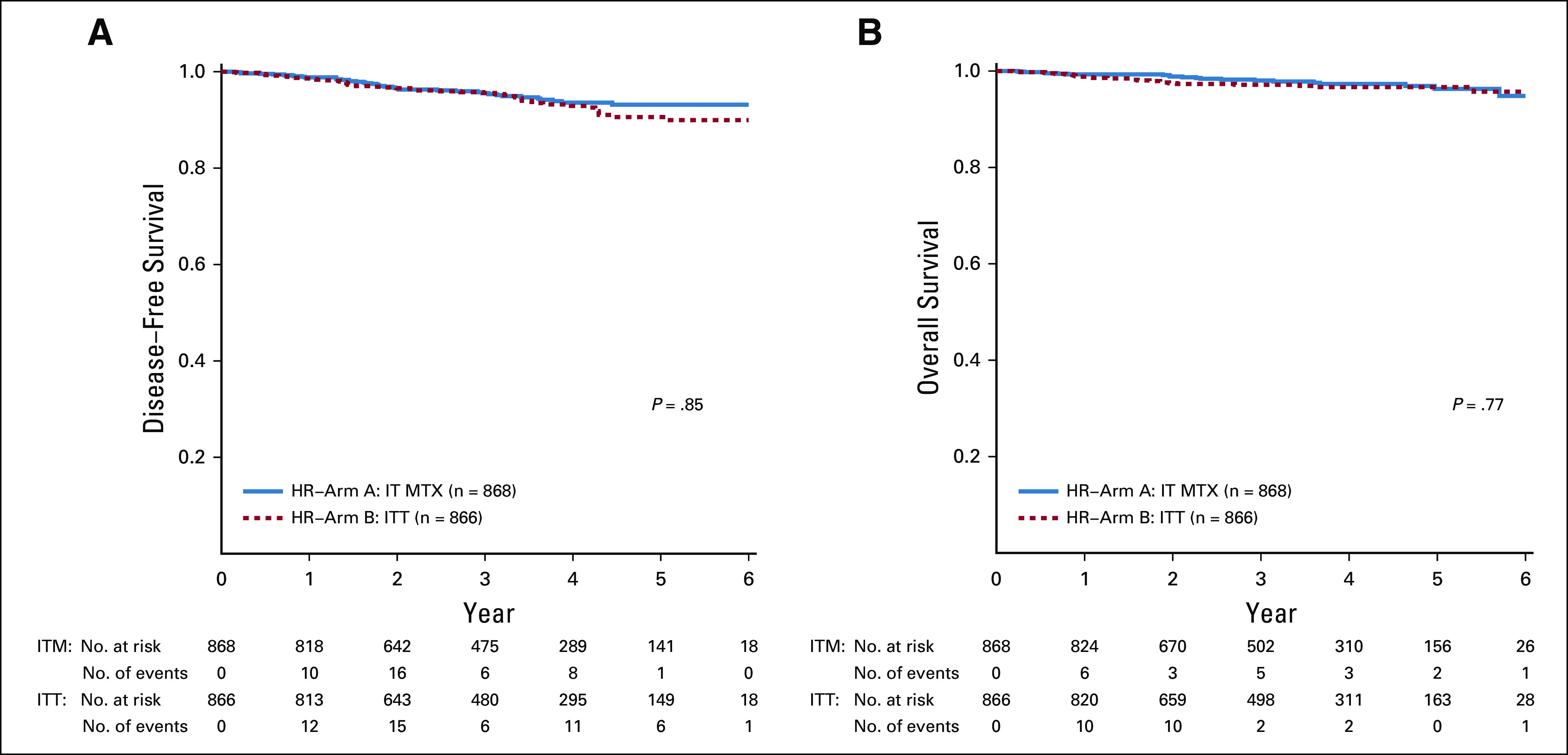
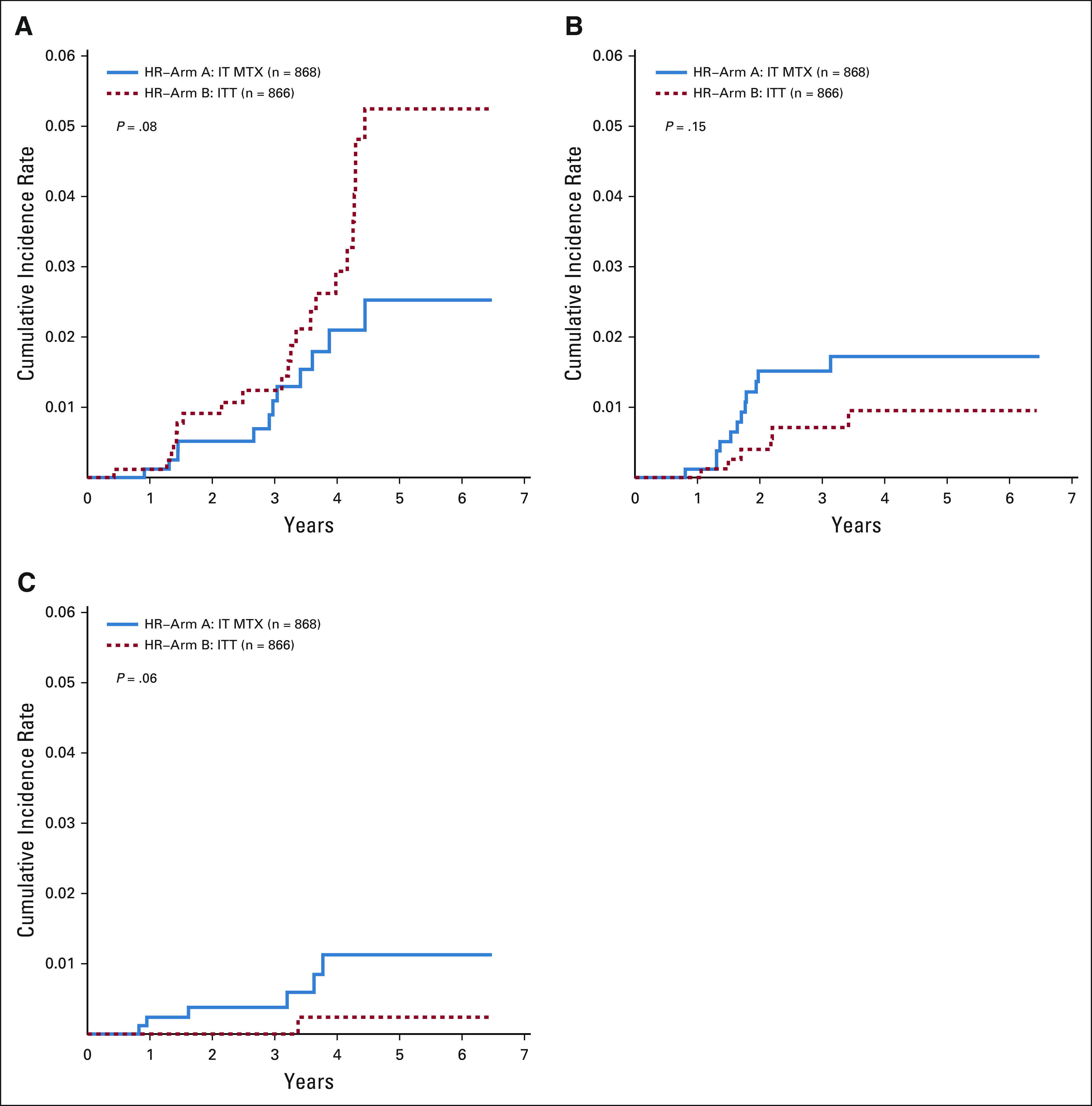
Results: Random assignment was closed to accrual in March 2018 after a futility boundary had been crossed, concluding that ITT could not be shown to be superior to IT MTX. The 5-year postinduction DFS and overall survival rates (± SE) of children randomly assigned to IT MTX versus ITT were 93.2% ± 2.1% v 90.6% ± 2.3% (P = .85), and 96.3% ± 1.5% v 96.7% ± 1.4% (P = .77), respectively. There were no differences in the cumulative incidence of isolated bone marrow relapse, isolated CNS relapse, or combined bone marrow and CNS relapse rates, or in toxicities observed for patients receiving IT MTX compared with ITT. There were no significant differences in neurocognitive outcomes for patients receiving IT MTX compared with ITT.

Conclusion: Postinduction CNS prophylaxis with ITT did not improve 5-year DFS for children with HR B-ALL. The standard of care for CNS prophylaxis for children with B-ALL and no overt CNS involvement remains IT MTX.

Trial registration: ClinicalTrials.gov NCT02883049.


Figures
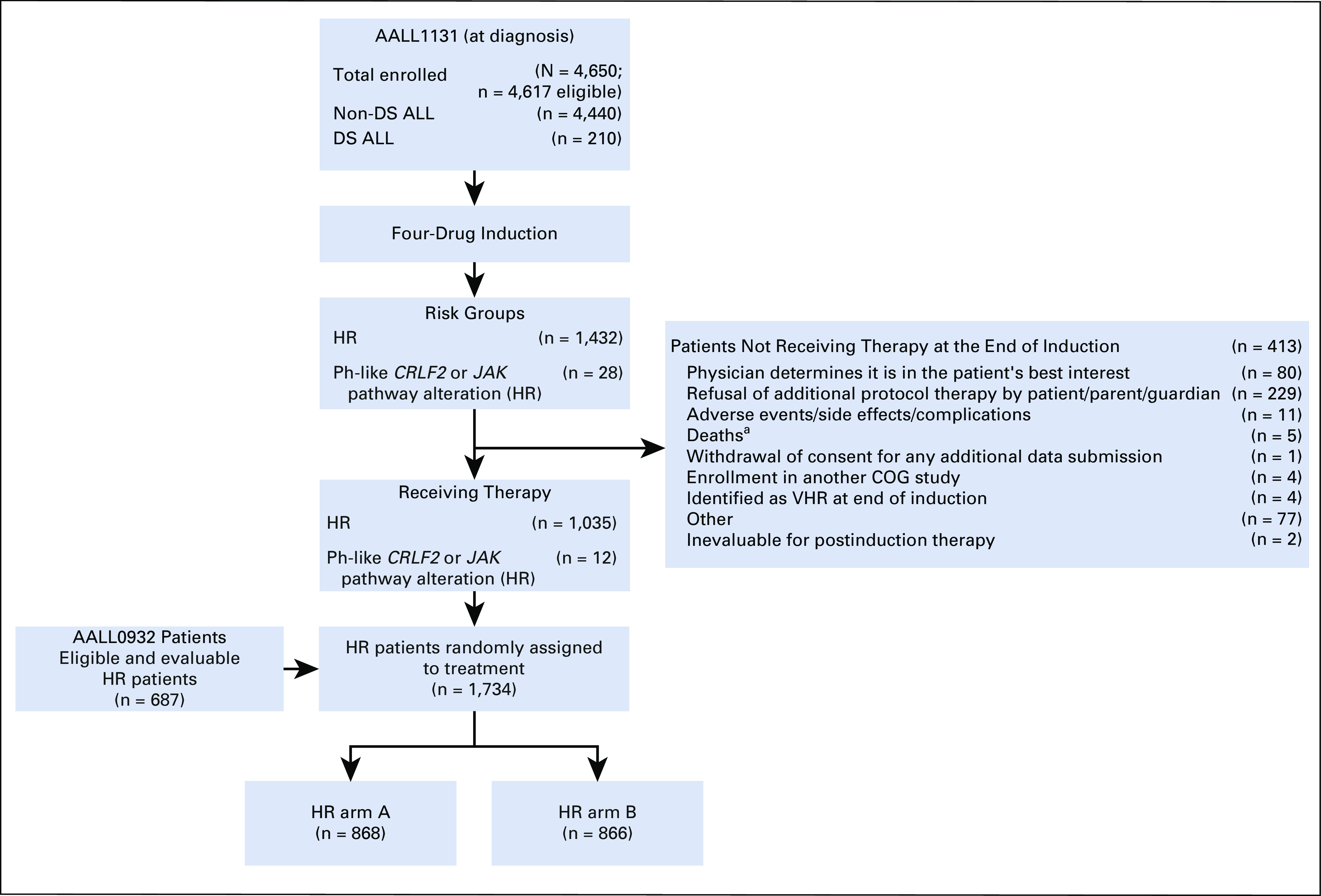
FIG 1.
FIG 1.
CONSORT diagram for selecting study patients with high-risk (HR) B-cell acute lymphoblastic leukemia (B-ALL). (a) Causes of induction death: n = 3 due to protocol treatment, n = 1 due to cardiac arrest, n = 1 patient in whom a pancreatic pseudocyst developed, which continued to grow; hemorrhaging occurred, followed by hypotension and respiratory failure. COG, Children’s Oncology Group; DS, Down syndrome; Ph, Philadelphia.
FIG 2.
FIG 2.
Comparison of survival rates for intrathecal MTX versus ITT. (A) Five-year disease-free survival (± SE): 93.2% ± 2.1% and 90.6% ± 2.3% (P = .85); (B) 5-year overall survival (± SE): 96.3% ± 1.5% and 96.7% ± 1.4% (P = .77). HR, high risk; ITT, intrathecal triple therapy; MTX, methotrexate.
FIG 3.
FIG 3.
Comparison of cumulative incidence of relapse for IT methotrexate versus ITT. (A) Five-year cumulative incidence (± SE) of isolated bone marrow relapse was 2.5% ± 0.8% and 5.2% ± 1.2%, respectively (P = .08); (B) 5-year cumulative incidence of isolated CNS relapse were 1.7% ± 0.5% and 1.0% ± 0.4%, respectively (P = .15); and (C) 5-year cumulative incidence of combined bone marrow and CNS relapse were 1.1% ± 0.5% and 0.2% ± 0.2% (P = .06). IT MTX, intrathecal methotrexate; ITT, intrathecal triple therapy.
FIG 4.
FIG 4.
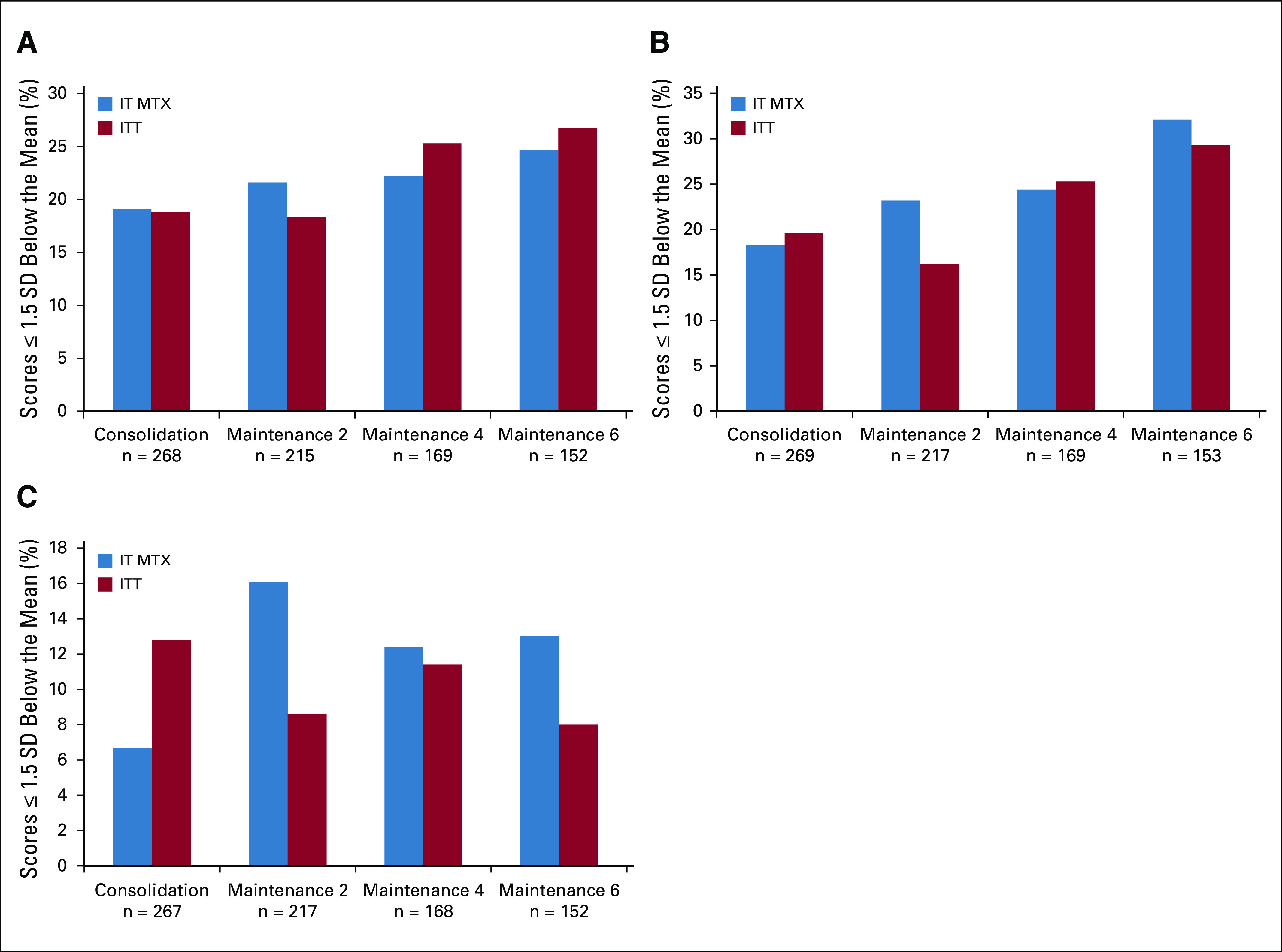
Comparison of Cogstate scores for IT MTX versus ITT. (A) Percentage of abnormal reaction time/processing speed scores over time by treatment arm. (B) Percentage of abnormal visual attention scores over time by treatment arm. (C) Percentage of abnormal working memory scores over time by treatment arm. Note: All results reflect all data collected as of September 30, 2018; many participants had not yet reached the end of maintenance courses 4 and 6. χ2 statistics comparing rates of impairment as a function of treatment group were nonsignificant for all time points. IT MTX, intrathecal methotrexate; ITT, intrathecal triple therapy; SD, standard deviation.

References

    1. Pui CH, Yang JJ, Hunger SP, et al. Childhood acute lymphoblastic leukemia: Progress through collaboration. J Clin Oncol. 2015;33:2938–2948. - PMC - PubMed
    1. Möricke A, Zimmermann M, Reiter A, et al. Long-term results of five consecutive trials in childhood acute lymphoblastic leukemia performed by the ALL-BFM study group from 1981 to 2000. Leukemia. 2010;24:265–284. - PubMed
    1. Hunger SP, Lu X, Devidas M, et al. Improved survival for children and adolescents with acute lymphoblastic leukemia between 1990 and 2005: A report from the Children’s Oncology Group. J Clin Oncol. 2012;30:1663–1669. - PMC - PubMed
    1. Nguyen K, Devidas M, Cheng SC, et al. Factors influencing survival after relapse from acute lymphoblastic leukemia: A Children’s Oncology Group study. Leukemia. 2008;22:2142–2150. - PMC - PubMed
    1. Gaynon PS, Angiolillo AL, Carroll WL, et al. Long-term results of the children’s cancer group studies for childhood acute lymphoblastic leukemia 1983-2002: A Children’s Oncology Group Report. Leukemia. 2010;24:285–297. - PMC - PubMed

Publication types

MeSH terms

Associated data