doi: 10.3201/eid2610.202449.
Epub 2020 Jun 4.
Viral RNA Load in Mildly Symptomatic and Asymptomatic Children with COVID-19, Seoul, South Korea
- PMID: 32497001
- PMCID: PMC7510743
- DOI: 10.3201/eid2610.202449
Item in Clipboard
Viral RNA Load in Mildly Symptomatic and Asymptomatic Children with COVID-19, Seoul, South Korea
Emerg Infect Dis.
2020 Oct.
Abstract
Along with positive SARS-CoV-2 RNA in nasopharyngeal swabs, viral RNA was detectable at high concentration for >3 weeks in fecal samples from 12 mildly symptomatic and asymptomatic children with COVID-19 in Seoul, South Korea. Saliva also tested positive during the early phase of infection. If proven infectious, feces and saliva could serve as transmission sources.
Keywords: COVID-19; SARS-CoV-2; Seoul; South Korea; children; coronavirus; coronavirus disease; feces; respiratory infections; saliva; severe acute respiratory syndrome coronavirus 2; viral load; viruses; zoonoses.
Figures
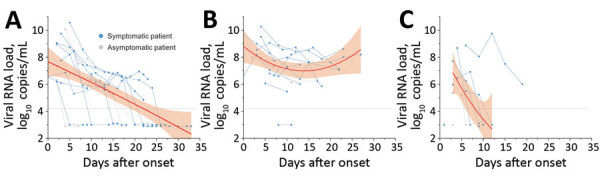
Changes in severe acute respiratory syndrome coronavirus 2 viral RNA load in A) nasopharyngeal swabs, B) feces, and C) saliva of mildly symptomatic and asymptomatic children with coronavirus disease over time, South Korea. The thick red line indicates trend in viral RNA load over time, and the shaded areas represent 95% CIs. The dashed line indicates the detection limit (1.25 × 10⁴ copies/mL). Specimens with undetectable viral RNA loads are shown under the dashed line. Days after onset indicates days after symptom onset for symptomatic patients, days after diagnosis for asymptomatic patients.
References
Publication types
MeSH terms
Substances
LinkOut - more resources
Full Text Sources
Medical
Miscellaneous