


Association of hypertension and antihypertensive treatment with COVID-19 mortality: a retrospective observational study
- PMID: 32498076
- PMCID: PMC7314067
- DOI: 10.1093/eurheartj/ehaa433
Association of hypertension and antihypertensive treatment with COVID-19 mortality: a retrospective observational study
Abstract
Aims: It remains unknown whether the treatment of hypertension influences the mortality of patients diagnosed with coronavirus disease 2019 (COVID-19).
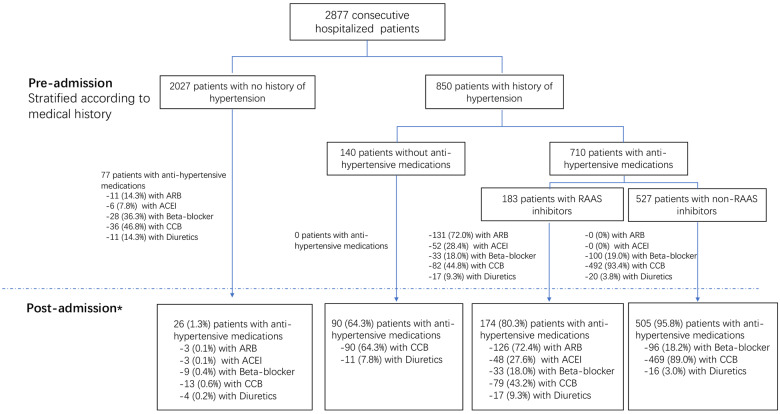
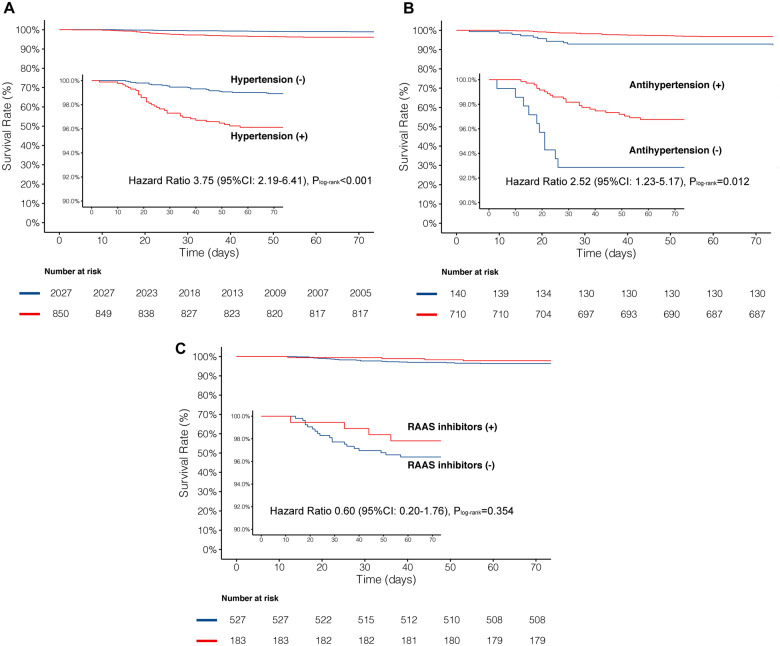
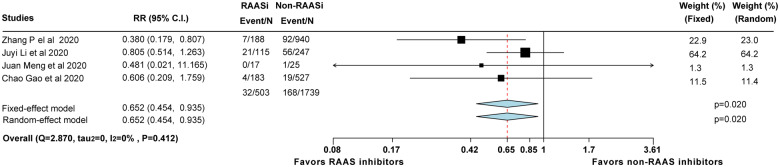
Methods and results: This is a retrospective observational study of all patients admitted with COVID-19 to Huo Shen Shan Hospital. The hospital was dedicated solely to the treatment of COVID-19 in Wuhan, China. Hypertension and the treatments were stratified according to the medical history or medications administrated prior to the infection. Among 2877 hospitalized patients, 29.5% (850/2877) had a history of hypertension. After adjustment for confounders, patients with hypertension had a two-fold increase in the relative risk of mortality as compared with patients without hypertension [4.0% vs. 1.1%, adjusted hazard ratio (HR) 2.12, 95% confidence interval (CI) 1.17-3.82, P = 0.013]. Patients with a history of hypertension but without antihypertensive treatment (n = 140) were associated with a significantly higher risk of mortality compared with those with antihypertensive treatments (n = 730) (7.9% vs. 3.2%, adjusted HR 2.17, 95% CI 1.03-4.57, P = 0.041). The mortality rates were similar between the renin-angiotensin-aldosterone system (RAAS) inhibitor (4/183) and non-RAAS inhibitor (19/527) cohorts (2.2% vs. 3.6%, adjusted HR 0.85, 95% CI 0.28-2.58, P = 0.774). However, in a study-level meta-analysis of four studies, the result showed that patients with RAAS inhibitor use tend to have a lower risk of mortality (relative risk 0.65, 95% CI 0.45-0.94, P = 0.20).
Conclusion: While hypertension and the discontinuation of antihypertensive treatment are suspected to be related to increased risk of mortality, in this retrospective observational analysis, we did not detect any harm of RAAS inhibitors in patients infected with COVID-19. However, the results should be considered as exploratory and interpreted cautiously.
Keywords: Angiotensin receptor blockers (ARBs); Angiotensin-converting enzyme inhibitors (ACEIs); Antihypertensive regimen; COVID-19.
Published on behalf of the European Society of Cardiology. All rights reserved. © The Author(s) 2020. For permissions, please email: journals.permissions@oup.com.
Figures
Comment in
-
Renin-angiotensin system inhibitors in the COVID-19 pandemic: consequences of antihypertensive drugs.Eur Heart J. 2020 Jun 7;41(22):2067-2069. doi: 10.1093/eurheartj/ehaa487. Eur Heart J. 2020. PMID: 32498078 Free PMC article. No abstract available.
-
The saga continues: is COVID-19 a cardiopulmonary disease?Eur Heart J. 2020 Jun 7;41(22):2041-2044. doi: 10.1093/eurheartj/ehaa502. Eur Heart J. 2020. PMID: 33216882 Free PMC article. No abstract available.
References
-
- Wu Z, McGoogan JM.. Characteristics of and important lessons from the coronavirus disease 2019 (COVID-19) outbreak in China: summary of a report of 72314 cases from the Chinese Center for Disease Control and Prevention. JAMA 2020;323:1239–1242. - PubMed
-
- Wu C, Chen X, Cai Y, Xia J, Zhou X, Xu S, Huang H, Zhang L, Zhou X, Du C, Zhang Y, Song J, Wang S, Chao Y, Yang Z, Xu J, Zhou X, Chen D, Xiong W, Xu L, Zhou F, Jiang J, Bai C, Zheng J, Song Y.. Risk factors associated with acute respiratory distress syndrome and death in patients with coronavirus disease 2019 pneumonia in Wuhan, China. JAMA Intern Med 2020;doi: 10.1001/jamainternmed.2020.0994. - PMC - PubMed
-
- Zhou F, Yu T, Du R, Fan G, Liu Y, Liu Z, Xiang J, Wang Y, Song B, Gu X, Guan L, Wei Y, Li H, Wu X, Xu J, Tu S, Zhang Y, Chen H, Cao B.. Clinical course and risk factors for mortality of adult inpatients with COVID-19 in Wuhan, China: a retrospective cohort study. Lancet 2020;395:1054–1062. - PMC - PubMed
Publication types
MeSH terms
Substances
LinkOut - more resources
Full Text Sources
Medical
