Long-term Effects of Bilateral Subthalamic Deep Brain Stimulation on Postural Instability and Gait Difficulty in Patients with Parkinson's Disease
- PMID: 32498496
- PMCID: PMC7280933
- DOI: 10.14802/jmd.19081
Long-term Effects of Bilateral Subthalamic Deep Brain Stimulation on Postural Instability and Gait Difficulty in Patients with Parkinson's Disease
Abstract
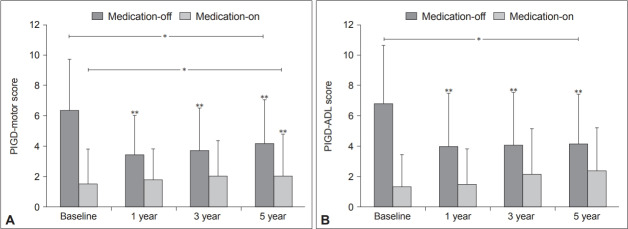
Objective: The long-term effects of bilateral subthalamic nucleus deep brain stimulation (STN-DBS) on postural instability and gait difficulty (PIGD) in patients with Parkinson's disease (PD) remain unclear. In this study, we aimed to evaluate the longterm effects of STN-DBS surgery on PIGD symptoms in patients with advanced-stage PD.
Methods: This study included 49 consecutively included patients with PD who underwent bilateral STN-DBS. The Unified Parkinson's Disease Rating Scale (UPDRS) scores and subscores for PIGD were assessed at baseline and at 1, 3, and 5 years postoperatively. The PIGD subscore was divided into PIGD-motor and PIGD-activities of daily living (ADL) scores according to parts III and II of the UPDRS, respectively.
Results: The PIGD-motor and PIGD-ADL scores at the "medication-off" state improved at 3 and 5 years, respectively. Overall, the UPDRS III and II scores at "medication-off" improved at 5 years. The UPDRS IV score also significantly improved and the levodopa equivalent daily dosage decreased at all follow-ups. Finally, the PIGD-motor score at baseline was able to predict long-term improvement in the PIGD-motor score at the 5-year follow-up.
Conclusion: The STN-DBS has both short- and long-term effects on PIGD, as well as overall motor function, in patients with advanced PD. The degree of PIGD at the preoperative evaluation can be used to predict long-term outcomes after STN-DBS surgery.
Keywords: Deep brain stimulation; Gait difficulty; Parkinson disease; Postural instability; Subthalamic nucleus.
Conflict of interest statement
The authors have no financial conflicts of interest.
Figures
References
-
- Okun MS. Deep-brain stimulation for Parkinson’s disease. N Engl J Med. 2012;367:1529–1538. - PubMed
-
- Benabid AL, Chabardes S, Mitrofanis J, Pollak P. Deep brain stimulation of the subthalamic nucleus for the treatment of Parkinson’s disease. Lancet Neurol. 2009;8:67–81. - PubMed
-
- Cossu G, Pau M. Subthalamic nucleus stimulation and gait in Parkinson’s Disease: a not always fruitful relationship. Gait Posture. 2017;52:205–210. - PubMed
-
- Fasano A, Aquino CC, Krauss JK, Honey CR, Bloem BR. Axial disability and deep brain stimulation in patients with Parkinson disease. Nat Rev Neurol. 2015;11:98–110. - PubMed
Grants and funding
LinkOut - more resources
Full Text Sources