


Comparison of HIV Incidence in the Zimbabwe Population-Based HIV Impact Assessment Survey (2015-2016) with Modeled Estimates: Progress Toward Epidemic Control
- PMID: 32498542
- PMCID: PMC7986968
- DOI: 10.1089/AID.2020.0046
Comparison of HIV Incidence in the Zimbabwe Population-Based HIV Impact Assessment Survey (2015-2016) with Modeled Estimates: Progress Toward Epidemic Control
Abstract
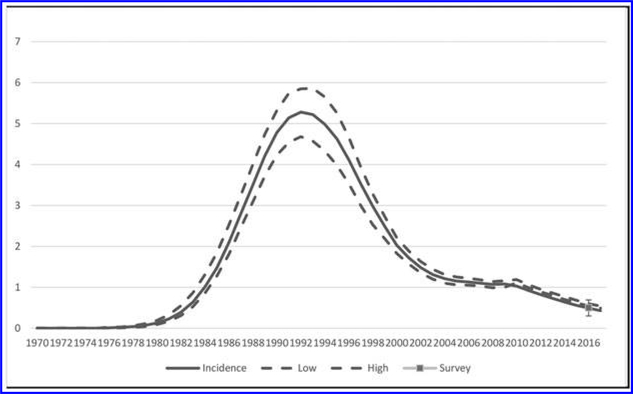
Between October 2015 and August 2016, Zimbabwe conducted the Zimbabwe Population-Based HIV Impact Assessment (ZIMPHIA) cross-sectional survey to determine progress toward epidemic control. Of 25,131 eligible adults aged 15-64 years, 20,577 (81.8%) consented to face-to-face questionnaire and biomarker testing in this nationally representative household survey. Home-based rapid HIV testing was performed using Determine, First Response, and STAT-PAK as the tiebreaker. HIV-positive tests were confirmed in a laboratory using Geenius HIV-1/2; viral load (VL) was measured using Roche TaqMan and BioMerieux NucliSENS. Recency of infection was tested using Sedia HIV-1 Limiting Antigen (LAg)-Avidity. Presence of antiretroviral (ARV) drugs was detected using high performance liquid chromatography/mass spectrometry (HPLC/MS). The recent infection testing algorithm included LAg-avidity enzyme immunoassay [normalized optical density (ODn ≤1.5), VL ≥1,000 copies/mL, and absence of ARV drugs]. Weighted annual HIV incidence was compared with United Nations Joint Programme on HIV/AIDS (UNAIDS) Spectrum models estimates. Overall, 26 of 2,901 HIV-seropositive individuals had a recent infection (men, 8; women, 18). Overall weighted annual incidence among persons aged 15-64 years was 0.42% [95% confidence interval (CI): 0.25-0.59] and was 0.44% (95% CI: 0.25-0.62) for those aged 15-49 years, similar to 2016 Spectrum model estimate (0.54%, 95% CI: 0.49-0.66) for this age group. Among persons aged 15-49 years, HIV prevalence was 13.35% (95% CI: 12.71-14.02), estimated HIV-positive individuals were 968,951 (95% CI: 911,473-1,026,430), of these, 41,911 (95% CI: 37,412-44,787) were annual-new infections, and this was similar to 2016 Spectrum estimates. The observed HIV incidence in ZIMPHIA 2015-2016 validated the 2016 Spectrum estimates and Zimbabwe's progress toward epidemic control.
Keywords: Spectrum; comparison; incidence.
Conflict of interest statement
Author Disclosure Statement
B.P. as inventor of the Limiting Antigen Avidity Assay method receives a portion of the royalties received by the CDC from commercialization of the assay. All other authors declare no conflicts of interest.
Figures
References
-
- Joint United Nations Programme on HIV/AIDS (UNAIDS): HIV Prevention 2020 Road Map—Accelerating HIV prevention to reduce new infections by 75%. November 2017. Available at: https://www.unaids.org/sites/default/files/media_asset/hiv-prevention-20... accessed November 17, 2017.
-
- Joint United Nations Programme on HIV/AIDS (UNAIDS). 2014 Fast-track: ending the AIDS epidemic by 2030. Geneva. Available at www.unaids.org/sites/default/files accessed November 21, 2016.
-
- Joint United Nations Programme on HIV/AIDS (UNAIDS). Progress report on the Global Plan 2016. Available at www.unaids.org/sites/default/files/media_asset/global-AIDS-update-2016_e... accessed October 13, 2017.
-
- Joint United Nations Programme on HIV/AIDS (UNAIDS). Data book 2017. Available at www.unaids.org/sites/default/files/media_asset/20170720_Data_book_2017_e... accessed Janurary 19, 2019.
Publication types
MeSH terms
Substances
Grants and funding
LinkOut - more resources
Full Text Sources
Medical
