


Non-invasive brain stimulation in Stroke patients (NIBS): A prospective randomized open blinded end-point (PROBE) feasibility trial using transcranial direct current stimulation (tDCS) in post-stroke hemispatial neglect
- PMID: 32498606
- PMCID: PMC8372288
- DOI: 10.1080/09602011.2020.1767161
Non-invasive brain stimulation in Stroke patients (NIBS): A prospective randomized open blinded end-point (PROBE) feasibility trial using transcranial direct current stimulation (tDCS) in post-stroke hemispatial neglect
Erratum in
-
Correction.Neuropsychol Rehabil. 2022 Jun;32(5):794-795. doi: 10.1080/09602011.2022.2092326. Neuropsychol Rehabil. 2022. PMID: 35854657 Free PMC article. No abstract available.
Abstract
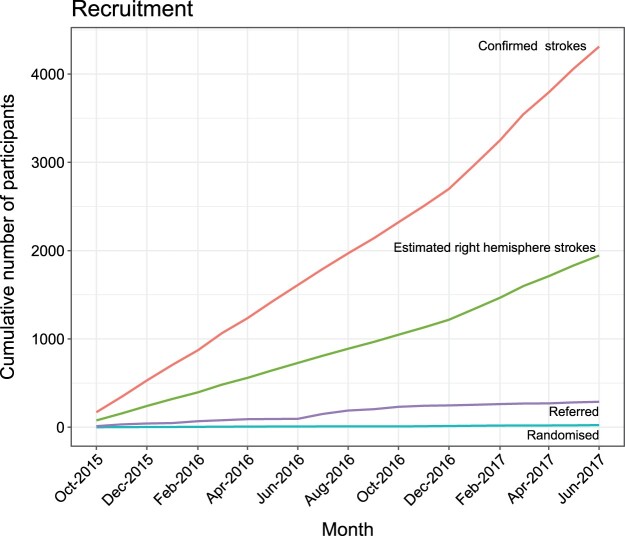
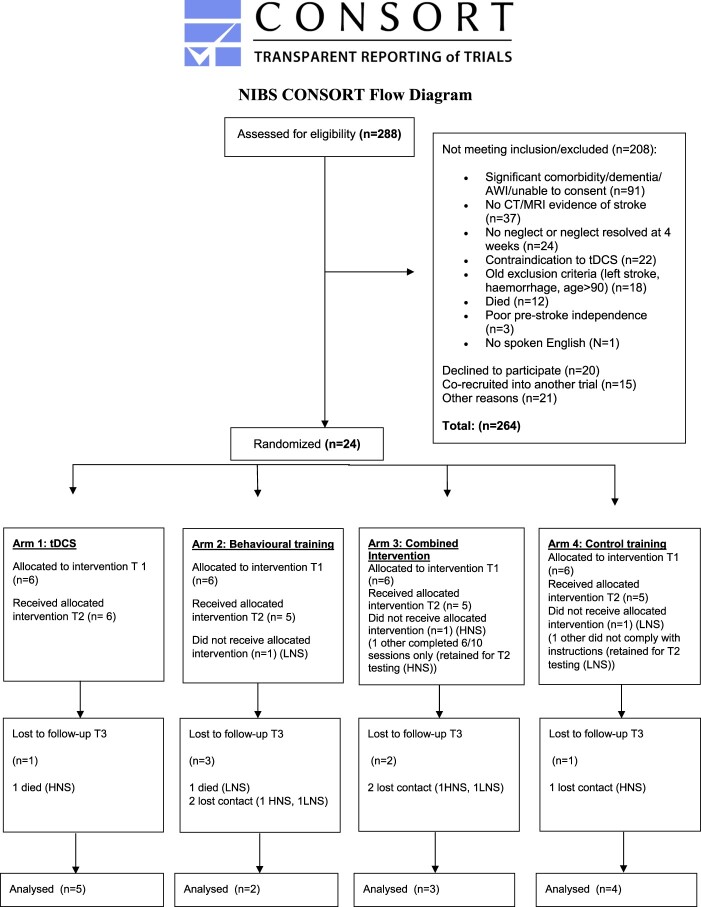
Up to 80% of people who experience a right-hemisphere stroke suffer from hemispatial neglect. This syndrome is debilitating and impedes rehabilitation. We carried out a clinical feasibility trial of transcranial direct current stimulation (tDCS) and a behavioural rehabilitation programme, alone or in combination, in patients with neglect. Patients >4 weeks post right hemisphere stroke were randomized to 10 sessions of tDCS, 10 sessions of a behavioural intervention, combined intervention, or a control task. Primary outcomes were recruitment and retention rates, with secondary outcomes effect sizes on measures of neglect and quality of life, assessed directly after the interventions, and at 6 months follow up. Of 288 confirmed stroke cases referred (representing 7% of confirmed strokes), we randomized 8% (0.6% of stroke cases overall). The largest number of exclusions (91/288 (34%)) were due to medical comorbidities that prevented patients from undergoing 10 intervention sessions. We recruited 24 patients over 29 months, with 87% completing immediate post-intervention and 67% 6 month evaluations. We established poor feasibility of a clinical trial requiring repeated hospital-based tDCS within a UK hospital healthcare setting, either with or without behavioural training, over a sustained time period. Future trials should consider intensity, duration and location of tDCS neglect interventions.Trial registration: ClinicalTrials.gov identifier: NCT02401724.
Keywords: Hemispatial neglect; Non-invasive brain stimulation; Prospective randomized open blinded end-point (PROBE) trial; Stroke; Transcranial direct current stimulation (tDCS).
Conflict of interest statement
No potential conflict of interest was reported by the author(s).
Figures
References
-
- Allman, C., Amadi, U., Winkler, A. M., Wilkins, L., Filippini, N., Kischka, U., Stagg, C., & Johansen-Berg, H. (2016). Ipsilesional anodal tDCS enhances the functional benefits of rehabilitation in patients after stroke. Science Translational Medicine, 8(330), 330re1–330re1. 10.1126/scitranslmed.aad5651 - DOI - PMC - PubMed
-
- Antal, A., Kincses, T. Z., Nitsche, M. A., Bartfai, O., & Paulus, W. (2004). Excitability changes induced in the human primary visual cortex by transcranial direct current stimulation: Direct electrophysiological evidence. Investigative Ophthalmology & Visual Science, 45(2), 702–707. 10.1167/iovs.03-0688 - DOI - PubMed
-
- Bang, D.-H., & Bong, S.-Y. (2015). Effect of combination of transcranial direct current stimulation and feedback training on visuospatial neglect in patients with sub-acute stroke: A pilot randomized controlled trial. Journal of Physical Therapy Science, 27(9), 2759–2761. 10.1589/jpts.27.2759 - DOI - PMC - PubMed
-
- Beck, A. T., Steer, R. A., & Brown, G. K. (1996). Beck depression inventory-second edition manual. The Psychological Corporation.
-
- Benwell, C. S. Y., Learmonth, G., Miniussi, C., Harvey, M., & Thut, G. (2015). Non-linear effects of transcranial direct current stimulation as a function of individual baseline performance: Evidence from biparietal tDCS influence on lateralized attention bias. Cortex, 69, 152–165. 10.1016/j.cortex.2015.05.007 - DOI - PubMed