. 2020 Sep;147(11):1196-1205.
doi: 10.1017/S0031182020000918. Epub 2020 Jun 5.

Interactions with ectoparasitic mites induce host metabolic and immune responses in flies at the expense of reproduction-associated factors

Affiliations

Interactions with ectoparasitic mites induce host metabolic and immune responses in flies at the expense of reproduction-associated factors

Joshua B Benoit et al. Parasitology. 2020 Sep.

Abstract

Parasites cause harm to their hosts and represent pervasive causal agents of natural selection. Understanding host proximate responses during interactions with parasites can help predict which genes and molecular pathways are targets of this selection. In the current study, we examined transcriptional changes arising from interactions between Drosophila melanogaster and their naturally occurring ectoparasitic mite, Gamasodes queenslandicus. Shifts in host transcript levels associated with behavioural avoidance revealed the involvement of genes underlying nutrient metabolism. These genetic responses were reflected in altered body lipid and glycogen levels in the flies. Mite infestation triggered a striking immune response, while male accessory gland protein transcript levels were simultaneously reduced, suggesting a trade-off between host immune responses to parasite challenge and reproduction. Comparison of transcriptional analyses during mite infestation to those during nematode and parasitoid attack identified host genes similarly expressed in flies during these interactions. Validation of the involvement of specific genes with RNA interference lines revealed candidates that may directly mediate fly-ectoparasite interactions. Our physiological and molecular characterization of the Drosophila-Gamasodes interface reveals new proximate mechanisms underlying host-parasite interactions, specifically host transcriptional shifts associated with behavioural avoidance and infestation. The results identify potential general mechanisms underlying host resistance and evolutionarily relevant trade-offs.

Keywords: Drosophila; Gamasodes; RNA-seq; ectoparasite; mites; nutrient levels; parasite resistance; trade-offs.


Figures

Fig. 1.
Fig. 1.
RNA-seq analyses of genes with significant differences in relation to control flies. (A) Heatmap of genes downregulated during prolonged infestation (left) and Gene ontology (GO) categories enriched and under-represented. (B) Heatmap of genes upregulated during prolonged infestation (left) and GO categories enriched and under-represented (categories of specific interest are listed). (C) Heatmap of genes associated with exposure to mites (left), and GO categories that were enriched. Analyses conducted with g:Profiler (Raudvere et al., 2019) and Revigo (Supek et al., 2011). Sizes of boxes represent relative abundance of each GO category with colours assigned at random. Boxes within the same colour are unlabelled lower level GO terms. Specific details of differentially expressed genes are given in Tables S1 and S2. Gene identifications are based on those available from FlyBase (Thurmond et al., 2019).
Fig. 2.
Fig. 2.
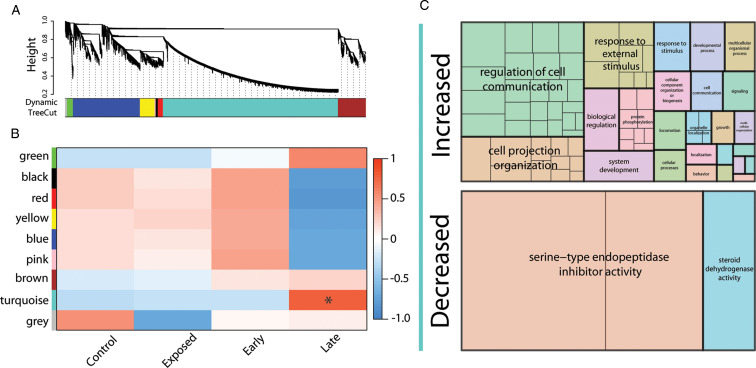
WGCNA to examine correlated expression of genes related to infestation or behavioural resistance. (A) Hierarchical cluster dendrogram of control, early infestation, prolonged infestation and exposed flies to identify specific modules with correlated expression. The lower bar graph represents the specific colours assigned for each module by the Dynamic tree cut methods (‘Grey’ module represents unassigned genes). (B) Specific modules associated with each treatment. * indicates a statistically significant level of correlation between the specific samples and module. (C) GO analysis of genes with increased and decreased expression in the turquoise module associated with prolonged infestation. Analyses were conducted with g:Profiler (Raudvere et al., 2019) and Revigo (Supek et al., 2011). Sizes of boxes represent relative abundance of each GO category with colours assigned at random. Boxes within the same colour are subsets of the higher level GO term.
Fig. 3.
Fig. 3.
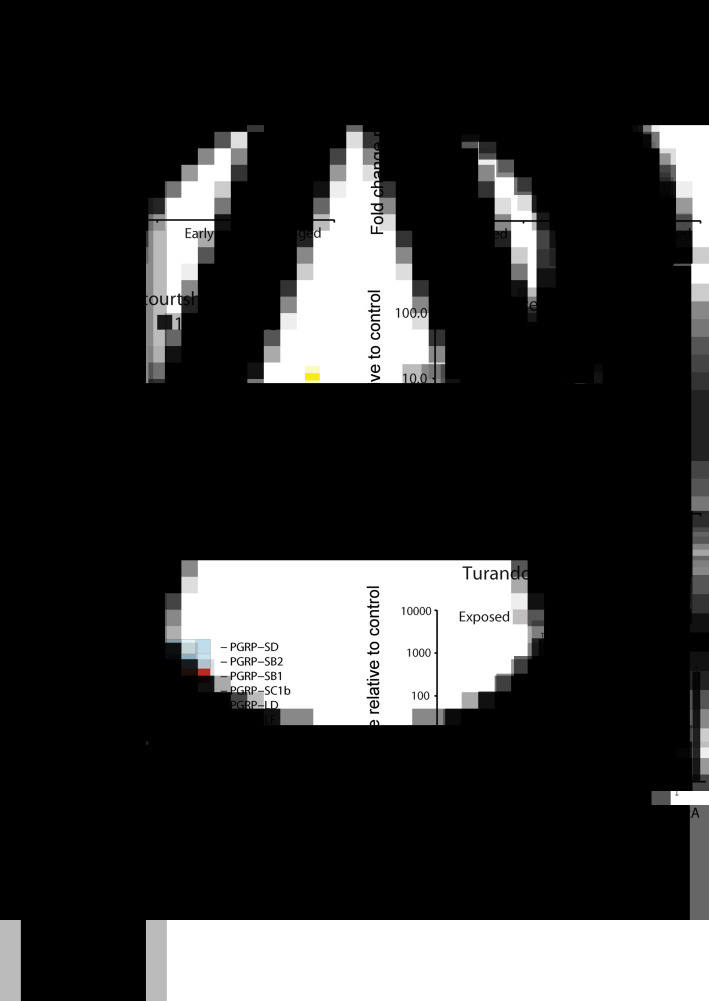
Specific gene ontogeny categories of interest with altered expression in relation to prolonged mite infestation: (A) melanization, (B) cuticle proteins, (C) male courtship, (D) ejaculate components, (E) peptidoglycan recognition proteins (PGRPs) and (F) turandots. Categories were assigned through Flybase (Thurmond et al., 2019). All categories show enrichment or reduction compared to expected results for all genes based on a Fisher's exact test. Yellow, statistically significant increase in expression in the prolonged group. Blue, statistically significant decrease in expression in the prolonged group. Black, no difference in expression in the prolonged group. Light shading represents standard error for the mean of genes within each group. Numbersby boxes at top of each plotrepresent the total number of genes increased, decreased or with no difference in expression during prolonged infestation. Groups with less than three genes are displayed individually. Gene identifications are based on those available from FlyBase (Thurmond et al., 2019).
Fig. 4.
Fig. 4.
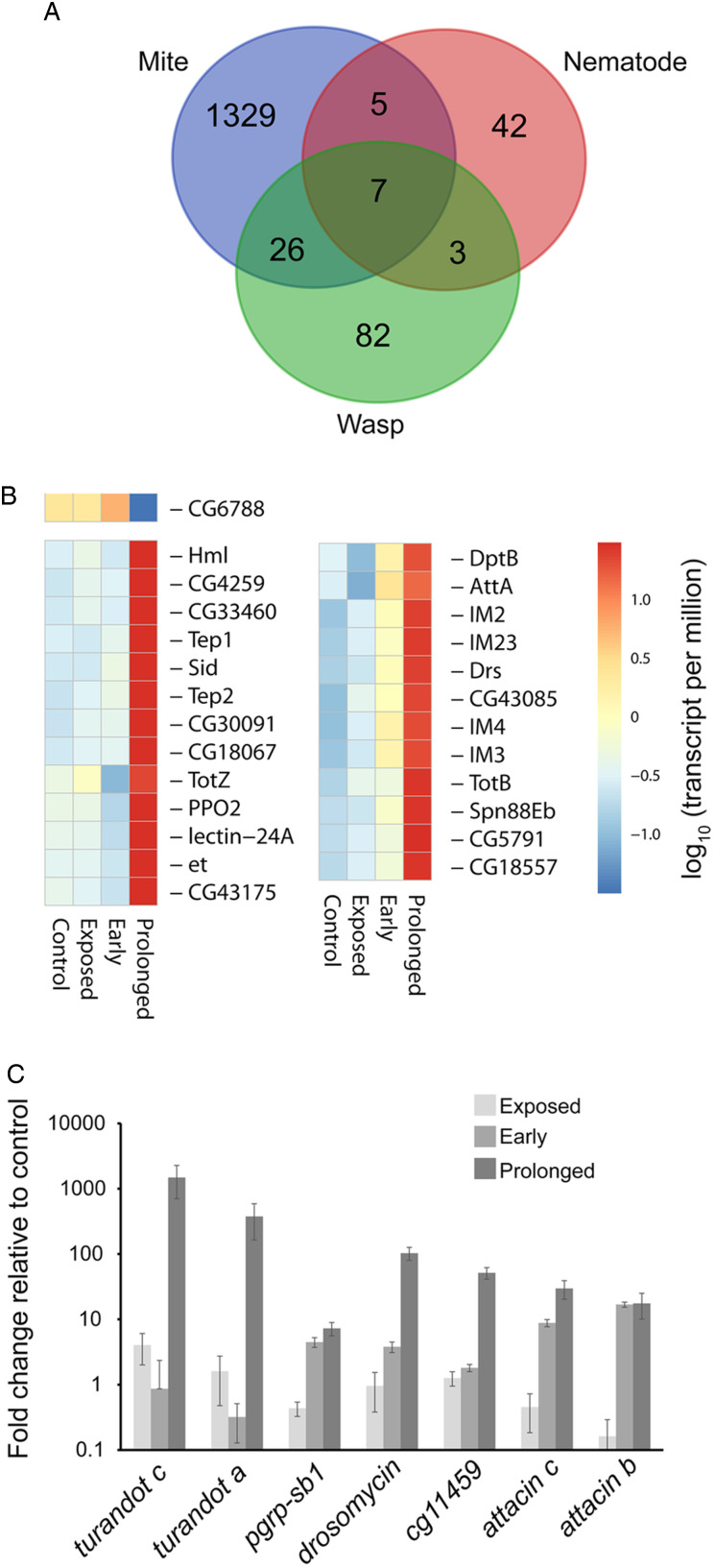
Overlapping expression profiles between D. melanogaster infested with mites, parasitoid wasps and nematodes. (A) Venn diagram for genes with statistically different expression profiles. Seven genes were overlapping between all three treatments. (B, C) Expression profiles of genes that overlap during parasitism by mites, wasps and nematodes in relation to mite, exposure or infestation. RNA-seq results for parasitoid wasps are from Salazar-Jaramillo et al. (2017) and nematodes from Castillo et al. (2015). Gene identifications are based on those available from FlyBase (Thurmond et al., 2019).
Fig. 5.
Fig. 5.
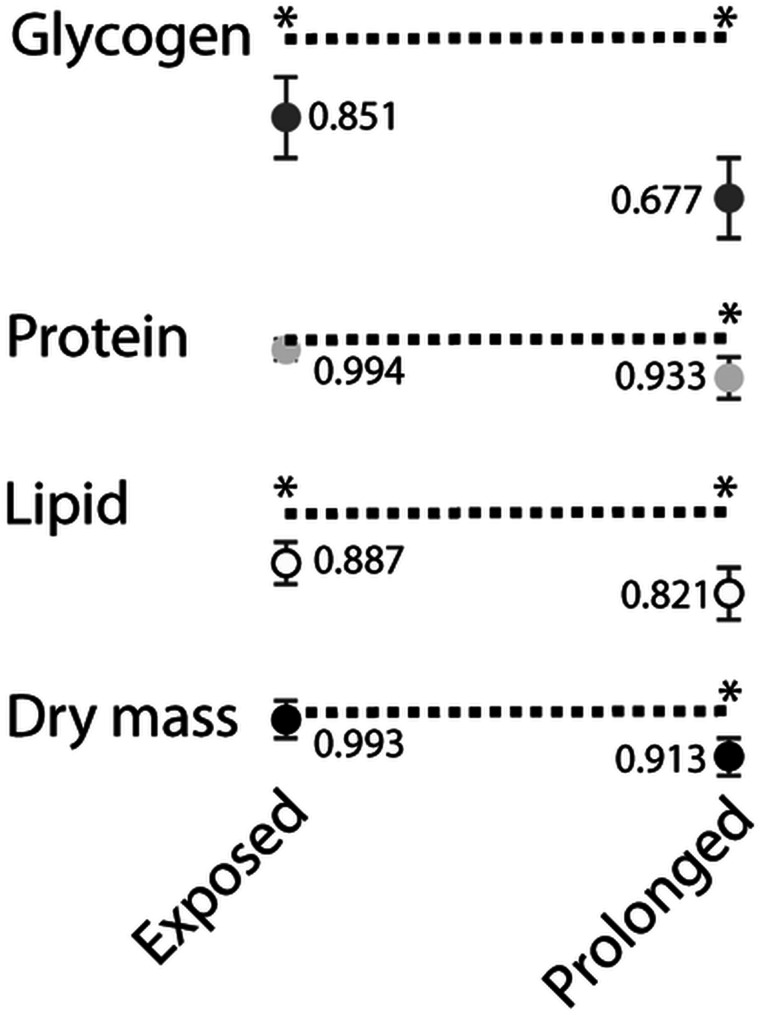
Nutrient reserve levels for flies infested or exposed (but uninfested) to mites. Each number represents the level of a given nutrient expressed as a proportion of the level in control flies which is denoted by the dashed line. * indicates statistical significance in comparison to control. Each point represents the mean ± s.e. of three groups (five flies per group).
Fig. 6.
Fig. 6.
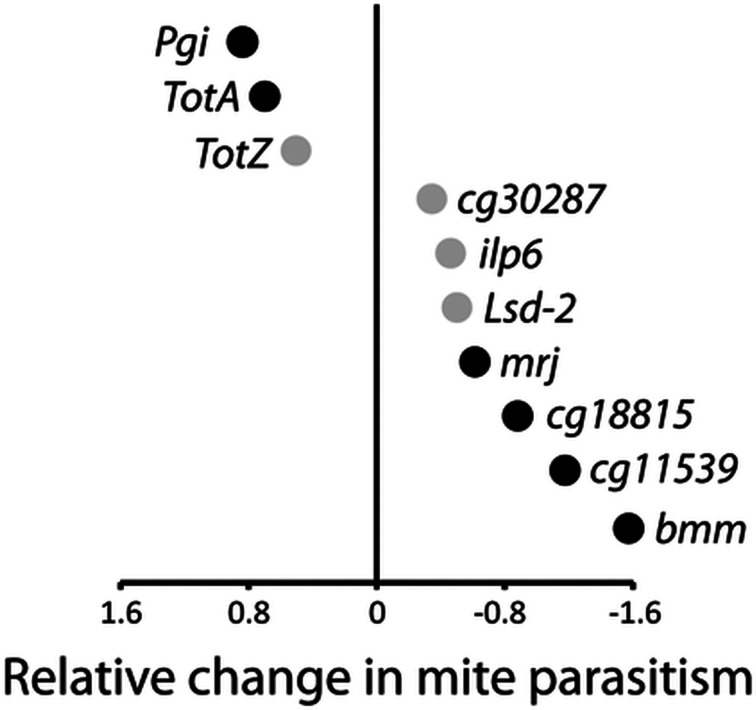
Effects of RNAi of specific genes on parasitism by mites. Values on the x-axis are logistic regression coefficients (see Table S3); negative values indicate that the RNAi line had a lower likelihood of becoming infested than its respective control. Black dots indicate statistically significant contrasts.

References

    1. Bolger M, Lohse M and Usadel B (2014) Trimmomatic: a flexible trimmer for Illumina sequence data. Bioinformatics 30, 2114–2120. - PMC - PubMed
    1. Brix K, Dunkhorst A, Mayer K and Jordans S (2008) Cysteine cathepsins: cellular roadmap to different functions. Biochimie 90, 194–207. - PubMed
    1. Brown JKM and Tellier A (2011) Plant–parasite coevolution: bridging the gap between genetics and ecology. Annual Review of Phytopathology 49, 345–367. - PubMed
    1. Brown JB, Boley N, Eisman R, May GE, Stoiber MH, Duff MO, Booth BW, Wen J, Park S, Suzuki AM, Wan KH, Yu C, Zhang D, Carlson JW, Cherbas L, Eads BD, Miller D, Mockaitis K, Roberts J, Davis CA, Frise E, Hammonds AS, Olson S, Shenker S, Sturgill D, Samsonova AA, Weiszmann R, Robinson G, Hernandez J, Andrews J, Bickel PJ, Carninci P, Cherbas P, Gingeras TR, Hoskins RA, Kaufman TC, Lai EC, Oliver B, Perrimon N, Graveley BR and Celniker SE (2014) Diversity and dynamics of the Drosophila transcriptome. Nature 512, 393–399. - PMC - PubMed
    1. Buzatto BA, Kotiaho JS, Assis LAF and Simmons LW (2019) A link between heritable parasite resistance and mate choice in dung beetles. Behavioral Ecology 30, 1382–1387.

Publication types