Review
. 2020 Oct;45(10):829-844.
doi: 10.1016/j.tibs.2020.05.009. Epub 2020 Jun 1.

Nothing Is Yet Set in (Hi)stone: Novel Post-Translational Modifications Regulating Chromatin Function

Affiliations
Review

Nothing Is Yet Set in (Hi)stone: Novel Post-Translational Modifications Regulating Chromatin Function

Jennifer C Chan et al. Trends Biochem Sci. 2020 Oct.

Abstract

Histone post-translational modifications (PTMs) have emerged as exciting mechanisms of biological regulation, impacting pathways related to cancer, immunity, brain function, and more. Over the past decade alone, several histone PTMs have been discovered, including acylation, lipidation, monoaminylation, and glycation, many of which appear to have crucial roles in nucleosome stability and transcriptional regulation. In this review, we discuss novel histone PTMs identified within the past 10 years, with an extended focus on enzymatic versus nonenzymatic mechanisms underlying modification and adduction. Furthermore, we consider how these novel histone PTMs might fit within the framework of a so-called 'histone code', emphasizing the physiological relevance of these PTMs in metabolism, development, and disease states.

Keywords: acylation; glycation; histone code hypothesis; lipidation; monoaminylation; nonenzymatic adduction.


Figures

Figure 1.
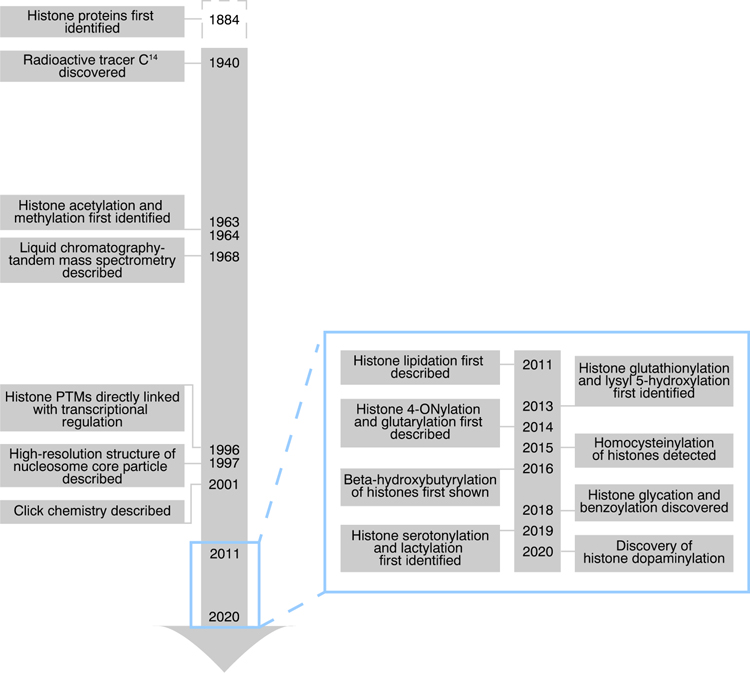
Figure 1.. Selected Milestones in Histone Post-Translational Modification (PTM) Discovery.
Timeline showing a brief history of representative technological advancements that paved the way for histone PTM discovery during the 20th century. Left: In 1884, histone proteins were first identified by A. Kossel using acid extraction on avian red blood cells [96]. In 1940, M. Kamen and S. Ruben synthesized the radioactive isotope carbon-14 (C14) [97]. In 1963–1964, histone lysine acetylation and methylation were first identified using C14 labeling and acid extractions [4,5]. In 1968, V, Tal’Roze et al. described electron ionization, and were the first to report the development of liquid chromatography-tandem mass spectrometry (LC-MS/MS) [98]. In 1996, J. Brownell et al. reported direct evidence that histone acetyltransferase Gcn5 acetylates chromatin to activate gene expression [6] and, in the same year, J. Taunton et al. cloned human histone deacetylase I, previously associated with transcriptional changes [99]. In 1997, K. Luger et al. showed how histone proteins interacted with 146 base pairs of DNA by determining the crystal structure of the nucleosome core particle at 2.8- Å resolution [100]. In 2001, K. Sharpless and colleagues at Scripps Research Institute fully described click chemistry, a term he coined in 1998 [21]. Sky-blue inset: timeline of novel histone PTM discovery over the past decade (2011–mid-2020).
Figure 2.
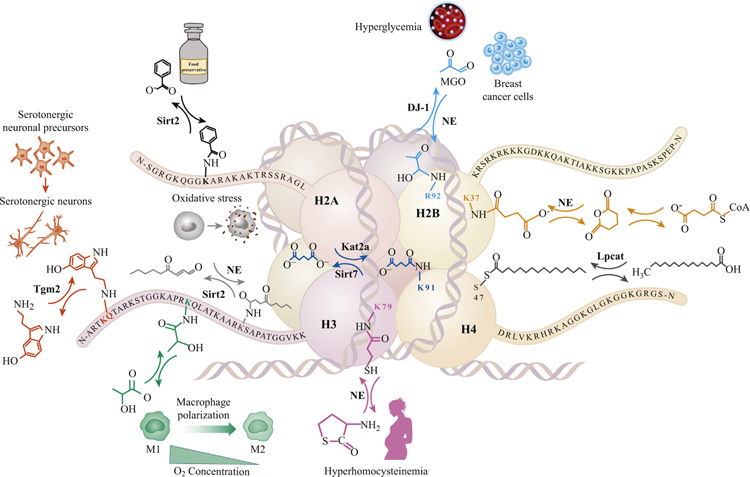
Figure 2.
H2A is modified at lysine (K) 9 by benzoylation, removed by Sirtuin 2 (Sirt2) and influenced by the food preservative sodium benzoate (black). H2B receives nonenzymatic (NE) adduction by (i) succinyl-coA on K37, which undergoes intramolecular catalysis to form a highly reactive electrophilic anhydride (right, orange); and (ii) methylglyoxal (MGO) glycation, prevalent in hyperglycemia and breast cancer tumor cells, on arginine (R) 92 and is removed by the deglyase DJ-1 (sky-blue). H3 is (i) serotonylated by transglutaminase 2 (Tgm2) at glutamine 5, neighboring a methylated lysine 4 (H3 K4me3Q5ser) and is altered by differentiation of serotonergic neuronal precursors (far left, vermilion); (ii) lactylated at H3 K18 under hypoxic conditions and macrophage response to pathogens (blue-green); (iii) adducted by the peroxidized lipid electrophile 4-oxo-2-noneal, 4-ONylating H3 K27 under oxidative stress and can be removed by Sirt2 (left, light gray); and (iv) adducted on the globular site H3 K79 by homocysteine thyolactone, which is increased under conditions of hyperhomocysteinemia (e.g., pregnant women at risk of offspring neural tube defects; red-purple). H4 is (i) lipidated at serine 47 by the enzyme lysophosphatidylcholine acyltransferase 1 (Lpcat1), catalyzing addition of a 16-carbon fatty palmitic acid (right, dark gray); and (ii) glutarylated at H4 K91 by the histone glutaryltransferase Kat2a and removed by Sirtuin 7 (Sirt7, dark blue).

References

    1. Zhao Y et al. (2015) Comprehensive catalog of currently documented histone modifications. Cold Spring Harb. Perspect. Biol 7, a025064. - PMC - PubMed
    1. Kornberg RD et al. (1999) Twenty-five years of the nucleosome, fundamental particle of the eukaryote chromosome. Cell 98, 285–294 - PubMed
    1. Mersfelder EL et al. (2006) The tale beyond the tail: histone core domain modifications and the regulation of chromatin structure. Nucleic Acids Res 34, 2653–2662 - PMC - PubMed
    1. Phillips DM (1963) The presence of acetyl groups of histones. Biochem. J 87, 258–263 - PMC - PubMed
    1. Allfry VG et al. (1964) Acetylation and methylation of histones and their possible role in the regulation of RNA synthesis. Proc. Natl. Acad. Sci. U. S. A 51, 786–794 - PMC - PubMed

Publication types

LinkOut - more resources