. 2020 May 15:11:509.
doi: 10.3389/fpls.2020.00509. eCollection 2020.

Insights Into Genetic and Molecular Elements for Transgenic Crop Development

Affiliations

Insights Into Genetic and Molecular Elements for Transgenic Crop Development

Marcos Fernando Basso et al. Front Plant Sci. .

Abstract

Climate change and the exploration of new areas of cultivation have impacted the yields of several economically important crops worldwide. Both conventional plant breeding based on planned crosses between parents with specific traits and genetic engineering to develop new biotechnological tools (NBTs) have allowed the development of elite cultivars with new features of agronomic interest. The use of these NBTs in the search for agricultural solutions has gained prominence in recent years due to their rapid generation of elite cultivars that meet the needs of crop producers, and the efficiency of these NBTs is closely related to the optimization or best use of their elements. Currently, several genetic engineering techniques are used in synthetic biotechnology to successfully improve desirable traits or remove undesirable traits in crops. However, the features, drawbacks, and advantages of each technique are still not well understood, and thus, these methods have not been fully exploited. Here, we provide a brief overview of the plant genetic engineering platforms that have been used for proof of concept and agronomic trait improvement, review the major elements and processes of synthetic biotechnology, and, finally, present the major NBTs used to improve agronomic traits in socioeconomically important crops.

Keywords: T-DNA delivery; minimal expression cassette; new biotechnological tools; plant genetic transformation; tissue culture.


Figures

FIGURE 1
FIGURE 1
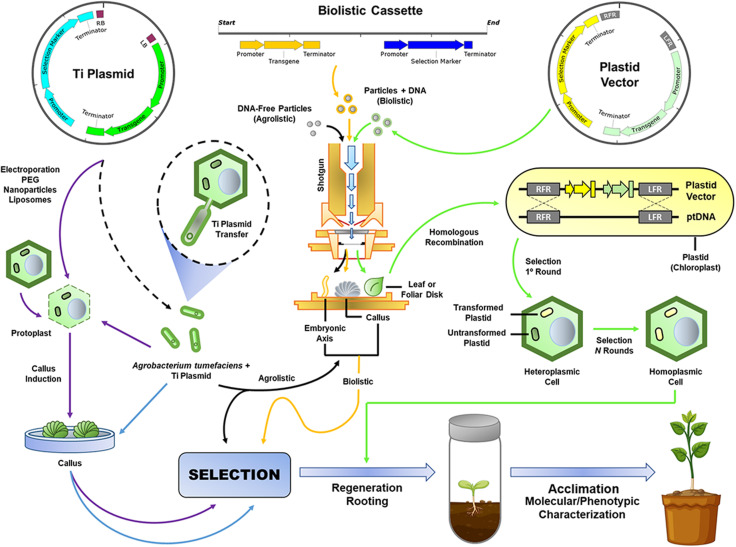
Plant genetic transformation approaches. New biotechnological tools (NBTs) that use mainly the type IV secretion system (T4SS) of A. tumefaciens, biolistic, or agrolistic methods for Ti plasmid or minimal expression cassette delivery to plant cells (e.g., protoplasts) or tissues (e.g., embryogenic callus or axis, apical meristem, and immature leaf whorl cross-sections), and, finally, transformation of the nuclear or plastid genomes. Dotted black arrow: A. tumefaciens transformation with the Ti plasmid; purple arrows: protoplast transformation; blue arrows: Agrobacterium-mediated callus transformation; yellow arrows: biolistic transformation; black arrows: agrolistic transformation; green arrows: plastid transformation; ptDNA: plastid genomic DNA; and Ti Plasmid: tumor-inducing plasmid.
FIGURE 2
FIGURE 2
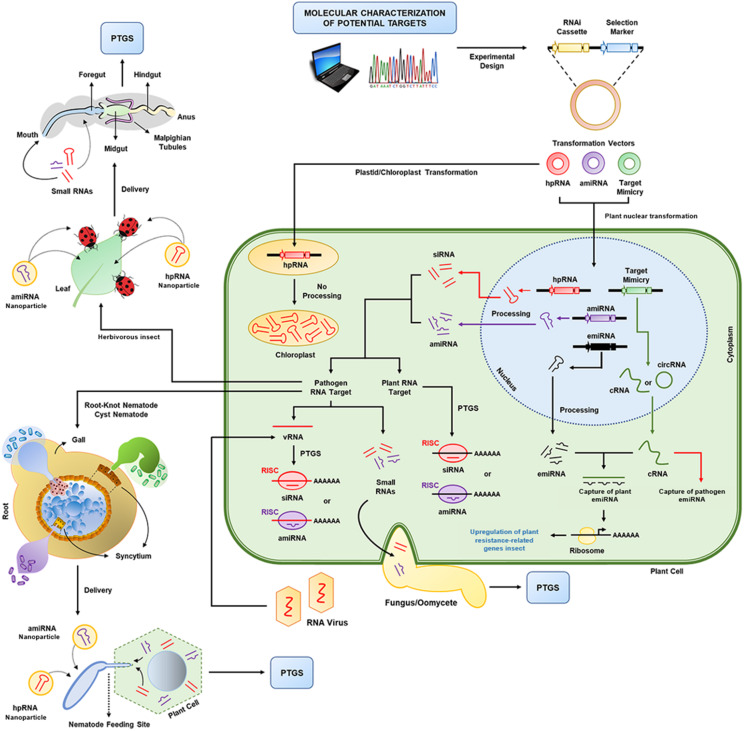
RNA interference (RNAi) technology in plants. After the molecular and phenotypic characterization of potential target genes (from plants or pathogens), expression cassettes are designed for small RNA accumulation in transgenic plants. Here, three transformation vectors for the expression of three different types of small RNAs are shown: hairpin RNA (hpRNA), artificial microRNA (amiRNA) and target mimicry molecules (miRNA sponges), which are called competitive RNAs (cRNAs) or circular RNAs (circRNAs) and can capture plant or pathogen endogenous miRNAs (emiRNAs). After nuclear transformation, these small RNAs are expressed and processed by the plant cell. The short interfering RNAs (siRNAs) and miRNAs produced combine with the plant RNA-induced silencing complex (RISC), which will promote gene knockdown in the plant (e.g., susceptibility genes) or pathogen (e.g., viruses and virulence genes). For extracellular pathogens (e.g., fungi/oomycetes), the small RNAs produced can be transferred at the site of contact between the plant cell and the pathogen. For more complex multicellular eukaryotes (e.g., insects and nematodes), the delivery of small RNAs occurs mainly through feeding. Additionally, non-transgenic approaches based on nanoencapsulation of dsRNAs or small RNAs can be applied to gene knockdown. PTGS: posttranscriptional gene silencing; vRNA: viral RNA.
FIGURE 3
FIGURE 3
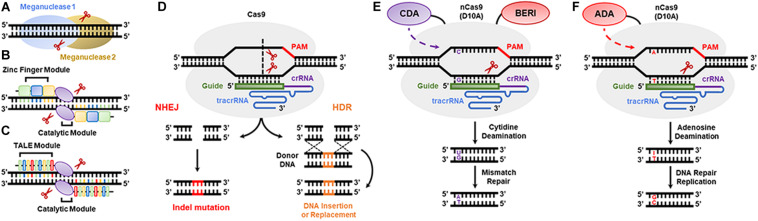
DNA genome editing techniques used in transgenic plant development. (A) Meganucleases, (B) zinc finger nucleases, (C) transcription activator-like effector nuclease (TALEN), (D) the CRISPR/Cas9 system based on non-homologous recombination system (NHEJ) and homology-directed recombination (HDR) strategies, (E) cytidine deaminase-based DNA base editors, and (F) adenosine deaminase-based DNA base editors.
FIGURE 4
FIGURE 4
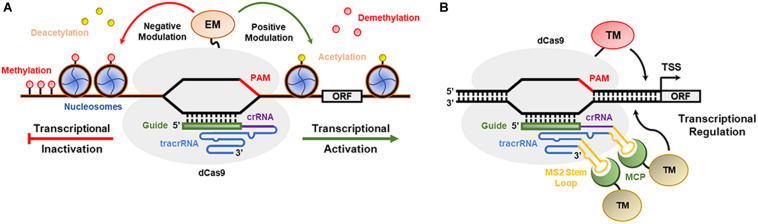
CRISPR-based epigenetic/transcriptional modulation in plants. (A) dCas9 combines with epigenetic modulators (EM) to modulate the formation of euchromatin and heterochromatin in plants. (B) A CRISPR-based transcriptional module is presented with dCas9 anchored in a gene promoter and interacting with transcriptional modulators (TMs).
FIGURE 5
FIGURE 5
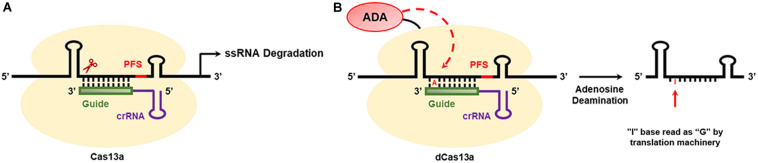
CRISPR/Cas13a-based knockdown and RNA base editing in transgenic plant development. (A) The CRISPR/Cas13a system can be used to degrade specific ssRNAs due to the presence of two higher eukaryotic and prokaryotic nucleotide-binding endo-RNase domains and the absence of a DNase catalytic site. (B) The dCas13a nuclease (with RNAse domains mutated) can be fused to specific deaminase domains to promote single-base editing. So far, the deaminase domain most successfully fused to the Cas13a nuclease was that of an adenosine deaminase (ADA), specifically, the ADAR2 domain, which is capable of converting adenosine (A) to inosine (I), which in turn is recognized as guanine (G) by the translation machinery, in ssRNA molecules.
FIGURE 6
FIGURE 6
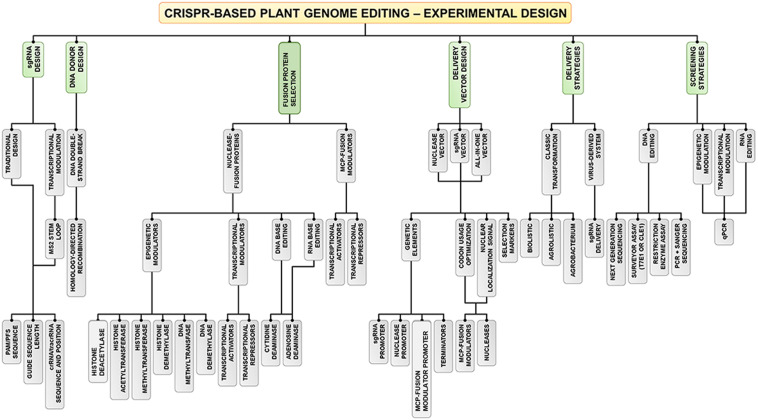
Flowchart of the suggested pipeline for CRISPR-based transgenic plant development. After a preliminary analysis of the region of the target genome that will be edited, a nuclease (Cas9, Cpf1, Cms1, Cas13a, among others) or nuclease variant (nickase or dead) should be chosen. This choice must be based on both the molecular and phenotypic responses expected from the transgenic plant, as well as on the strategy (gene overexpression, knockdown, or knockout) and the sgRNA characteristics required for each of the nucleases, such as the presence/absence and position of crRNA/tracrRNA, in addition to the PAM sequence (Cas9, Cpf1, Cms1, among others) or PFS (Cas13a).
FIGURE 7
FIGURE 7
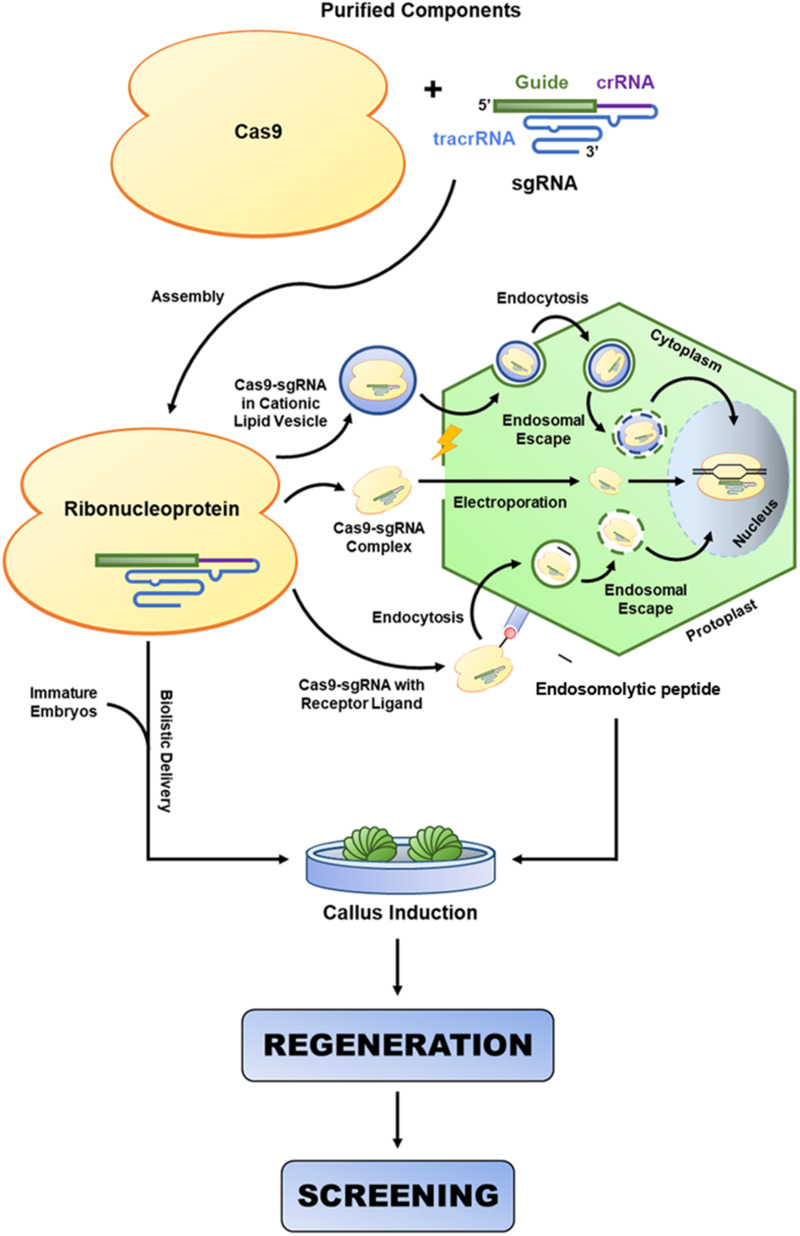
Ribonucleoprotein (RNP)-mediated plant genome editing. The experimental design starts with the design of the sgRNA, which is then transcribed in vitro and purified. In parallel, the Cas9 nuclease is expressed in a heterologous system and purified. After the purification and assembly of these two components (Cas9 and sgRNA), the ribonucleoprotein complex or ribonucleoprotein (RNP) can be delivered to the plant cell in several ways: (i) via electroporation; (ii) via cationic lipid vesicles; and (iii) via ligand-receptor interactions. These three RNP delivery methodologies are most commonly used in in vitro studies with protoplasts, and (ii) and (iii) deliver the complex via endocytosis. A fourth delivery methodology was recently presented in which the RNP is applied to coat tungsten or gold particles, and this conjugate is used to transform immature plant embryos (biolistic technique). In all these systems, after delivery, callus formation is induced for subsequent plant regeneration. Finally, the regenerated seedlings are subjected to screening steps, such as an initial PCR amplification of the DNA target region followed by Sanger sequencing and subsequent confirmation by next-generation sequencing (NGS). The advantages of this technology are that it is DNA-free and selection-marker-free, in addition to avoiding possible undesirable effects caused by constitutive Cas9 expression in the edited plants.

References

    1. Abdollahi M. R., Moieni A., Salmanian A. H., Mousavi A. (2009). Secondary embryogenesis and transient expression of the β-glucuronidase gene in hypocotyls of rapeseed microspore-derived embryos. Biol. Plant. 53:573. 10.1007/BF00225896 - DOI - PubMed
    1. Abudayyeh O. O., Gootenberg J. S., Essletzbichler P., Han S., Joung J., Belanto J. J., et al. (2017). RNA targeting with CRISPR-Cas13. Nature 550 280–284. 10.1038/nature24049 - DOI - PMC - PubMed
    1. Adem M., Beyene D., Feyissa T. (2017). Recent achievements obtained by chloroplast transformation. Plant Methods 13:30. 10.1186/s13007-017-0179-1 - DOI - PMC - PubMed
    1. Agarwal P. K., Gupta K., Lopato S., Agarwal P. (2017). Dehydration responsive element binding transcription factors and their applications for the engineering of stress tolerance. J. Exp. Bot. 68 2135–2148. 10.1093/jxb/erx118 - DOI - PubMed
    1. Aggarwal P. R., Nag P., Choudhary P., Chakraborty N., Chakraborty S. (2018). Genotype-independent Agrobacterium rhizogenes-mediated root transformation of chickpea: a rapid and efficient method for reverse genetics studies. Plant Methods 14:55. 10.1186/s13007-018-0315-6 - DOI - PMC - PubMed

LinkOut - more resources