Review
. 2020 May 19;1(2):100019.
doi: 10.1016/j.xcrm.2020.100019. Epub 2020 May 1.

Down Syndrome and COVID-19: A Perfect Storm?

Affiliations
Review

Down Syndrome and COVID-19: A Perfect Storm?

Joaquin M Espinosa. Cell Rep Med. .

Abstract

People with Down syndrome show signs of chronic immune dysregulation, including a higher prevalence of autoimmune disorders, increased rates of hospitalization during respiratory viral infections, and higher mortality rates from pneumonia and sepsis. At the molecular and cellular levels, they show markers of chronic autoinflammation, including interferon hyperactivity, elevated levels of many inflammatory cytokines and chemokines, and changes in diverse immune cell types reminiscent of inflammatory conditions observed in the general population. However, the impact of this immune dysregulation in severe acute respiratory syndrome coronavirus 2 (SARS-CoV-2) infection and CoV disease of 2019 (COVID-19) remains unknown. This Perspective outlines why individuals with Down syndrome should be considered an at-risk population for severe COVID-19. Specifically, the immune dysregulation caused by trisomy 21 may result in an exacerbated cytokine release syndrome relative to that observed in the euploid population, thus justifying additional monitoring and specialized care for this vulnerable population.


Conflict of interest statement

The author is listed as a co-inventor in provisional patents for strategies to attenuate the cytokine storm in COVID-19.

Figures
None
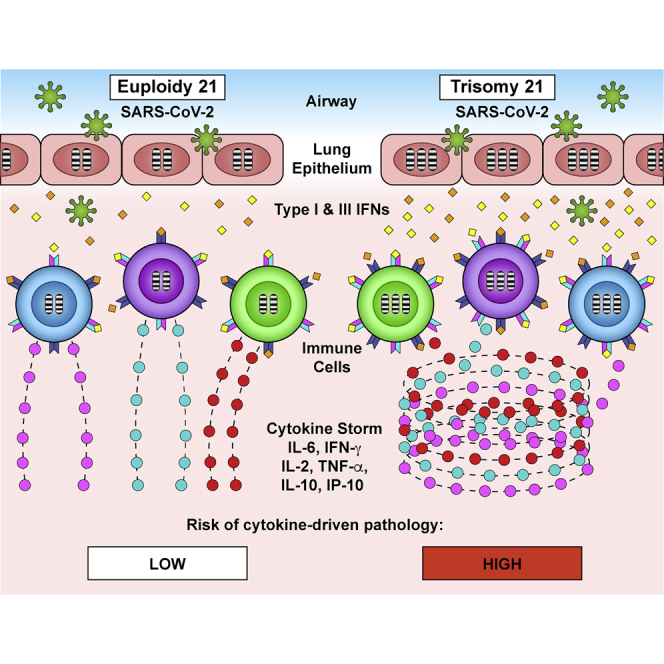
Graphical abstract
Figure 1
Figure 1
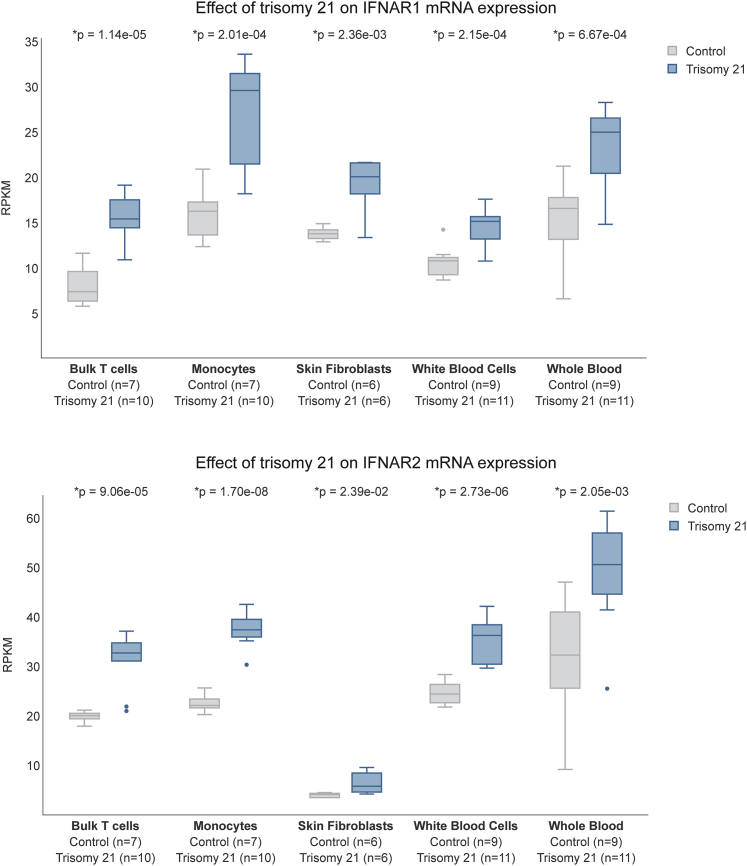
Individuals with Down Syndrome Overexpress IFN Receptors Box and whisker plots displaying mRNA expression for the type I IFNRs encoded on chromosome 21, IFNAR1 and IFNAR2. Data are presented in reads per kilobase of transcripts per million (RPKM) mapped reads. Data were generated via RNA sequencing (RNA-seq) transcriptome analysis as described by Araya et al., Sullivan et al., and Powers et al. p values were calculated with the Student’s t test. All of the boxplots show median, 25th, and 75th percentile values. Error bars are 1.5 times the interquartile range (IQR) or the maximum data point if <1.5 IQR. Data are publicly available in the research portal TrisomExplorer at http://explorer.trisome.org/transcriptome/.
Figure 2
Figure 2
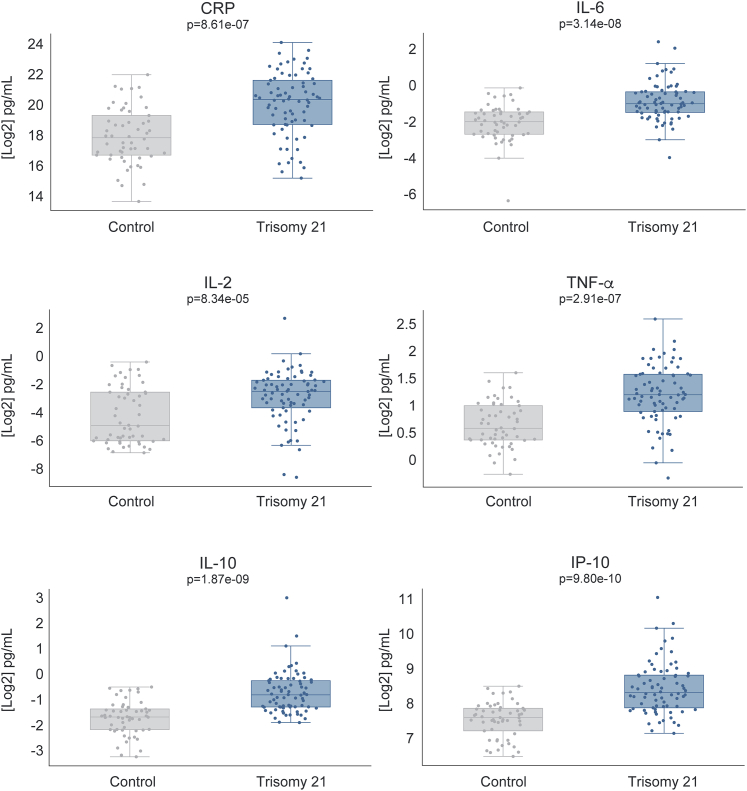
Elevated Baseline Cytokine Levels in Individuals with Down Syndrome Box and whisker plots showing cytokine levels in typical people versus people with Down syndrome. Plasma cytokine levels were measured using the Meso Scale Discovery V-PLEX 54-PLEX Human Cytokine Kit and a U-PLEX custom array, as described in Powers et al. All p values were calculated using a Kolmogorov-Smirnov (KS) test. All of the boxplots show median, 25th, and 75th percentile values. Error bars are 1.5 times the IQR or the maximum data point if <1.5 IQR. Data are publicly available at http://explorer.trisome.org/proteome/.
Figure 3
Figure 3
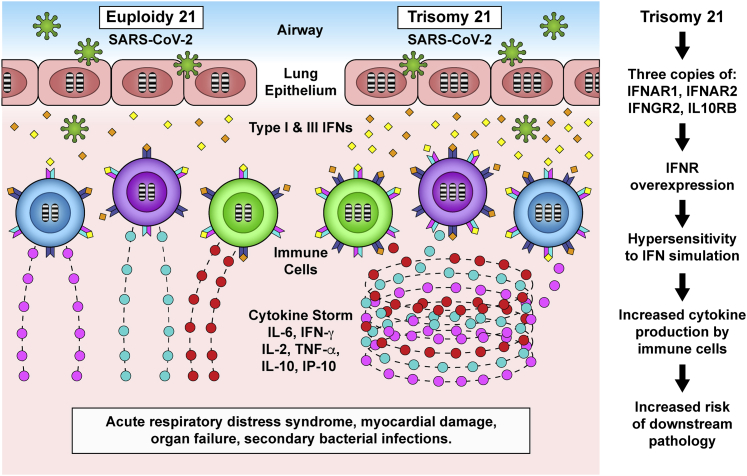
Proposed Model of the Impact of Trisomy 21 on the COVID-19 Pathological Cascade Trisomy 21 involves triplication of 4 IFN receptors, the type I IFN receptors IFNAR1 and IFNAR2, the type II IFN receptor IFNGR2, and the type III IFN receptor IL10RB. IFN receptor overexpression leads to hypersensitivity to type I and type III IFNs upon exposure of lung epithelial cells to SARS-CoV-2. Key immune cell types of people with Down syndrome, including dendritic cells and T cells, display changes indicative of hyperactivation and increased differentiation toward inflammatory states even before SARS-CoV-2 infection. This heightened immune activity could predispose the immune system of individuals with Down syndrome to cytokine overproduction and an increased risk of acute respiratory distress syndrome, myocardial damage, organ failure, and secondary bacterial infections.

References

    1. Iughetti L., Predieri B., Bruzzi P., Predieri F., Vellani G., Madeo S.F., Garavelli L., Biagioni O., Bedogni G., Bozzola M. Ten-year longitudinal study of thyroid function in children with Down’s syndrome. Horm. Res. Paediatr. 2014;82:113–121. - PubMed
    1. Aversa T., Valenzise M., Salerno M., Corrias A., Iughetti L., Radetti G., De Luca F., Wasniewska M. Metamorphic thyroid autoimmunity in Down Syndrome: from Hashimoto’s thyroiditis to Graves’ disease and beyond. Ital. J. Pediatr. 2015;41:87. - PMC - PubMed
    1. Pierce M.J., LaFranchi S.H., Pinter J.D. Characterization of Thyroid Abnormalities in a Large Cohort of Children with Down Syndrome. Horm. Res. Paediatr. 2017;87:170–178. - PMC - PubMed
    1. Carlsson A., Axelsson I., Borulf S., Bredberg A., Forslund M., Lindberg B., Sjöberg K., Ivarsson S.A. Prevalence of IgA-antigliadin antibodies and IgA-antiendomysium antibodies related to celiac disease in children with Down syndrome. Pediatrics. 1998;101:272–275. - PubMed
    1. Pueschel S.M., Romano C., Failla P., Barone C., Pettinato R., Castellano Chiodo A., Plumari D.L. A prevalence study of celiac disease in persons with Down syndrome residing in the United States of America. Acta Paediatr. 1999;88:953–956. - PubMed