. 2020 Oct 1;202(7):1013-1023.
doi: 10.1164/rccm.201911-2151OC.

Age-associated B Cells Appear in Patients with Granulomatous Lung Diseases

Affiliations

Age-associated B Cells Appear in Patients with Granulomatous Lung Diseases

Swati Phalke et al. Am J Respir Crit Care Med. .

Abstract

Rationale: A subpopulation of B cells (age-associated B cells [ABCs]) is increased in mice and humans with infections or autoimmune diseases. Because depletion of these cells might be valuable in patients with certain lung diseases, the goal was to find out if ABC-like cells were at elevated levels in such patients.Objectives: To measure ABC-like cell percentages in patients with lung granulomatous diseases.Methods: Peripheral blood and BAL cells from patients with sarcoidosis, beryllium sensitivity, or hypersensitivity pneumonitis and healthy subjects were analyzed for the percentage of B cells that were ABC-like, defined by expression of CD11c, low levels of CD21, FcRL 1-5 (Fc receptor-like protein 1-5) expression, and, in some cases, T-bet.Measurements and Main Results: ABC-like cells in blood were at low percentages in healthy subjects and higher percentages in patients with sarcoidosis as well as at high percentages among BAL cells of patients with sarcoidosis, beryllium disease, and hypersensitivity pneumonitis. Treatment of patients with sarcoidosis led to reduced percentages of ABC-like cells in blood.Conclusions: Increased levels of ABC-like cells in patients with sarcoidosis may be useful in diagnosis. The increase in percentage of ABC-like cells in patients with lung granulomatous diseases and decrease in treated patients suggests that depletion of these cells may be valuable.

Keywords: age-associated B cells (ABCs); beryllium sensitivity; chronic beryllium disease; hypersensitivity pneumonitis; sarcoidosis.


Figures
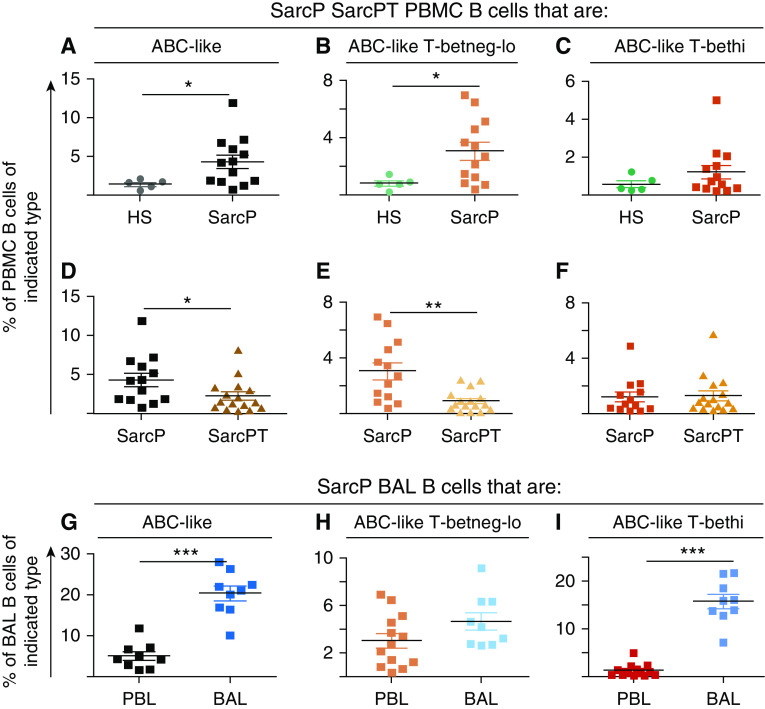
Figure 1.
Figure 1.
Age-associated B cell (ABC)-like cells are enriched in the peripheral blood mononuclear cells (PBMCs) and BAL of patients with sarcoidosis and are reduced in percentage in patients on therapy. PBMCs and BAL cells were obtained from healthy subjects (HSs), sarcoidosis patients not on treatment (SarcPs), and sarcoidosis patients on treatment (SarcPTs) as described in Methods. The treatment protocols and data for the patients are listed in Table 1. Cells were stained as described in Methods, and staining was detected on a CyAn (Beckman Coulter) instrument. Data were analyzed using FlowJo software (Tree Star). The percentage of PBMC B cells from HSs and SarcPs that were (A) ABC-like, (B) ABC-like T-betneg-lo, and (C) ABC-like T-bethi are shown. The results in each panel were analyzed using Mann-Whitney tests. (DF) Data are as described for AC, except each panel compares data for each cell type for SarcPs and SarcPTs. (G–I) Data are as described for AC, except each panel contains data for the indicated cell types from the B cells in PBMCs of SarcPs and B cells in BAL from the same patients. *P < 0.05, **P < 0.01, and ***P < 0.001. PBL = peripheral blood lymphocytes.
Figure 2.
Figure 2.
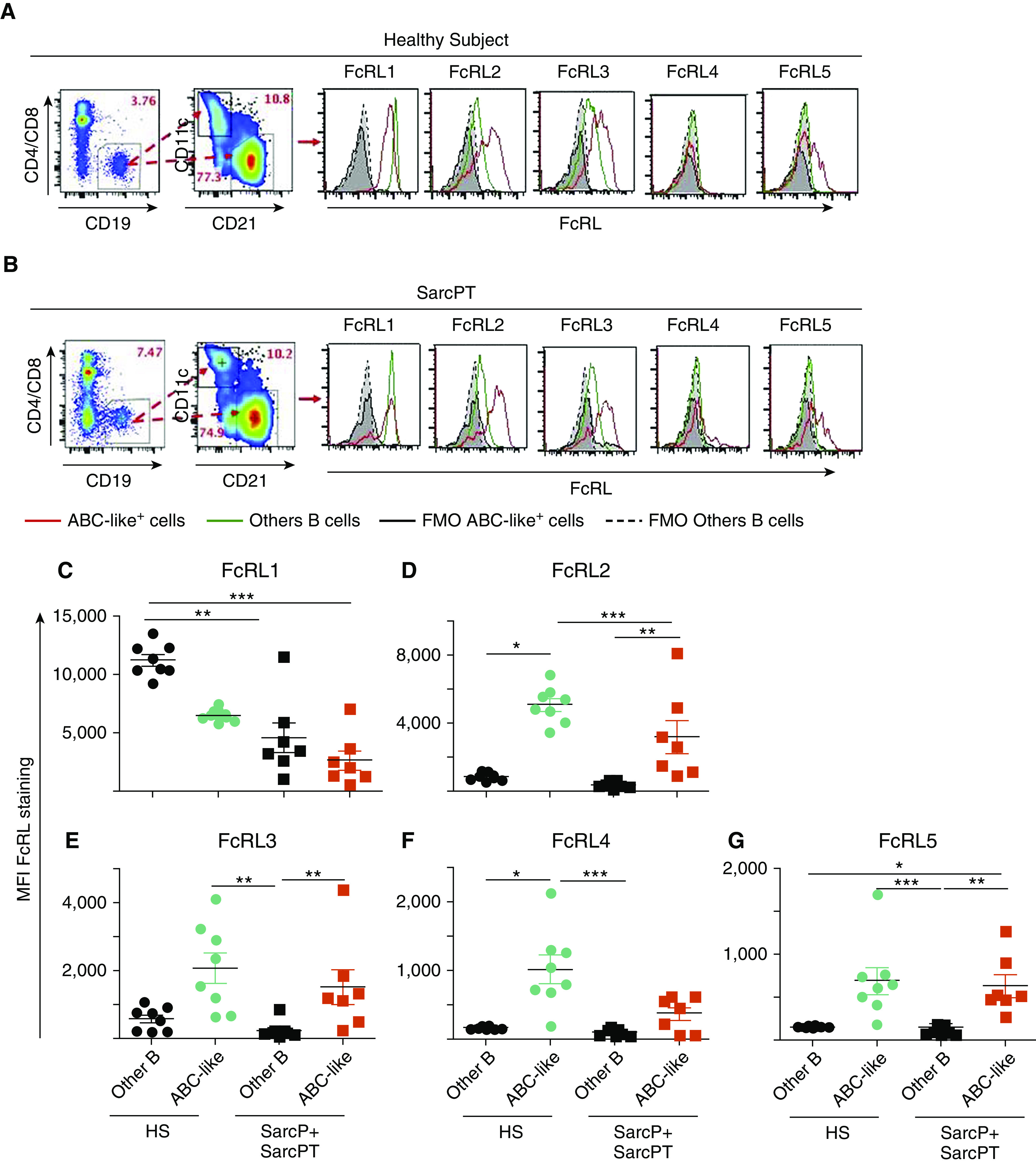
FcRL 1 (Fc receptor–like protein 1) is expressed at lower levels, and FcRLs 2 and 5 are expressed at higher levels on age-associated B cell (ABC)-like cells than on B cells that are not ABC-like regardless of whether the cells were obtained from healthy subjects (HSs), sarcoidosis patients not on treatment (SarcPs), or sarcoidosis patients on treatment (SarcPTs). Patient abbreviations are as described in the legend to Figure 1. Peripheral blood mononuclear cells from an HS and SarcPT were stained to define B cells that were not ABC-like (CD19+, CD11cneg CD21med-hi,) and ABC-like cells (CD19+ CD11c+ CD21lo). The different types of B cells were gated, and their levels of expression of FcRLs1–5, using phycoerythrin-labeled antibodies, are shown. (A and B) For each sample, the percentages of peripheral blood mononuclear cells that were B cells and the percentages of B cells that were or were not ABC-like are shown by numbers in red on the figures. Staining of the different types of B cells with the various anti-FcRL antibodies are shown in the histograms. The origins of the cells (HS or SarcP + SarcPT) are shown. (A) Sample from an HS. (B) Sample from a SarcPT. (CG) The levels of intensity of staining with anti-FcRL antibodies of B cells that were not ABC-like and were ABC-like are shown. Staining was with antibody against: (C) FcRL1, (D) FcRL2, (E) FcRL3, (F) FcRL4, and (G) FcRL5. Data were analyzed with Kruskal-Wallis tests with Dunn’s post hoc tests. *P < 0.05, **P < 0.01, and ***P < 0.001. FMO = fluorescence minus one; MFI = mean fluorescent intensity.
Figure 3.
Figure 3.
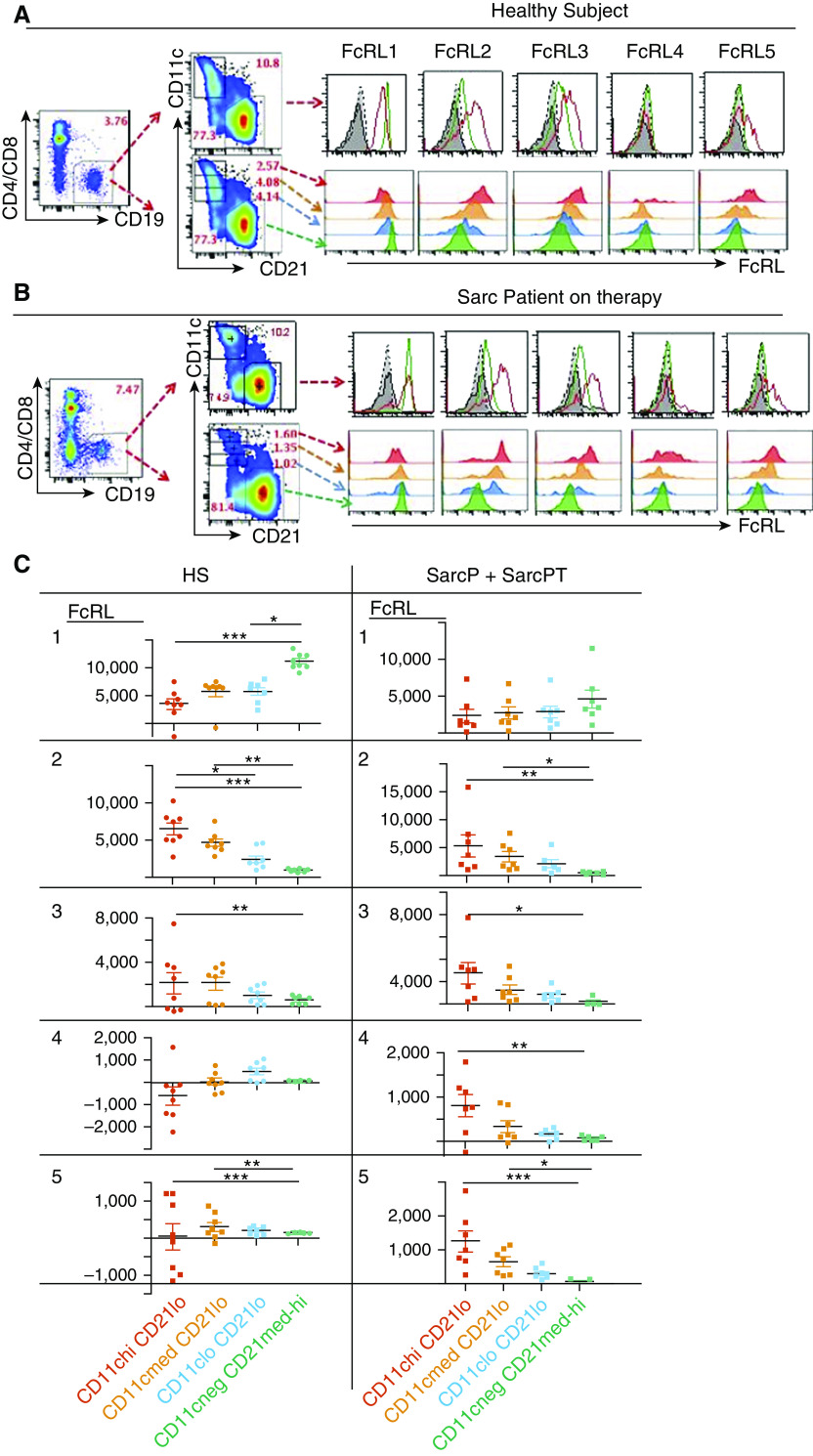
In sarcoidosis patients not on treatment (SarcPs) plus sarcoidosis patients on treatment (SarcPTs), levels of expression of FcRLs 2–5 (Fc receptor–like proteins 2–5) on age-associated B cell (ABC)-like cells correlate with those of CD11c. Patient abbreviations are as described in the legend to Figure 1. Cells were stained as described in the legend to Figure 2 and gated according to the levels of CD11c they bore. (A) Example of cells from a healthy subject. (B) Example of cells from a SarcPT. Staining of B cells that were not ABC-like and ABC-like cells and fluorescence minus one (staining levels in the channel that would be detecting the anti-FcRL antibodies in the absence of anti-FcRL antibodies in the sample) were as described in the legend to Figure 2. (C) The intensities of staining with antibodies against different FcRLs of ABC-like cells expressing different levels of CD11c and of B cells that were not ABC-like are shown. Staining levels with phycoerythrin isotype controls were subtracted from those with phycoerythrin-labeled anti-FcRLs. All but one of the SarcPs analyzed were on therapy. Data were analyzed with Kruskal-Wallis tests with Dunn’s post hoc tests. *P < 0.05, **P < 0.01, and ***P < 0.001. HS = healthy subject.
Figure 4.
Figure 4.
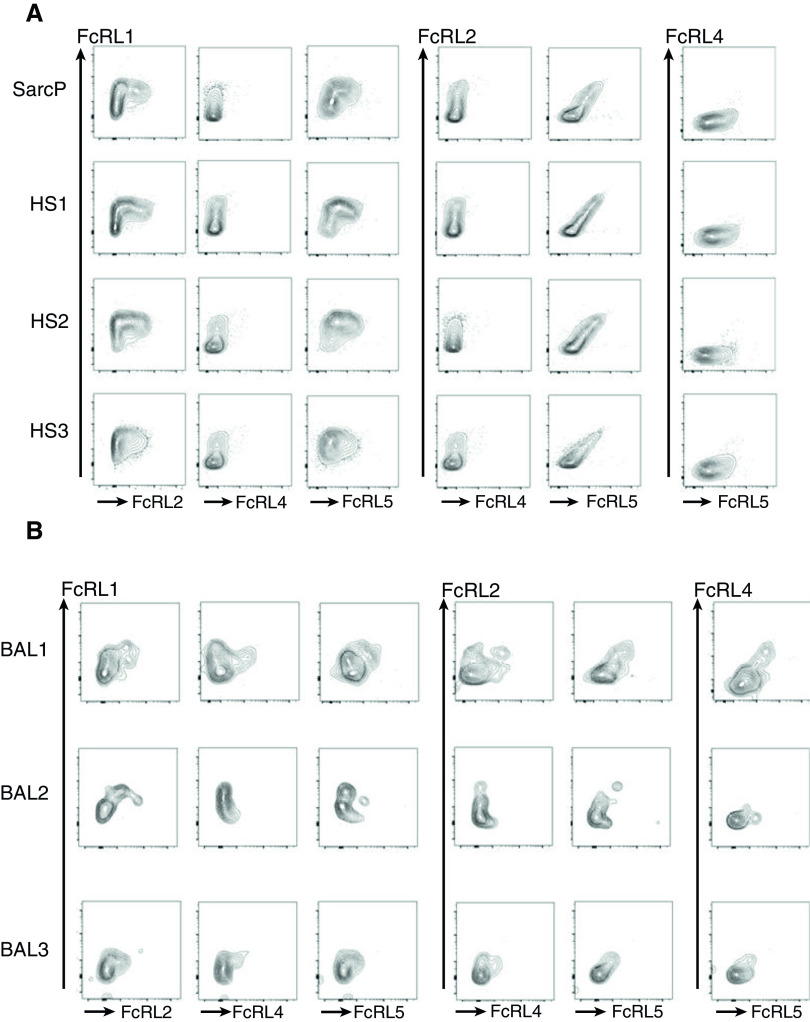
Correlation of levels of FcRLs (Fc receptor–like proteins) on peripheral blood mononuclear cells and BAL. Patient abbreviations are as described in the legend to Figure 1. (A) Peripheral blood mononuclear cells from three healthy subjects and one sarcoidosis patient not on treatment (SarcP) were stained as described in Methods, such that age-associated B cells could be identified and their levels of all five of the FcRLs analyzed with a single stain set. Data show the levels of expression of each FcRL with respect to that of each of the other FcRLs. Data for FcRL3 are not shown because, with this stain set, FcRL3 could not be detected. (B) Data shown are for BAL isolated from three different SarcPs. HS = healthy subject.
Figure 5.
Figure 5.
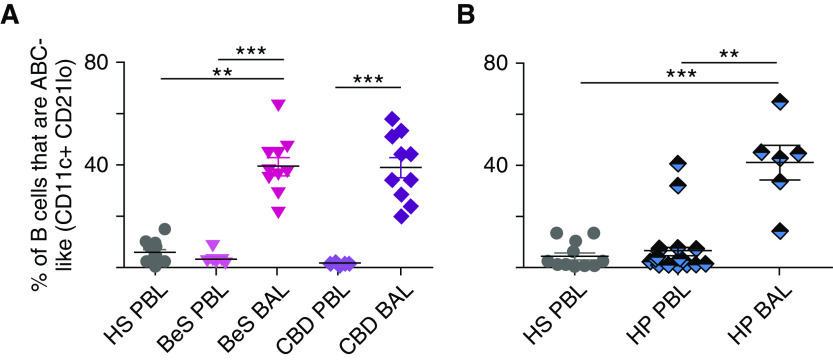
A high percentage of B cells in the BAL of patients with beryllium sensitivity (BeS), chronic beryllium disease (CBD), or hypersensitivity pneumonitis (HP) are age-associated B cell (ABC)-like cells. (A) ABC-like cells in the peripheral blood mononuclear cells or BAL of patients with BeS or CBD were stained as described in the legend to Figure 1. (B) ABC-like cells in the peripheral blood mononuclear cells or BAL of HP were stained as described in the legend to Figure 1. Data were analyzed using Kruskal-Wallis tests with Dunn’s post hoc tests. **P < 0.01 and ***P < 0.001. HS = healthy subject; PBL = peripheral blood lymphocytes.

Comment in

References

    1. Arumugakani G, Wood PM, Carter CR. Frequency of Treg cells is reduced in CVID patients with autoimmunity and splenomegaly and is associated with expanded CD21lo B lymphocytes. J Clin Immunol. 2010;30:292–300. - PubMed
    1. Ferre EM, Rose SR, Rosenzweig SD, Burbelo PD, Romito KR, Niemela JE, et al. Redefined clinical features and diagnostic criteria in autoimmune polyendocrinopathy-candidiasis-ectodermal dystrophy. JCI Insight. 2016;1:e88782. - PMC - PubMed
    1. Habibi S, Zaki-Dizaji M, Rafiemanesh H, Lo B, Jamee M, Gámez-Díaz L, et al. Clinical, immunologic, and molecular spectrum of patients with lps-responsive beige-like anchor protein deficiency: a systematic review. J Allergy Clin Immunol Pract. 2019;7:2379–2386, e5. - PubMed
    1. Hao Y, O’Neill P, Naradikian MS, Scholz JL, Cancro MP. A B-cell subset uniquely responsive to innate stimuli accumulates in aged mice. Blood. 2011;118:1294–1304. - PMC - PubMed
    1. Ho J, Moir S, Malaspina A, Howell ML, Wang W, DiPoto AC, et al. Two overrepresented B cell populations in HIV-infected individuals undergo apoptosis by different mechanisms. Proc Natl Acad Sci USA. 2006;103:19436–19441. - PMC - PubMed

Publication types

MeSH terms