


Conversion of Cannabidiol (CBD) into Psychotropic Cannabinoids Including Tetrahydrocannabinol (THC): A Controversy in the Scientific Literature
- PMID: 32503116
- PMCID: PMC7357058
- DOI: 10.3390/toxics8020041
Conversion of Cannabidiol (CBD) into Psychotropic Cannabinoids Including Tetrahydrocannabinol (THC): A Controversy in the Scientific Literature
Abstract
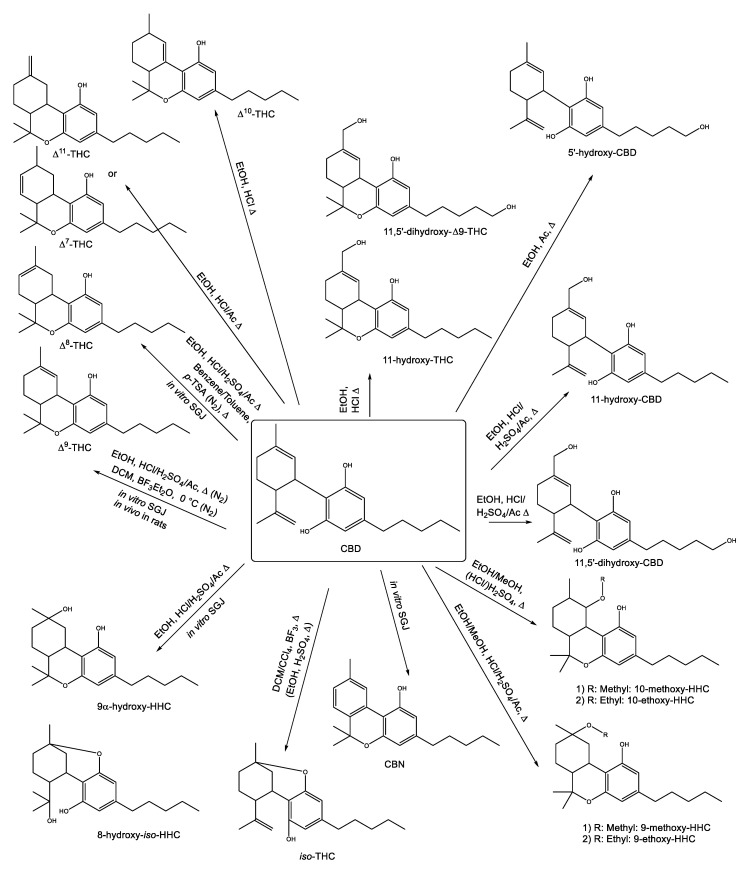
Cannabidiol (CBD) is a naturally occurring, non-psychotropic cannabinoid of the hemp plant Cannabis sativa L. and has been known to induce several physiological and pharmacological effects. While CBD is approved as a medicinal product subject to prescription, it is also widely sold over the counter (OTC) in the form of food supplements, cosmetics and electronic cigarette liquids. However, regulatory difficulties arise from its origin being a narcotic plant or its status as an unapproved novel food ingredient. Regarding the consumer safety of these OTC products, the question whether or not CBD might be degraded into psychotropic cannabinoids, most prominently tetrahydrocannabinol (THC), under in vivo conditions initiated an ongoing scientific debate. This feature review aims to summarize the current knowledge of CBD degradation processes, specifically the results of in vitro and in vivo studies. Additionally, the literature on psychotropic effects of cannabinoids was carefully studied with a focus on the degradants and metabolites of CBD, but data were found to be sparse. While the literature is contradictory, most studies suggest that CBD is not converted to psychotropic THC under in vivo conditions. Nevertheless, it is certain that CBD degrades to psychotropic products in acidic environments. Hence, the storage stability of commercial formulations requires more attention in the future.
Keywords: Cannabis sativa; cannabidiol; degradation; psychotropic effects; tetrahydrocannabinol.
Conflict of interest statement
The authors declare no conflict of interest.
Figures
References
-
- Lachenmeier D.W., Rajcic de Rezende T., Habel S., Sproll C., Walch S.G. Aktuelle Rechtsprechung bestätigt Novel-Food-Einstufung von Hanfextrakten und Cannabidiol (CBD) in Lebensmitteln—Betäubungsmitteleinstufung von Cannabislebensmitteln ist weiterhin unklar. Deut. Lebensm. Rundsch. 2020;116:111–119. doi: 10.5281/zenodo.3631608. - DOI
-
- UN General Assembly . Protocol Amending the Single Convention on Narcotic Drugs, 1961. United Nations; New York, NY, USA: 1972. - PubMed
-
- Lachenmeier D.W. Hanfhaltige Lebensmittel—Ein Problem? Deut. Lebensm. Rundsch. 2004;100:481–490. doi: 10.5281/zenodo.3384641. - DOI
Publication types
LinkOut - more resources
Full Text Sources
Other Literature Sources
