


Assessing Climate Change Impact on Ecosystems and Infectious Disease: Important Roles for Genomic Sequencing and a One Health Perspective
- PMID: 32503239
- PMCID: PMC7345041
- DOI: 10.3390/tropicalmed5020090
Assessing Climate Change Impact on Ecosystems and Infectious Disease: Important Roles for Genomic Sequencing and a One Health Perspective
Abstract
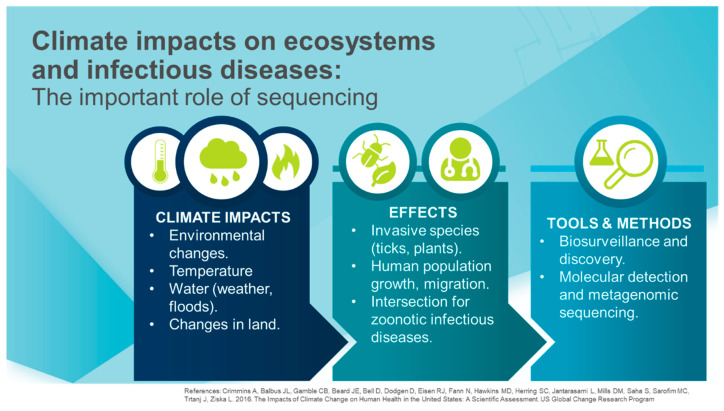
Changes in the Earth's climate and weather continue to impact the planet's ecosystems, including the interface of infectious disease agents with their hosts and vectors. Environmental disasters, natural and human-made activities raise risk factors that indirectly facilitate infectious disease outbreaks. Subsequently, changes in habitat, displaced populations, and environmental stresses that affect the survival of species are amplified over time. The recurrence and spread of vector-borne (e.g., mosquito, tick, aphid) human, animal, and plant pathogens to new geographic locations are also influenced by climate change. The distribution and range of humans, agricultural animals and plants, wildlife and native plants, as well as vectors, parasites, and microbes that cause neglected diseases of the tropics as well as other global regions are also impacted. In addition, genomic sequencing can now be applied to detect signatures of infectious pathogens as they move into new regions. Molecular detection assays complement metagenomic sequencing to help us understand the microbial community found within the microbiomes of hosts and vectors, and help us uncover mechanistic relationships between climate variability and pathogen transmission. Our understanding of, and responses to, such complex dynamics and their impacts can be enhanced through effective, multi-sectoral One Health engagement coupled with applications of both traditional and novel technologies. Concerted efforts are needed to further harness and leverage technology that can identify and track these impacts of climate changes in order to mitigate and adapt to their effects.
Keywords: One Health; biosecurity; climate change impact; genome; infectious disease; sequencing.
Conflict of interest statement
The authors declare no conflict of interest.
Figures
References
-
- Marjoram T. Silk Roads for the 21st Century: Engineering Mega-Infrastructure for Development and Sustainability. Front. Eng. Manag. 2016;3:187–196. doi: 10.15302/J-FEM-2016038. - DOI
-
- Stack J.P., Fletcher J., Gullino M.L. Climate Change and Plant Biosecurity: A New World Disorder? In: Mass A., Bodó B., Burnley C., Comardicea I., Roffey R., editors. Global Environmental Changes: New Drivers for Resistance, Crime and Terrorism. Nomos; Baden-Baden, Germany: 2013. pp. 161–181.
-
- Mirski T., Bartoszcze M., Bielawska-Drózd A. Impact of Climate Change on Infectious Diseases. Pol. J. Environ. Stud. 2012;21:525–532.
-
- CNA Military Advisory Board National Security and the Accelerating Risks of Climate Change. [(accessed on 20 November 2019)]; Available online: https://www.cna.org/cna_files/pdf/MAB_5-8-14.pdf.
