Review
. 2020 Sep 8:74:65-80.
doi: 10.1146/annurev-micro-020518-115443. Epub 2020 Jun 5.

Archaeal DNA Replication

Affiliations
Review

Archaeal DNA Replication

Mark D Greci et al. Annu Rev Microbiol. .

Abstract

It is now well recognized that the information processing machineries of archaea are far more closely related to those of eukaryotes than to those of their prokaryotic cousins, the bacteria. Extensive studies have been performed on the structure and function of the archaeal DNA replication origins, the proteins that define them, and the macromolecular assemblies that drive DNA unwinding and nascent strand synthesis. The results from various archaeal organisms across the archaeal domain of life show surprising levels of diversity at many levels-ranging from cell cycle organization to chromosome ploidy to replication mode and nature of the replicative polymerases. In the following, we describe recent advances in the field, highlighting conserved features and lineage-specific innovations.

Keywords: CMG; DNA polymerase; DNA primase; Sulfolobus; archaea; helicase.


Figures
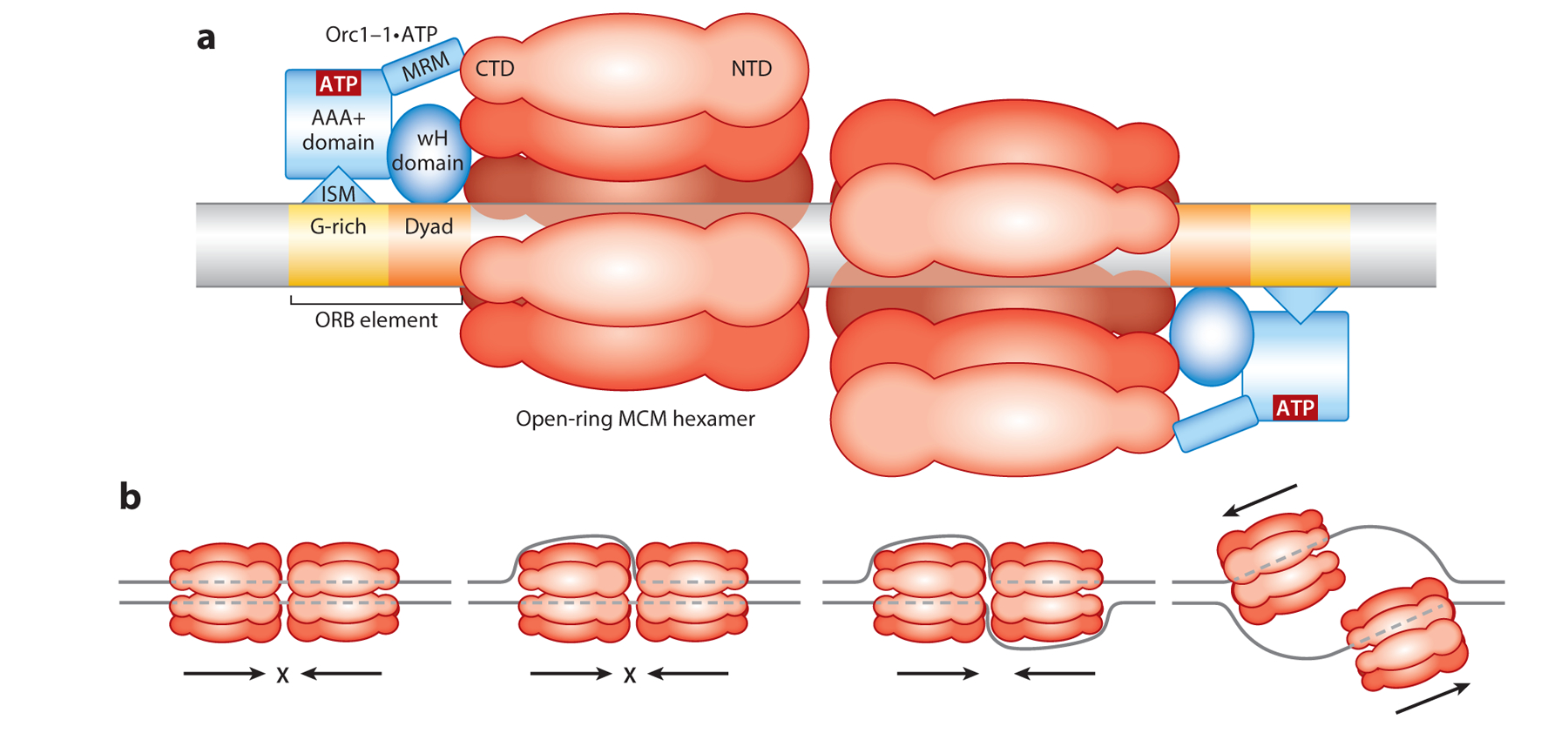
Figure 1
Figure 1
(a) Schematic of the loading of two open-ring homohexamers of MCM onto a replication origin by Orc1–1•ATP. The origin contains two cis-acting elements—ORB elements—that are presented in inverted orientation. Orc1–1 binds as a monomer, with the G-rich motif (yellow) in the ORB being recognized by the ISM motif present in the AAA+ ATPase domain of Orc1–1 and a dyad-containing sequence (orange) in the ORB bound by the wH domain of Orc1–1. When bound to ATP, Orc1–1 contacts the C-terminal domain of an MCM subunit via the MRM within Orc1–1’s AAA+ ATPase domain. (b) Model for origin melting by MCM. MCM proceeds with NTDs leading, and thus when one or two hexamers are double-stranded-DNA-bound, they will act as impediments to encroachment by the other hexamer (two left panels); dashed lines indicate DNA obscured from view in the central cavities of the MCM hexamers. However, once both hexamers have transitioned to binding single-stranded DNA following full melting, they will be able to pass one another, thus establishing bidirectional replication fork progression. Not shown in the illustration are the CG complexes that stimulate MCM’s helicase activity, incorporated at a currently unknown point in the origin activation process. Abbreviations: CTD, C-terminal domain; ISM, initiator-specific motif; MRM, MCM-recruitment motif; NTD, N-terminal domain; ORB, origin recognition box; wH, winged helix.
Figure 2
Figure 2
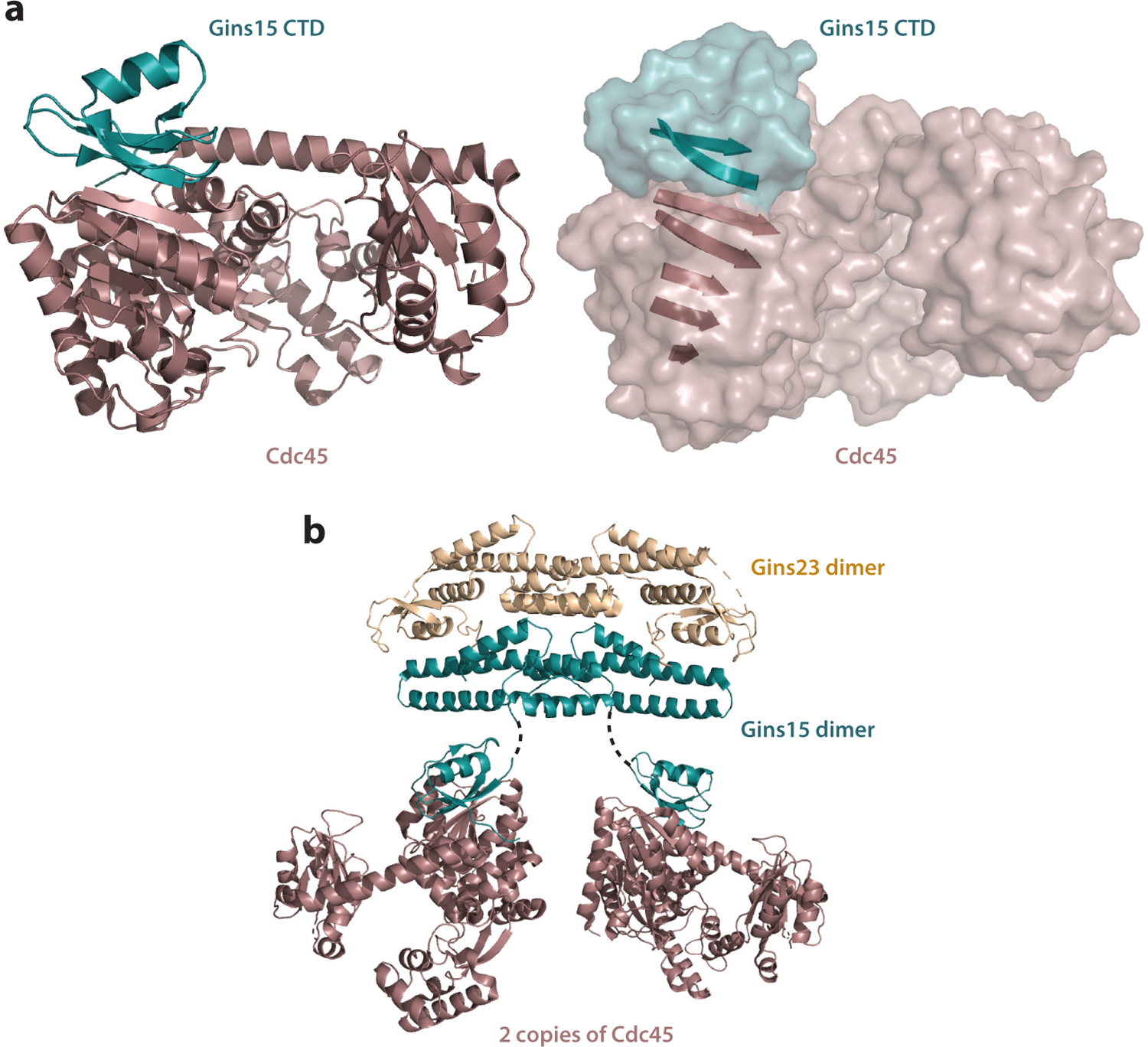
(a) The interaction interface between Gins15 and Cdc45 (aka GAN). The right-hand panel emphasizes the extended β sheet that lies at the heart of the interface. Data from PDB file 5GHS (44). Rendered with PyMOL. (b) Illustrative, but likely inaccurate, model for the interaction of two Cdc45s (GANs) with a GINS complex. The coordinates for the GINS complex were obtained from PDB 3ANW (43). Gins23 is shown in wheat, Gins15 in teal, and Cdc45 (GAN) in brown. The position of Cdc45 (GAN) relative to GINS in solution is currently unknown beyond the primary interaction interface with Gins15’s CTD. Rendered with PyMOL. Abbreviations: CTD, C-terminal domain; PDB, Protein Data Bank.
Figure 3
Figure 3
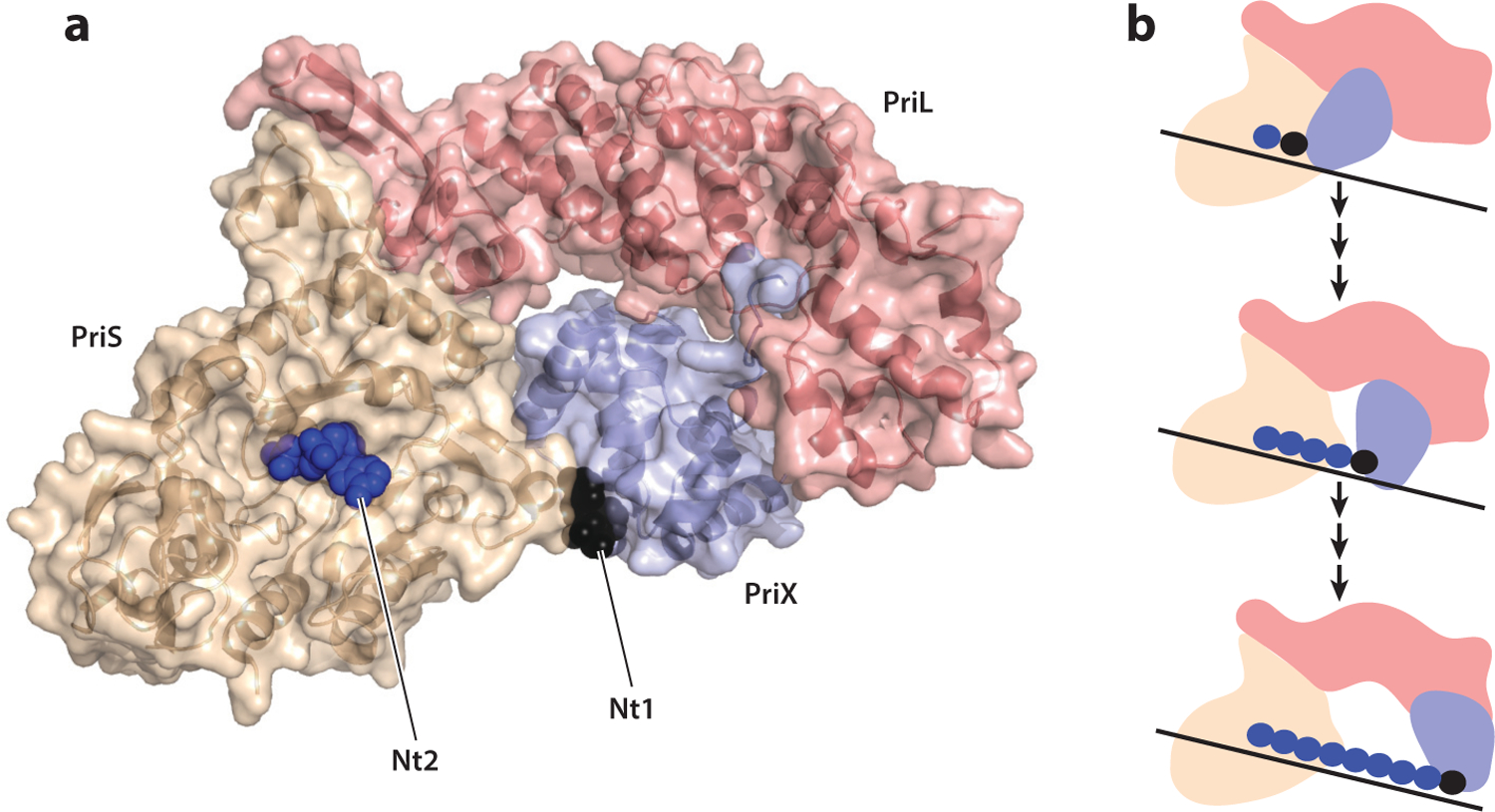
(a) Structure of Sulfolobus PriSLX with the initiating nucleotide (Nt1) shown in black and the nucleotide in the catalytic elongation site (Nt2) in blue. Prepared from Protein Data Bank file 5OF3. Rendered with PyMOL. (b) Schematic of the caliper model for primer length determination. As in panel a, PriS is shown in wheat, PriL in salmon, and PriX in blue. Juxtaposition of initiation and elongation sites allows dinucleotide formation. Subsequent nucleotide monophosphates are incorporated at the elongation site while the initiation site retains a grip on the 5′ end of the primer. Eventually, a maximal length of primer is reached, dictated by the maximal distance tolerated between initiation and elongation sites. This constraint could be imposed by distance and/or helical rotation of the heteroduplex.
Figure 4
Figure 4
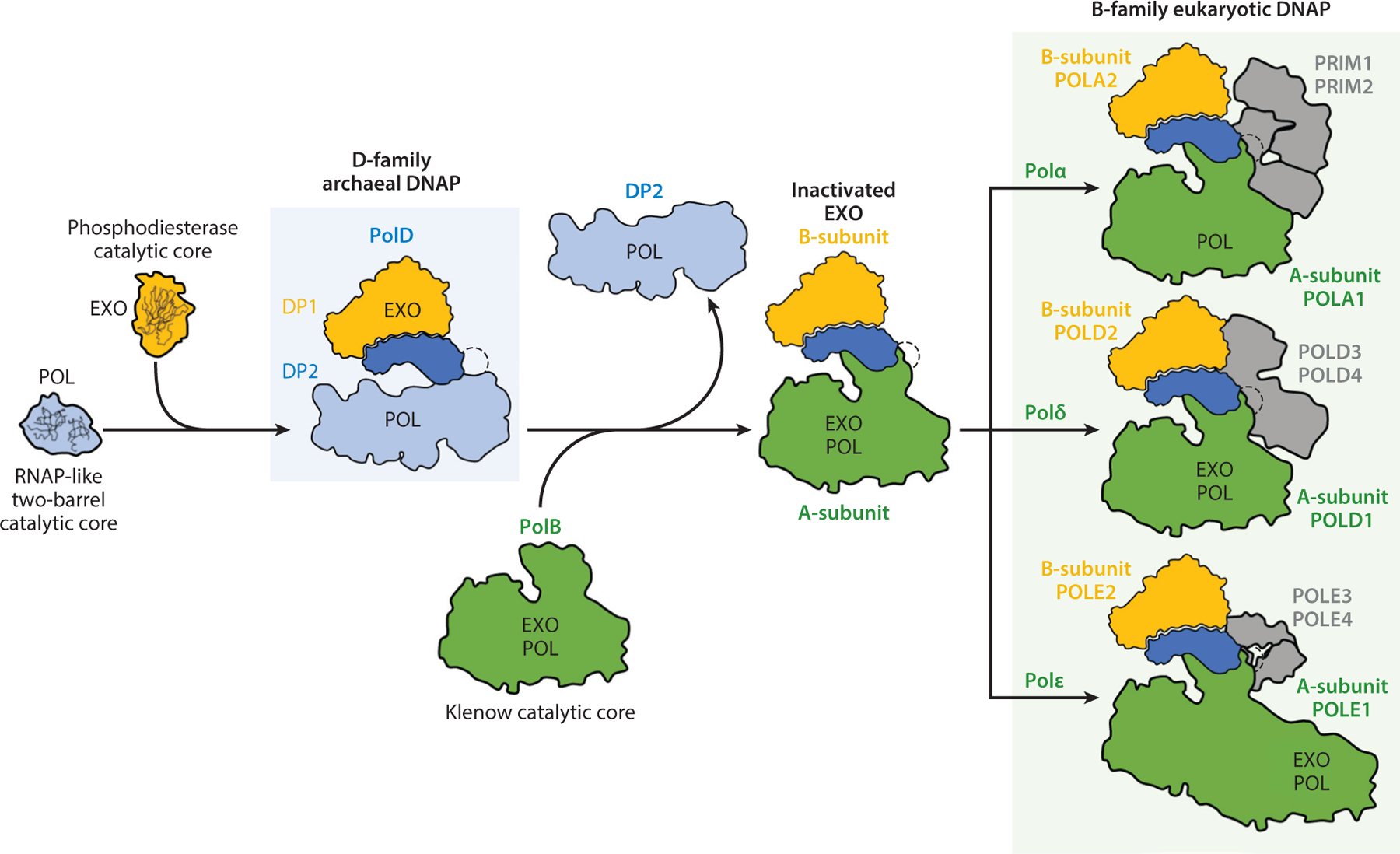
Schema for the evolution of PolD and eukaryotic DNA polymerases α, δ, and ε. Abbreviations: DNAP, DNA polymerase; EXO, exonuclease domain; POL, DNA polymerase domain; RNAP, RNA polymerase. Adapted from Reference (CC-BY-4.0).

References

    1. Ausiannikava D, Mitchell L, Marriott H, Smith V, Hawkins M, et al. 2018. Evolution of genome architecture in archaea: spontaneous generation of a new chromosome in Haloferax volcanii. Mol. Biol. Evol 35:1855–68 - PMC - PubMed
    1. Baranovskiy AG, Zhang Y, Suwa Y, Gu J, Babayeva ND, et al. 2016. Insight into the human DNA primase interaction with template-primer. J. Biol. Chem 291:4793–802 - PMC - PubMed
    1. Bell SD. 2017. Initiation of DNA replication in the archaea. Adv. Exp. Med. Biol 1042:99–115 - PubMed
    1. Bell SD. 2019. Initiating DNA replication: a matter of prime importance. Biochem. Soc. Trans 47:351–56 - PMC - PubMed
    1. Bell SD, Botchan MR. 2013. The minichromosome maintenance replicative helicase. Cold Spring Harb. Perspect. Biol 5:a012807. - PMC - PubMed

Publication types

LinkOut - more resources