


Association between walking 5000 step/day and fall incidence over six months in urban community-dwelling older people
- PMID: 32503501
- PMCID: PMC7275504
- DOI: 10.1186/s12877-020-01582-z
Association between walking 5000 step/day and fall incidence over six months in urban community-dwelling older people
Abstract
Background: Walking is the most common population-wide campaign for health promotion in older people. However, the cutoff threshold for walking steps/day to identify the older people who are at risk of falling is not recommended. Therefore, the objectives were to investigate the association between all possible risk factors including physical performance, physical activity and fall incidence over the six-month in community-dwelling older people who had low-risk of falling and to identify walking threshold (steps/day) for reducing risk of fall.
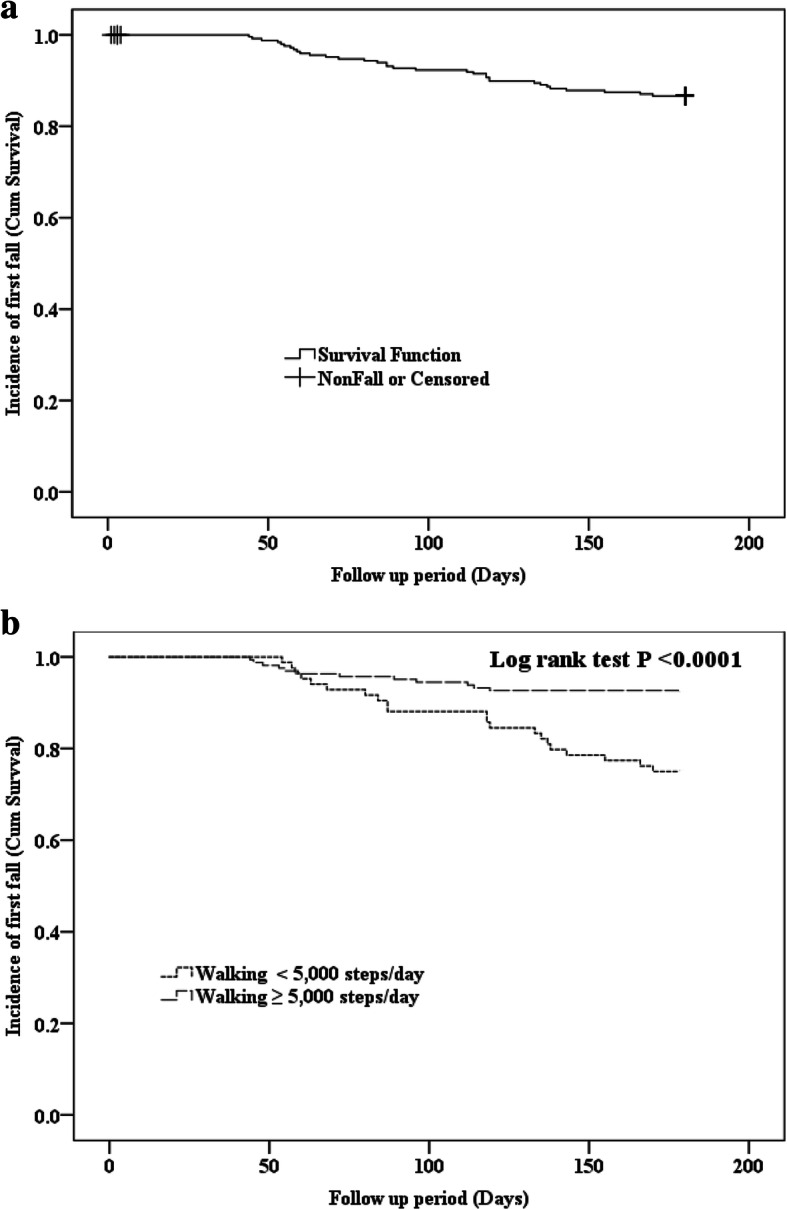
Methods: The older people who aged ≥60 years and had free of falling for 1 year were invited to participate in this study. They lived in five communities in Bangkok Thailand. Demographics and physical performances were collected at baseline. Walking (step/day) and 24-h physical activity (PA) were monitored for 5 consecutive days by the Actical® accelerometer wrapped on non-dominant wrists. The Physical Activity Scale for the Elderly (PASE) questionnaire was used to record activities in the past 7 days by interview. A monthly calendar was used to record fall incidence over the 6 months. Unadjusted and adjusted hazard ratio (HR) with 95% confidence interval (CI) were analyzed using the Cox's proportional hazard regression. The Kaplan Meier curve illustrated the probability to survive from fall over the 6 months.
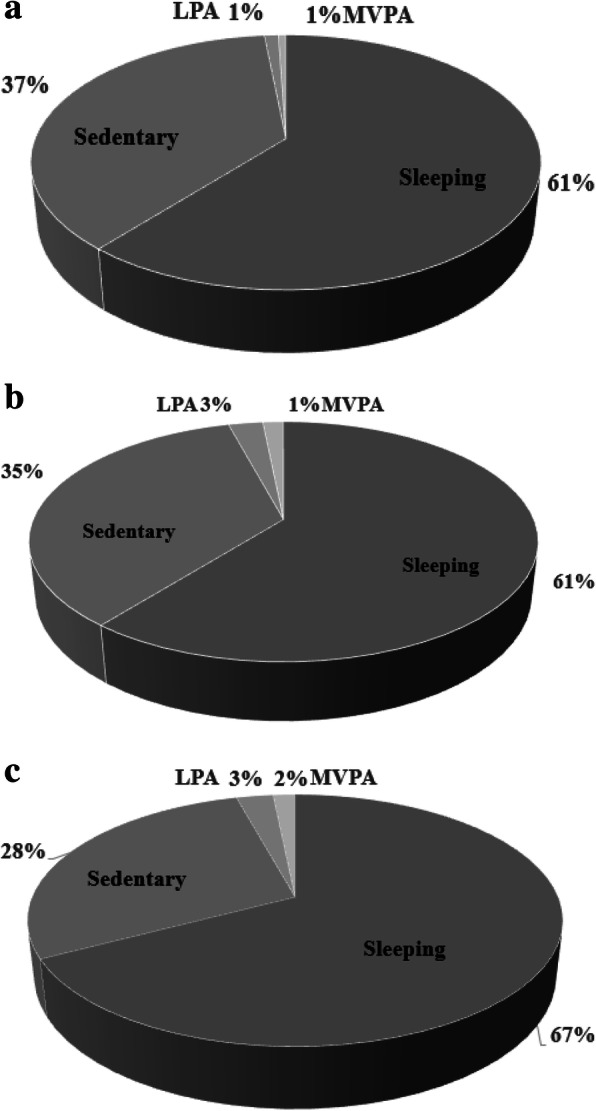
Results: Of 255, 33 older people (12.94%) reported first-fall incidence over the 6 months. Fall incidence density rate was 0.79 per 1000 person-day. Our findings showed that significant association between fall incidence and behavioral risk factors including PASE scores < 100 (HR = 3.53; 95% CI: 1.24-10.04), walking < 5000 steps/day (HR = 3.6; 95% CI: 1.76-7.31) and moderate to vigorous intensity of PA at < 60 min/week (HR = 3.66; 95% CI: 1.12-12.01). Fall incidence were related to the following risk factors: age (HR = 3.54; 95% CI: 1.37-9.11), took polypharmacy/antipsychotics (HR = 4.32; 95% CI: 2.12-8.79), presence of urinary incontinence (HR = 2.87; 95% CI: 1.45-5.68), low functional mobility by Timed Up and Go ≥13.5 s (HR = 6.43; 95% CI: 2.65-15.57).
Conclusions: This study proposed walking ≥5000 steps/day as a cutoff threshold to recommend for reducing risk of falling in community-dwelling older people who had low-risk of falling.
Keywords: Falls; Older people; Physical activity; Walking.
Conflict of interest statement
The authors declare that they have no competing interests.
Figures
References
-
- World Health Organization. WHO global report on falls prevention in older age. Geneva; 2007. Available from : https://www.who.int/ageing/publications/Falls_prevention7March.pdf.
-
- Romli MH, Tan MP, Mackenzie L, Lovarini M, Suttanon P, Clemson L. Falls amongst older people in Southeast Asia: a scoping review. Public Health. 2017;145:96–112. - PubMed
-
- Jitapunkul S, Na Songkhla M, Chayovan N, et al. Falls and their associated factors: a national survey of the Thai elderly. J Med Assoc Thail. 1998;81:233–241. - PubMed
-
- Assantachai P, Praditsuwan R, Chatthanawaree W, Pisalsarakij D, Thamlikkitkul V. Risk factors for falls in the Thai elderly in an urban community. J Med Assoc Thail. 2003;86:124–130. - PubMed
-
- National Statistical Office Ministry of Information and Communication Technology . Number and death rate report of the elderly population in Thailand. 2015.
Publication types
MeSH terms
LinkOut - more resources
Full Text Sources
Medical
Miscellaneous
