


How well does Malaysia achieve value for money in public sector purchasing of medicines? Evidence from medicines procurement prices from 2010 to 2014
- PMID: 32503539
- PMCID: PMC7275478
- DOI: 10.1186/s12913-020-05362-8
How well does Malaysia achieve value for money in public sector purchasing of medicines? Evidence from medicines procurement prices from 2010 to 2014
Abstract
Background: Malaysia's public healthcare sector provides a greater volume of medicines at lower overall cost compared to the private sector, indicating its importance in providing access to medicines for Malaysians. However, the Ministry of Health (MOH) has concerns about the continuous increase in the public sector medicines budget, and achieving efficiencies in medicines procurement is an important goal. The objectives of this study were to assess the overall trend in public sector pharmaceutical procurement efficiency from 2010 to 2014, and determine if the three different ways in which MOH procures medicines influence efficiency.
Methods: We matched medicines from the public sector procurement report by medicine formulation to medicines with a Management Sciences for Health (MSH) International Reference Price (IRP) for each year. Price ratios were calculated, and utilizing the information on quantity and expenditure for each product, summary measures of procurement efficiency were reported as quantity- and expenditure-weighted average price ratios (WAPRs) for each year. Utilizing MOH procurement data to obtain information on procurement type, a multiple regression analysis, controlling for factors that can influence prices, assessed whether procured efficiency (relative to IRPs) differed by MOH procurement type.
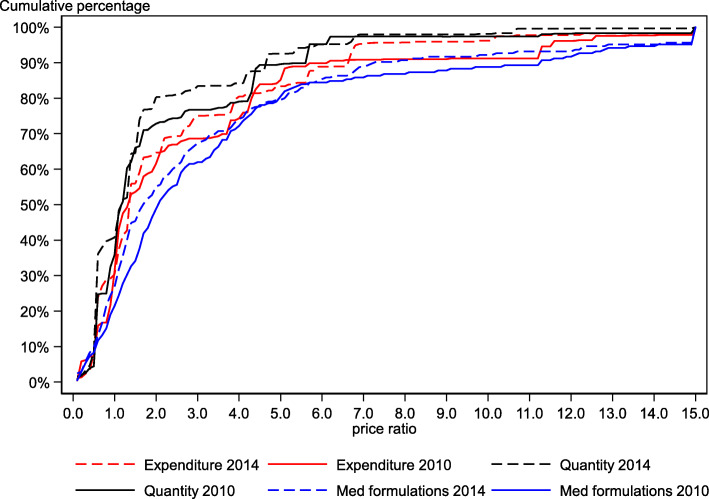
Results: Malaysia's public sector purchased medicines at two to three times the IRP throughout the study period. However, procurement prices were relatively stable in terms of WAPRs each year (2.2 and 3.2 in 2010 to 1.9 and 2.9 in 2014 for quantity and expenditure WAPRs, respectively). Procurement efficiency did not vary between the three different methods of MOH procurement. Procurement efficiency of both imported originators and imported generics were significantly lower (P < 0.001 and P < 0.01) than local generic products, and medicine source and category influenced the procurement efficiency of each MOH procurement mechanism.
Conclusion: The design of different medicines procurement mechanisms, along with the balance between ensuring competitive procurement prices and adhering to national industry and procurement policies, have not been able to achieve lower public sector medicines procurement prices (relative to IRP). Introducing pooled procurement options along with continuous monitoring of procurement efficiency and exploring ways to improve price competition among local and foreign suppliers is recommended.
Keywords: Efficiency; International reference price; Median price ratio; Medicines price; Public procurement.
Conflict of interest statement
The authors declare that they have no competing interests.
Figures
References
-
- Malaysia National Audit. Malaysia Pharmaceutical Audit & Malaysia Government Report 2007–2016. IQVIA Malaysia.
-
- Malaysia National Health Accounts Unit. Health Expenditure Report 1997-2016. Malaysia: Ministry of Health Malaysia; 2018. https://www.moh.gov.my/moh/resources/Penerbitan/Penerbitan%20Utama/MNHA%.... Accessed 10 Jan 2018.
-
- Pharmaceutical Services Division. Malaysian Statitistics on Medicines 2011-2014: Ministry of Health Malaysia; 2018. https://www.pharmacy.gov.my/v2/sites/default/files/document-upload/malay.... Accessed 10 Jan 2018.
-
- Government Procurement Division. Malaysia’s Government Procurement Regime. Malaysia: Ministry of Finance Malaysia; 2010.
MeSH terms
LinkOut - more resources
Full Text Sources
