


Telephone health coaching with exercise monitoring using wearable activity trackers (TeGeCoach) for improving walking impairment in peripheral artery disease: study protocol for a randomised controlled trial and economic evaluation
- PMID: 32503866
- PMCID: PMC7279623
- DOI: 10.1136/bmjopen-2019-032146
Telephone health coaching with exercise monitoring using wearable activity trackers (TeGeCoach) for improving walking impairment in peripheral artery disease: study protocol for a randomised controlled trial and economic evaluation
Abstract
Introduction: Peripheral artery disease (PAD) is the third most prevalent cardiovascular disease worldwide, with smoking and diabetes being the strongest risk factors. The most prominent symptom is leg pain while walking, known as intermittent claudication. To improve mobility, first-line treatment for intermittent claudication is supervised exercise programmes, but these remain largely unavailable and economically impractical, which has led to the development of structured home-based exercise programmes. This trial aims to determine the effectiveness and cost advantage of TeGeCoach, a 12-month long home-based exercise programme, compared with usual care of PAD. It is hypothesised that TeGeCoach improves walking impairment and lowers the need of health care resources that are spent on patients with PAD.
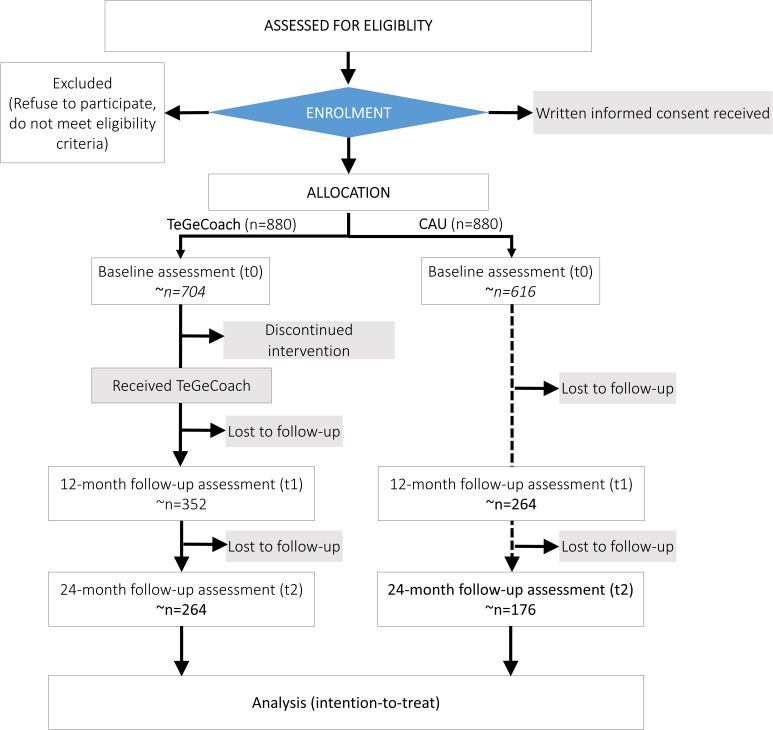
Methods and analysis: The investigators conduct a prospective, pragmatic randomised controlled clinical trial in a health insurance setting. 1760 patients diagnosed with PAD at Fontaine stage II are randomly assigned to either TeGeCoach or care-as-usual. TeGeCoach consists of telemonitored intermittent walking exercise with medical supervision by a physician and telephone health coaching. Participants allocated to the usual care group receive information leaflets and can access supervised exercise programmes, physical therapy and a variety of programmes for promoting a healthy lifestyle. The primary outcome is patient reported walking ability based on the Walking Impairment Questionnaire. Secondary outcome measures include quality of life, health literacy and health behaviour. Claims data are used to collect total health care costs, healthcare resource use and (severe) adverse events. Outcomes are measured at baseline, 12 and 24 months.
Ethics and dissemination: Ethical approval has been obtained from the Medical Association Hamburg. Findings are disseminated through peer-reviewed journals, reports to the funding body, conference presentations and media press releases. Data from this trial are made available to the public and researchers upon reasonable request.NCT03496948 (www.clinicaltrials.gov), Pre-results.
Keywords: VASCULAR MEDICINE; clinical trials; health economics; health services administration & management; peripheral artery disease.
© Author(s) (or their employer(s)) 2020. Re-use permitted under CC BY-NC. No commercial re-use. See rights and permissions. Published by BMJ.
Conflict of interest statement
Competing interests: None declared.
Figures
References
Publication types
MeSH terms
Associated data
LinkOut - more resources
Full Text Sources
Medical
