Community-based interventions for detection and management of diabetes and hypertension in underserved communities: a mixed-methods evaluation in Brazil, India, South Africa and the USA
- PMID: 32503887
- PMCID: PMC7279660
- DOI: 10.1136/bmjgh-2019-001959
Community-based interventions for detection and management of diabetes and hypertension in underserved communities: a mixed-methods evaluation in Brazil, India, South Africa and the USA
Abstract
Introduction: As non-communicable disease (NCD) burden rises worldwide, community-based programmes are a promising strategy to bridge gaps in NCD care. The HealthRise programme sought to improve hypertension and diabetes management for underserved communities in nine sites across Brazil, India, South Africa and the USA between 2016 and 2018. This study presents findings from the programme's endline evaluation.
Methods: The evaluation utilises a mixed-methods quasi-experimental design. Process indicators assess programme implementation; quantitative data examine patients' biometric measures and qualitative data characterise programme successes and challenges. Programme impact was assessed using the percentage of patients meeting blood pressure and A1c treatment targets and tracking changes in these measures over time.
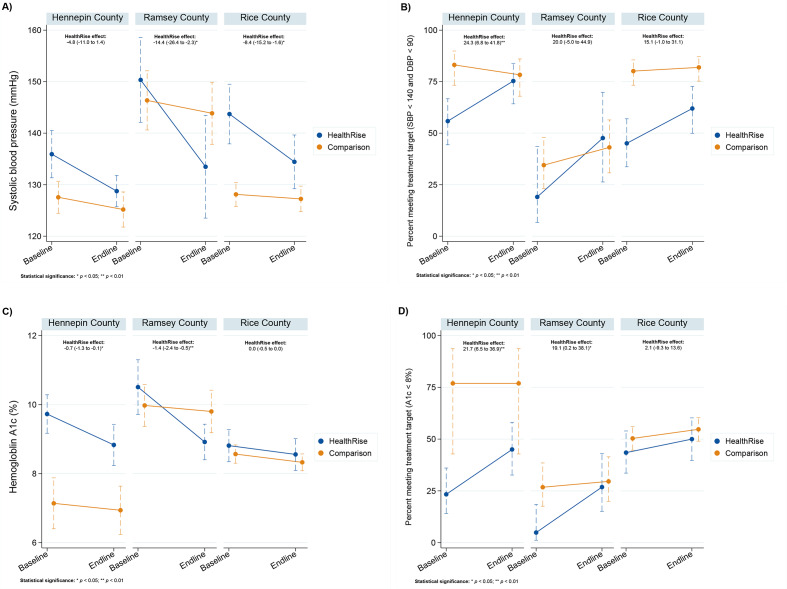
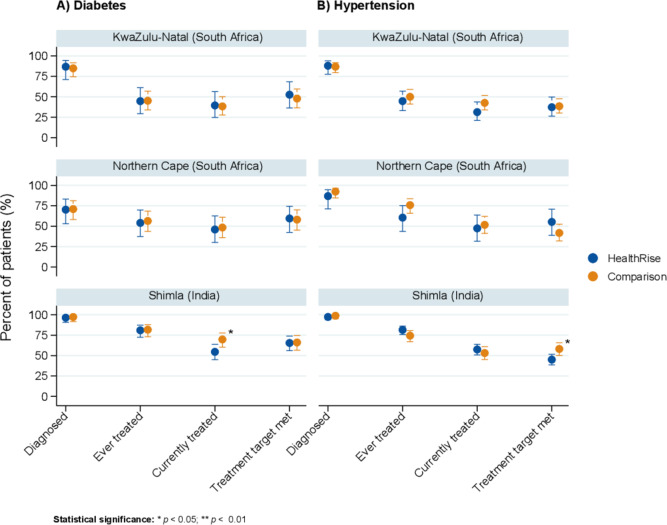
Results: Almost 60 000 screenings, most of them in India, resulted in 1464 new hypertension and 295 new diabetes cases across sites. In Brazil, patients exhibited statistically significant reductions in blood pressure and A1c. In Shimla, India, and in South Africa, country with the shortest implementation period, there were no differences between patients served by facilities in HealthRise areas relative to comparison areas. Among participating patients with diabetes in Hennepin and Ramsey counties and hypertension patients in Hennepin County, the percentage of HealthRise patients meeting treatment targets at endline was significantly higher relative to comparison group patients. Qualitative analysis identified linking different providers, services, communities and information systems as positive HealthRise attributes. Gaps in health system capacities and sociodemographic factors, including poverty, low levels of health education and limited access to nutritious food, are remaining challenges.
Conclusions: Findings from Brazil and the USA indicate that the HealthRise model has the potential to improve patient outcomes. Short implementation periods and strong emphasis on screening may have contributed to the lack of detectable differences in other sites. Community-based care cannot deliver its full potential if sociodemographic and health system barriers are not addressed in tandem.
Keywords: diabetes; hypertension; public health.
© Author(s) (or their employer(s)) 2020. Re-use permitted under CC BY-NC. No commercial re-use. See rights and permissions. Published by BMJ.
Conflict of interest statement
Competing interests: PB, NC, JD and MTUB are employees of the Medtronic Foundation. AB, CCh, CCi, MLC, VEK, PE, MALB, JMa, CM, MSM, SMa, DSdM, SMi, JMu, HCN, JAQO, MGO, VP, TR, ALR, DR, GS, DAS, TT, HT and SV are recipients of HealthRise grants from the Medtronic Foundation to implement HealthRise interventions. LSF, SW, MB, JNC, DVC, KC, HCD, NF, RG, TG, KPH, CRM, VM, MN, BP, MBR, GR, BT, AW, VC, TPN, and EG are recipients of funding from grants from the Medtronic Foundation to evaluate HealthRise interventions.
Figures
References
-
- Roth GA, Abate D, Abate KH, et al. Global, regional, and national age-sex-specific mortality for 282 causes of death in 195 countries and territories, 1980–2017: a systematic analysis for the global burden of disease study 2017. The Lancet 2018;392:1736–88. 10.1016/S0140-6736(18)32203-7 - DOI - PMC - PubMed
-
- Kyu HH, Abate D, Abate KH, et al. Global, regional, and national disability-adjusted life-years (DALYs) for 359 diseases and injuries and healthy life expectancy (HALE) for 195 countries and territories, 1990–2017: a systematic analysis for the global burden of disease study 2017. The Lancet 2018;392:1859–922. 10.1016/S0140-6736(18)32335-3 - DOI - PMC - PubMed
-
- GBD 2017 Risk Factor Collaborators Global, regional, and national comparative risk assessment of 84 behavioural, environmental and occupational, and metabolic risks or clusters of risks for 195 countries and territories, 1990-2017: a systematic analysis for the global burden of disease study 2017. Lancet 2018;392:1923–94. 10.1016/S0140-6736(18)32225-6 - DOI - PMC - PubMed
-
- Chang AY, Cowling K, Micah AE, et al. Past, present, and future of global health financing: a review of development assistance, government, out-of-pocket, and other private spending on health for 195 countries, 1995–2050. The Lancet 2019;393:2233–60. 10.1016/S0140-6736(19)30841-4 - DOI - PMC - PubMed
Publication types
MeSH terms
LinkOut - more resources
Full Text Sources
Medical
Research Materials