. 2020 Jun 5;11(1):2836.
doi: 10.1038/s41467-020-16727-2.

Manipulating magnetoelectric energy landscape in multiferroics

Affiliations

Manipulating magnetoelectric energy landscape in multiferroics

Yen-Lin Huang et al. Nat Commun. .

Abstract

Magnetoelectric coupling at room temperature in multiferroic materials, such as BiFeO3, is one of the leading candidates to develop low-power spintronics and emerging memory technologies. Although extensive research activity has been devoted recently to exploring the physical properties, especially focusing on ferroelectricity and antiferromagnetism in chemically modified BiFeO3, a concrete understanding of the magnetoelectric coupling is yet to be fulfilled. We have discovered that La substitutions at the Bi-site lead to a progressive increase in the degeneracy of the potential energy landscape of the BiFeO3 system exemplified by a rotation of the polar axis away from the 〈111〉pc towards the 〈112〉pc discretion. This is accompanied by corresponding rotation of the antiferromagnetic axis as well, thus maintaining the right-handed vectorial relationship between ferroelectric polarization, antiferromagnetic vector and the Dzyaloshinskii-Moriya vector. As a consequence, La-BiFeO3 films exhibit a magnetoelectric coupling that is distinctly different from the undoped BiFeO3 films.


Conflict of interest statement

The authors declare no competing interests.

Figures
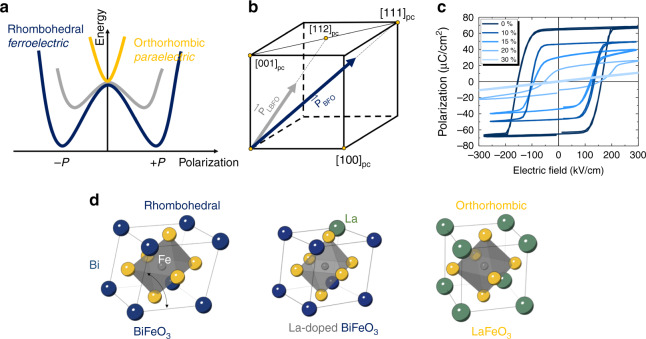
Fig. 1
Fig. 1. Ferroelectric ordering in Bi1−xLaxFeO3.
a Schematic for the energy landscape of the phase transition induced by lanthanum substitution in BiFeO3 described by Landau theory. b Schematic for the ferroelectric polarization rotation (from BiFeO3: [111]pc to Bi0.85La0.15FeO3: [112]pc) and suppression of ferroelectric polarization induced by lanthanum substitution in BiFeO3. c P-E measurements for different substitution levels of lanthanum in 100-nm-thick BiFeO3 films. d The schematics illustrate the evolution of crystal symmetry of bismuth ferrite (rhombohedral) to lanthanum ferrite (orthorhombic).
Fig. 2
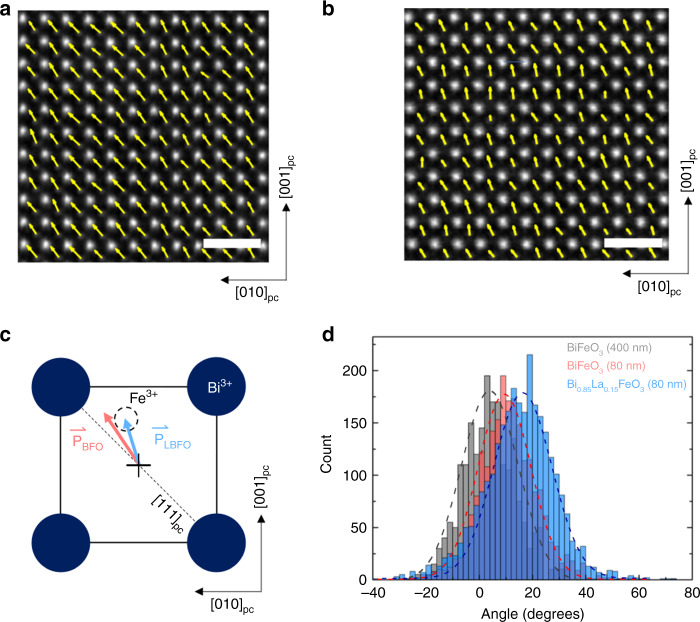
Fig. 2. Atomic images, polarization mapping, and change of polarization in BiFeO3 and Bi0.85La0.15FeO3 thin films.
a, b show the HAADF-STEM images of BiFeO3 and Bi0.85La0.15FeO3, respectively, with the polarization mapping of the Fe atoms overlaid. The scale bar is 1 nm. c Schematic of ferroelectric polarization in BiFeO3/Bi0.85La0.15FeO3 unit cell. The vectors in (a, b) were extracted from the displacement of Fe3+ position to the mass center of four Bi3+. d Histogram of polar distribution shows that the ferroelectric polarizations rotate 3.6°, 10.9° and 16.1° away from [111]pc in 400-nm-thick BiFeO3 (gray), 80-nm-thick BiFeO3 (red) and 80-nm-thick Bi0.85La0.15FeO3 (blue), respectively.
Fig. 3
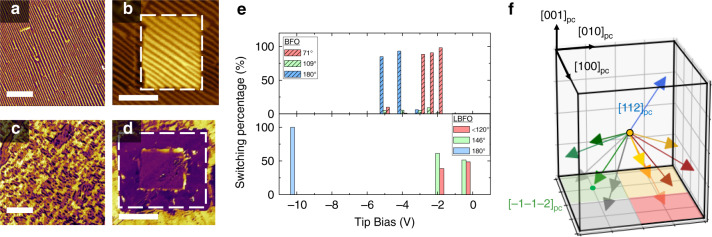
Fig. 3. Ferroelectric switching in BiFeO3 and Bi0.85La0.15FeO3 revealed by PFM.
a, c The as-grown IP-PFM images show different domain patterns in 20-nm-thick BiFeO3 and Bi0.85La0.15FeO3 thin films, respectively. b In-plane PFM images of 20-nm-thick BiFeO3 after PFM electric poling with −5 V (upward polarized). d In-plane PFM images of 20-nm-thick Bi0.85La0.15FeO3 after PFM electric poling with −10 V (upward polarized). The scale bar is 1 μm. e The summary of the polarization switching angles for 20-nm-thick BiFeO3 and Bi0.85La0.15FeO3 thin films. f Schematic of ferroelectric polarization switching in Bi0.85La0.15FeO3 thin film.
Fig. 4
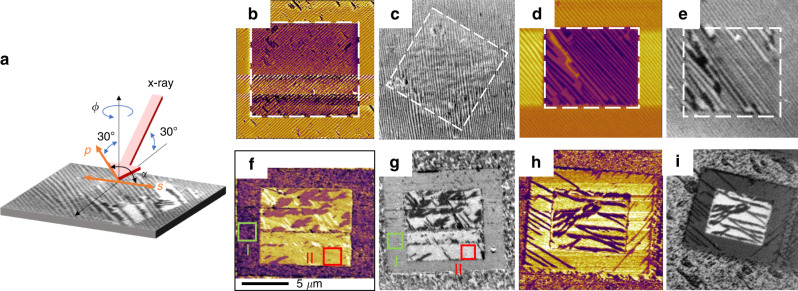
Fig. 4. PFM and XMLD-PEEM images of BiFeO3 and Bi0.85La0.15FeO3 thin films.
a Schematic of the XMLD-PEEM experimental geometries used to probe the angle dependence (Φ), linear dichroism. Linear polarizations: α = 0°; Linear polarization p: α = 90°. b, c In-plane-PFM and XMLD-PEEM images of 80-nm-thick BiFeO3. d, e In-plane-PFM and XMLD-PEEM images of 20-nm-thick BiFeO3. f, g In-plane-PFM and XMLD-PEEM images of 80-nm-thick Bi0.85La0.15FeO3. The green/red boxes represent the positive/negative polarized domain I/II. h, i In-plane-PFM and XMLD-PEEM images of 20-nm-thick Bi0.85La0.15FeO3.
Fig. 5
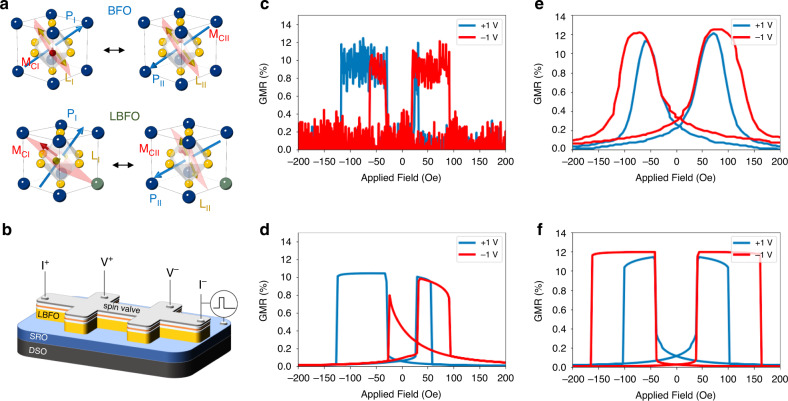
Fig. 5. Magnetic anisotropy switching by electric field via the heterostructure of spin-valve/BiFeO3 (Bi0.85La0.15FeO3).
a Schematics for the different electrically polarized states of P, L, and MC in BiFeO3 and Bi0.85La0.15FeO3. b Schematic for magnetoresistance measurements on spin-valve/BiFeO3 (Bi0.85La0.15FeO3) heterostructure. c R(H) of spin-valve/BiFeO3 on the different electrically polarized states. d micromagnetic simulations on R(H) of spin-valve/BiFeO3 with different polarization states. e R(H) of spin-valve/ Bi0.85La0.15FeO3 on the different electrically polarized states. f Micromagnetic simulations on R(H) of spin-valve/ Bi0.85La0.15FeO3 with different polarization states.

References

    1. Fiebig M, Lottermoser T, Meier TD, Trassin M. The evolution of multiferroics. Nat. Rev. Mater. 2016;1:16046. doi: 10.1038/natrevmats.2016.46. - DOI
    1. Spaldin NA, Fiebig M. The renaissance of magnetoelectric multiferroics. Science. 2005;309:391–392. doi: 10.1126/science.1113357. - DOI - PubMed
    1. Chu YH, et al. Electric-field control of local ferromagnetism using a magnetoelectric multiferroic. Nat. Mater. 2008;7:478–482. doi: 10.1038/nmat2184. - DOI - PubMed
    1. Ramesh R, Spaldin NA. Multiferroics: progress and prospects in thin films. Nat. Mater. 2007;6:21–29. doi: 10.1038/nmat1805. - DOI - PubMed
    1. Spaldin NA, Ramesh R. Advances in magnetoelectric multiferroics. Nat. Mater. 2019;18:203–212. doi: 10.1038/s41563-018-0275-2. - DOI - PubMed