


Quadriceps tendon vs. patellar tendon autograft for ACL reconstruction using a hardware-free press-fit fixation technique: comparable stability, function and return-to-sport level but less donor site morbidity in athletes after 10 years
- PMID: 32504178
- PMCID: PMC7505888
- DOI: 10.1007/s00402-020-03508-1
Quadriceps tendon vs. patellar tendon autograft for ACL reconstruction using a hardware-free press-fit fixation technique: comparable stability, function and return-to-sport level but less donor site morbidity in athletes after 10 years
Abstract
Introduction: The use of quadriceps tendon-patellar bone (QTB) autograft for anterior cruciate ligament (ACL) reconstruction is gaining momentum. Yet, long-term results that compare this procedure with established methods are lacking. The aim of this study was to report and compare long-term results of ACL reconstruction using QTB autografts versus bone-patellar tendon-bone (BPTB) autografts, both anchored using a hardware-free press-fit fixation technique.
Materials and methods: 60 athletes (Tegner score ≥6) with primary ACL rupture were prospectively randomized into two groups. 56 patients were evaluated after a mean duration of 12.2 ± 1.9 months (range 10-14) and 43 patients after 10.3 ± 0.2 years (range 10-11).
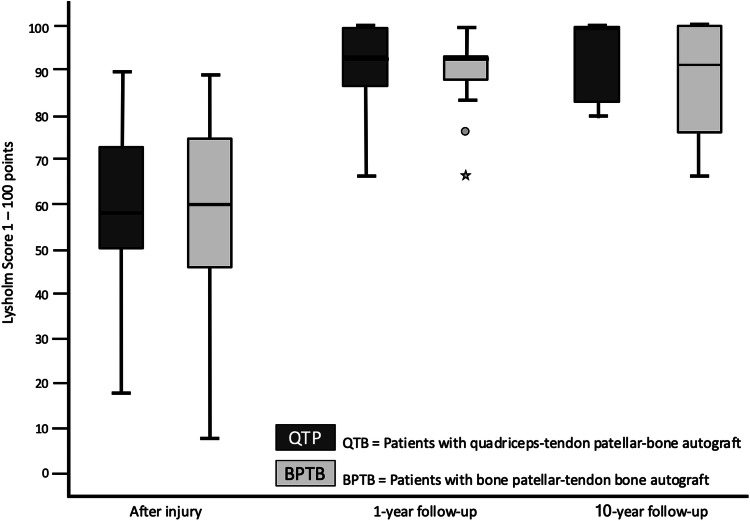
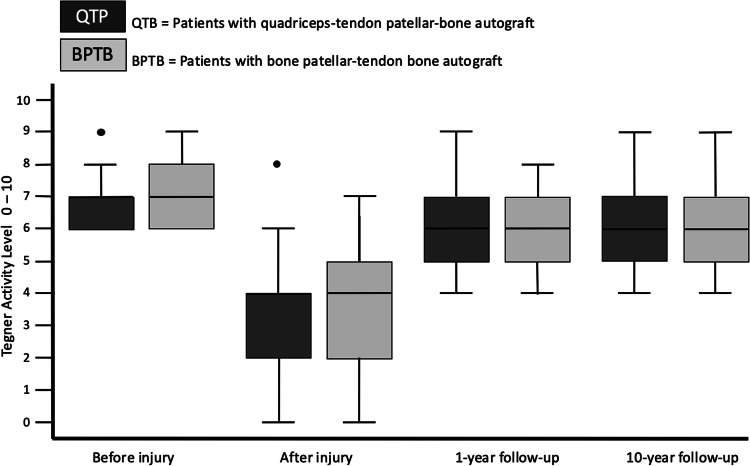
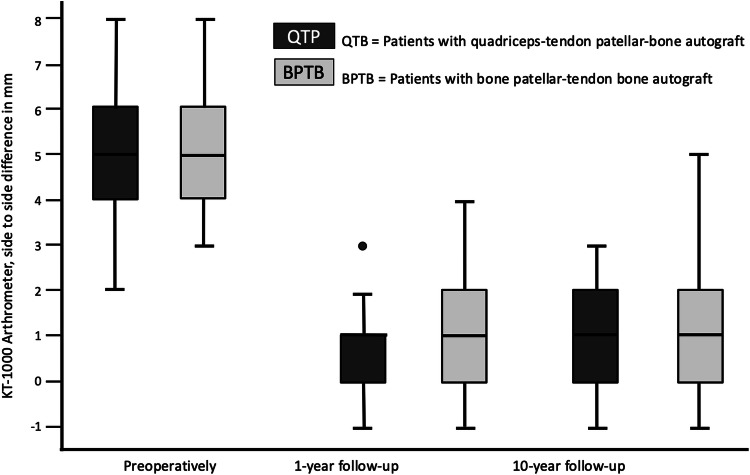
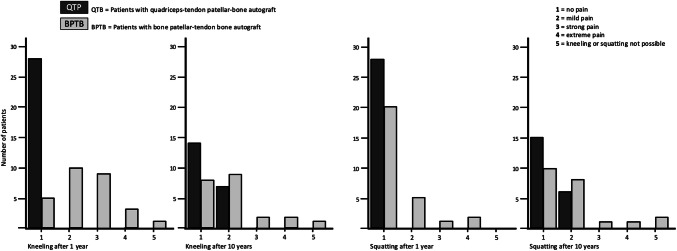
Results: On final follow-up, 90% of patients scored very good and good results in the functional Lysholm score (mean 99 ± 7.1, range 74-100 points). Normal or almost normal IKDC score was reported by 84% of the patients (mean 97 ± 9.5, range 60-100 points). The activity level decreased in the Tegner score from median of 7 before injury to 6 after 10 years. The KT-1000 arthrometer showed a difference in the anterior translation of less than 3 mm (mean 1.0 ± 1.2, range - 1 to 5 mm) in 91% of the patients. Significant degeneration was radiologically detected in one patient per group. No tunnel widening was seen in any patient. Up to 97% of all patients were satisfied with the operative procedure. No significant differences were found in the mentioned parameters between the two groups and also in comparison with the 1-year results. The only significant difference was in the donor site morbidity. Significantly more patients in the BPTB group had complaints during kneeling both at 1 (p < 0.001) and 10 years (p = 0.019). Squatting was also subjectively more problematic in the BPTB group than in the QTB group both after 1 (p = 0.003) and 10 years (p = 0.046).
Conclusions: This study shows equally good functional, clinical and radiological long-term results for both hardware-free methods of ACL reconstruction. These results clinically confirm the safety of press-fit anchoring after 10 years. The failure rate in this study was very low, with only one re-rupture in 10 years. The increased donor site morbidity when using the BPTB autograft compared to the QTB autograft supports already reported data. It was also seen in this study for the implant-free press-fit techniques.
Study design: Prospective and randomized, level of evidence 2.
Keywords: ACL reconstruction; Athletes; Patellar tendon; Press-fit fixation; Quadriceps autograft.
Conflict of interest statement
The authors declare that they have no competing interests.
Figures

References
-
- Sanders TL, Kremers HM, Bryan AJ, Fruth KM, Larson DR, Pareek A, Levy BA, Stuart MJ, Dahm DL, Krych AJ. Is anterior cruciate ligament reconstruction effective in preventing secondary meniscal tears and osteoarthritis? Am J Sports Med. 2016;44(7):1699–1707. doi: 10.1177/0363546516634325. - DOI - PubMed
-
- van Meer BL, Oei EH, Meuffels DE, van Arkel ER, Verhaar JA, Bierma-Zeinstra SM, Reijman M. Degenerative changes in the knee 2 years after anterior cruciate ligament rupture and related risk factors: a prospective observational follow-up study. Am J Sports Med. 2016;44(6):1524–1533. doi: 10.1177/0363546516631936. - DOI - PubMed
-
- Seo SS, Kim CW, Lee CR, Park DH, Kwon YU, Kim OG, Kim CK. Second-look arthroscopic findings and clinical outcomes of meniscal repair with concomitant anterior cruciate ligament reconstruction: comparison of suture and meniscus fixation device. Arch Orthop Trauma Surg. 2020;140(3):365–372. doi: 10.1007/s00402-019-03323-3. - DOI - PubMed
Publication types
MeSH terms
LinkOut - more resources
Full Text Sources
Medical
