


Translational Intracerebral Hemorrhage Research: Has Current Neuroprotection Research ARRIVEd at a Standard for Experimental Design and Reporting?
- PMID: 32504197
- PMCID: PMC7575495
- DOI: 10.1007/s12975-020-00824-x
Translational Intracerebral Hemorrhage Research: Has Current Neuroprotection Research ARRIVEd at a Standard for Experimental Design and Reporting?
Abstract
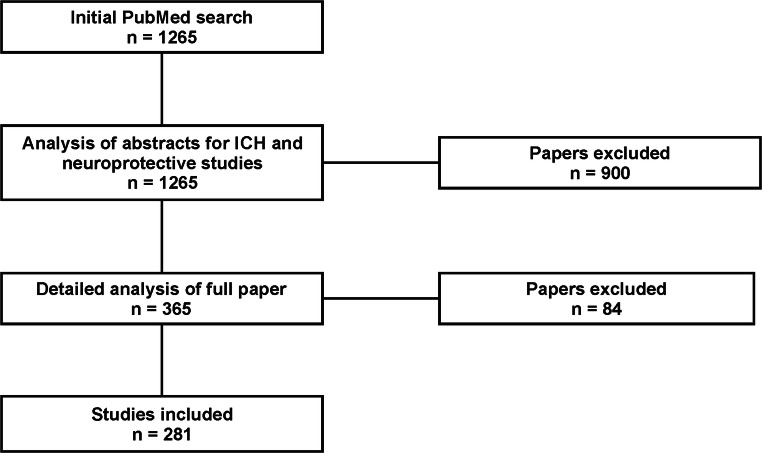
One major aim of preclinical intracerebral hemorrhage (ICH) research is to develop and test potential neuroprotectants. Published guidelines for experimental design and reporting stress the importance of clearly and completely reporting results and methodological details to ensure reproducibility and maximize information availability. The current review has two objectives: first, to characterize current ICH neuroprotection research and, second, to analyze aspects of translational design in preclinical ICH studies. Translational design is the adoption and reporting of experimental design characteristics that are thought to be clinically relevant and critical to reproducibility in animal studies (e.g., conducting and reporting experiments according to the STAIR and ARRIVE guidelines, respectively). Given that ICH has no current neuroprotective treatments and an ongoing reproducibility crisis in preclinical research, translational design should be considered by investigators. We conducted a systematic review of ICH research from 2015 to 2019 using the PubMed database. Our search returned 281 published manuscripts studying putative neuroprotectants in animal models. Contemporary ICH research predominantly uses young, healthy male rodents. The collagenase model is the most commonly used. Reporting of group sizes, blinding, and randomization are almost unanimous, but group size calculations, mortality and exclusion criteria, and animal model characteristics are infrequently reported. Overall, current ICH neuroprotection research somewhat aligns with experimental design and reporting guidelines. However, there are areas for improvement. Because failure to consider translational design is associated with inflation of effect sizes (and possibly hindered reproducibility), we suggest that researchers, editors, and publishers collaboratively consider enhanced adherence to published guidelines.
Keywords: Animal models; Experimental design; Experimental reporting; Intracerebral hemorrhage; Neuroprotection; Reproducibility; Systematic review; Translational research.
Conflict of interest statement
The authors declare that they have no conflict of interest.
Figures



References
-
- Krishnamurthi RV, Moran AE, Forouzanfar MH, Bennett DA, Mensah GA, Lawes CMM, Barker-Collo S, Connor M, Roth GA, Sacco R. The global burden of hemorrhagic stroke: a summary of findings from the GBD 2010 study. Glob Heart. 2014;9:101–6. - PubMed
-
- van Asch CJ, Luitse MJ, Rinkel GJ, van der Tweel I, Algra A, Klijn CJ. Incidence, case fatality, and functional outcome of intracerebral haemorrhage over time, according to age, sex, and ethnic origin: a systematic review and meta-analysis. Lancet Neurol. 2010;9(2):167–76. - PubMed
-
- Corbett D, Carmichael ST, Murphy TH, Jones TA, Schwab ME, Jolkkonen J, Clarkson AN, Dancause N, Weiloch T, Johansen-Berg H. Enhancing the alignment of the preclinical and clinical stroke recovery research pipeline: consensus-based core recommendations from the Stroke Recovery and Rehabilitation Roundtable translational working group. Neurorehabil Neural Repair. 2017;31(8):699–707. - PubMed
Publication types
MeSH terms
Substances
Grants and funding
LinkOut - more resources
Full Text Sources
