. 2020 Aug;81(2):e39-e45.
doi: 10.1016/j.jinf.2020.05.077. Epub 2020 Jun 3.

Detection of SARS-CoV-2 antibodies using commercial assays and seroconversion patterns in hospitalized patients

Affiliations

Detection of SARS-CoV-2 antibodies using commercial assays and seroconversion patterns in hospitalized patients

E Tuaillon et al. J Infect. 2020 Aug.

Abstract

Objectives: SARS-CoV-2 antibody assays are needed for serological surveys and as a complement to molecular tests to confirm COVID-19. However, the kinetics of the humoral response against SARS-CoV-2 remains poorly described and relies on the performance of the different serological tests.

Methods: In this study, we evaluated the performance of six CE-marked point-of-care tests (POC) and three ELISA assays for the diagnosis of COVID-19 by exploring seroconversions in hospitalized patients who tested positive for SARS-CoV-2 RNA.

Results: Both the ELISA and POC tests were able to detect SARS-CoV-2 antibodies in at least half of the samples collected seven days or more after the onset of symptoms. After 15 days, the rate of detection rose to over 80% but without reaching 100%, irrespective of the test used. More than 90% of the samples collected after 15 days tested positive using the iSIA and Accu-Tell® POC tests and the ID.Vet IgG ELISA assay. Seroconversion was observed 5 to 12 days after the onset of symptoms. Three assays suffer from a specificity below 90% (EUROIMMUN IgG and IgA, UNscience, Zhuhai Livzon).

Conclusions: The second week of COVID-19 seems to be the best period for assessing the sensitivity of commercial serological assays. To achieve an early diagnosis of COVID-19 based on antibody detection, a dual challenge must be met: the immunodiagnostic window period must be shortened and an optimal specificity must be conserved.

Keywords: COVID-19; ELISA; SARS-CoV-2 antibodies; point of care tests.


Conflict of interest statement

Conflict of Interest The authors declare that there are no conflicts of interest.

Figures
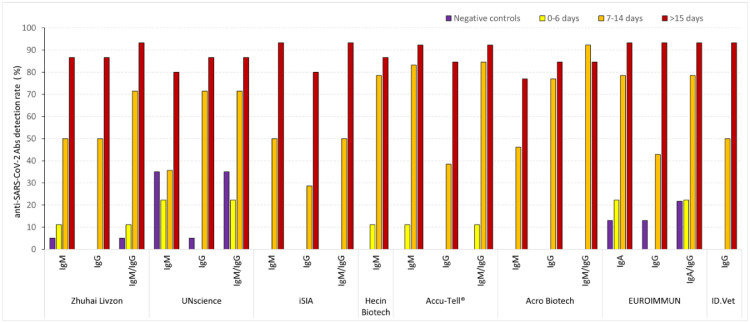
Fig. 1
Fig. 1
Proportion of samples testing positive for anti-SARS-CoV-2 antibodies. Samples were stratified based on the delay from onset of symptoms. Weak signals, i.e., trace in immunochromatographic test results close to the cut-off value in ELISA, were considered as positive. The proportion of positive tests for each category and for each test and antibody isotype is indicated. For tests combining the detection of two isotypes, the last column indicates positivity for at least one of the two isotypes.
Fig. 2
Fig. 2
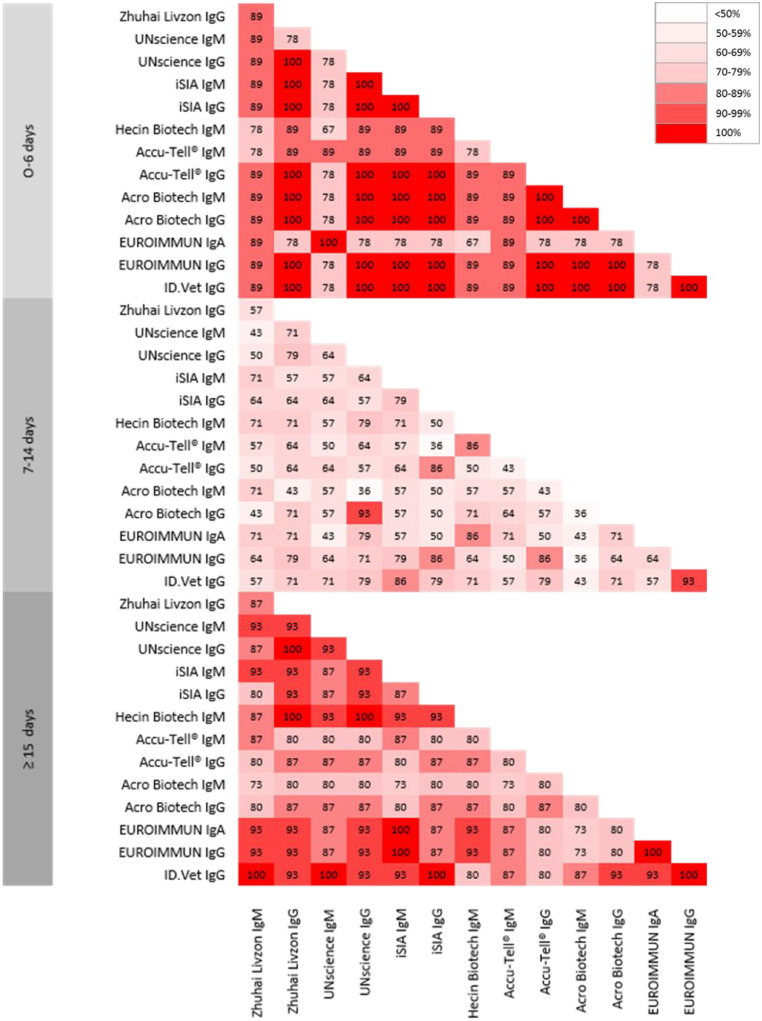
Between-tests agreement rates. The percentage of agreement between the POC and ELISA tests is presented.
Fig. 3
Fig. 3
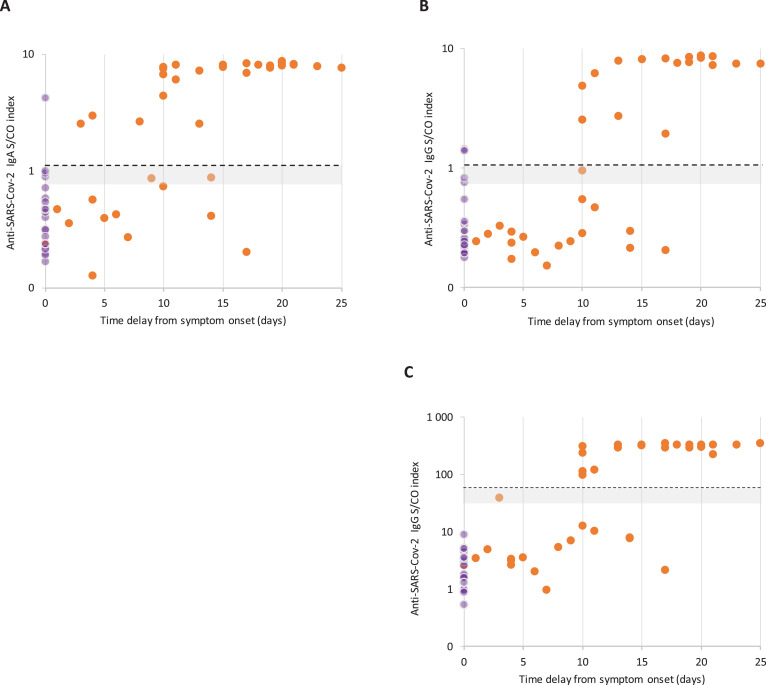
Signal-to-cut-off results according to the time delay from symptom onset. A) EUROIMMUN IgA test. B) EUROIMMUN IgG test. C) ID.Vet IgG test. Samples from patients with proven SARS-CoV-2 infection are indicated by an orange circle, negative controls by a purple circle. The positivity threshold is indicated by the dotted line. Results in the area of uncertainty (gray) were considered positive.
Fig. 4
Fig. 4
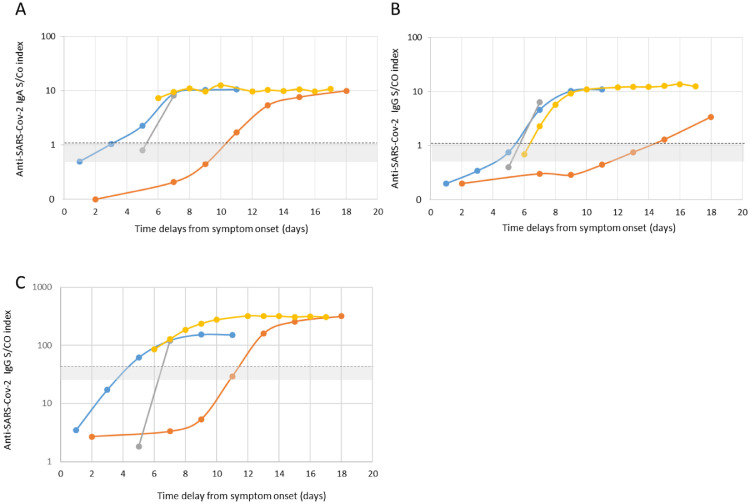
Seroconversions for anti-SARS-CoV-2 antibodies. The results of four patients are presented; in orange patient # 1; in yellow patient # 2, in blue patient # 3, in gray patient # 4. A) EUROIMMUN IgA test. B) EUROIMMUN IgG test. C) ID.Vet IgG test. The positivity threshold is indicated by the dotted line. The area of uncertainty is indicated in gray.
Fig. 5
Fig. 5
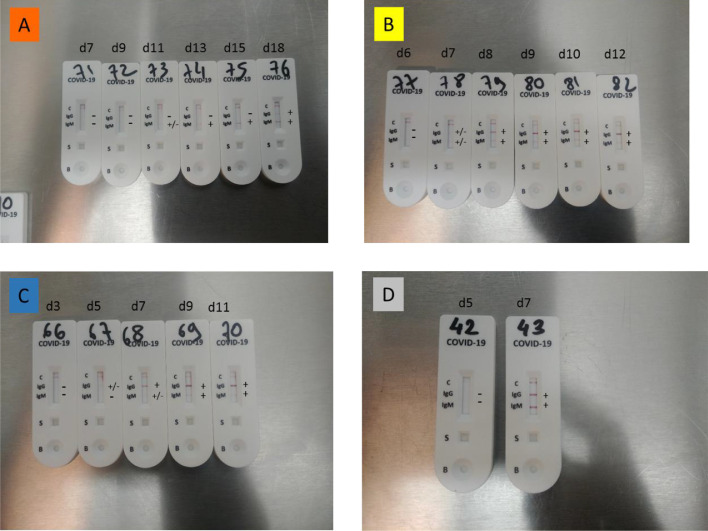
Pattern of anti-SARS-CoV-2 seroconversion using a lateral flow assay (Accu-Tell®). The results of three patients are presented. A) Patient # 1 (orange curve in Fig. 3). B) Patient # 2 (yellow curve in Fig. 3). C) Patient # 3 (blue curve in Fig. 3). D) Patient # 4 (gray curve in Fig. 3).

Comment in

References

    1. Tang Yi-Wei, Schmitz Jonathan E., Persing David H., Stratton Charles W. The Laboratory Diagnosis of COVID-19 Infection: Current Issues and Challenges. J Clin Microbiol. 2020 doi: 10.1128/JCM.00512-20. - DOI - PMC - PubMed
    1. Wang Wenling, Xu Yanli, Gao Ruqin, Lu Roujian, Han Kai, Wu Guizhen. Detection of SARS-CoV-2 in Different Types of Clinical Specimens. JAMA. 2020 doi: 10.1001/jama.2020.3786. - DOI - PMC - PubMed
    1. Pan Yang, Zhang Daitao, Yang Peng, Poon Leo L.M., Wang Quanyi. Viral load of SARS-CoV-2 in clinical samples. Lancet Infect Dis. 2020;20(4):411–412. doi: 10.1016/S1473-3099(20)30113-4. - DOI - PMC - PubMed
    1. Qu Jiuxin, Wu Chi, Li Xiaoyong, Zhang Guobin, Jiang Zhaofang, Li Xiaohe. Profile of IgG and IgM antibodies against severe acute respiratory syndrome coronavirus 2 (SARS-CoV-2) Clin Infect Dis. 2020 doi: 10.1093/cid/ciaa489. - DOI - PMC - PubMed
    1. Perera Ranawaka Apm, Mok Chris Kp, Tsang Owen Ty, Lv Huibin, Ko Ronald Lw, Wu Nicholas C. Serological assays for severe acute respiratory syndrome coronavirus 2 (SARS-CoV-2), March 2020. Euro Surveill. 2020;25(16) doi: 10.2807/1560-7917.ES.2020.25.16.2000421. - DOI - PMC - PubMed

Publication types

MeSH terms