Measurement of mean systemic filling pressure after severe hemorrhagic shock in swine anesthetized with propofol-based total intravenous anesthesia: implications for vasopressor-free resuscitation
- PMID: 32506874
- PMCID: PMC7280792
- DOI: 10.4266/acc.2019.00773
Measurement of mean systemic filling pressure after severe hemorrhagic shock in swine anesthetized with propofol-based total intravenous anesthesia: implications for vasopressor-free resuscitation
Abstract
Background: Mean systemic filling pressure (Pmsf) is a quantitative measurement of a patient's volume status and represents the tone of the venous reservoir. The aim of this study was to estimate Pmsf after severe hemorrhagic shock and cardiac arrest in swine anesthetized with propofol-based total intravenous anesthesia, as well as to evaluate Pmsf's association with vasopressor-free resuscitation.
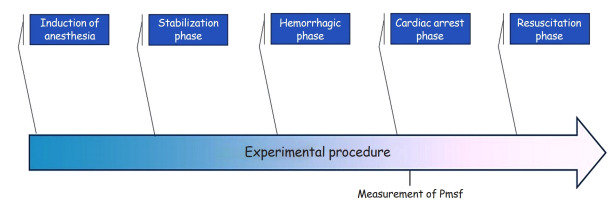
Methods: Ten healthy Landrace/Large-White piglets aged 10-12 weeks with average weight 20±1 kg were used in this study. The protocol was divided into four distinct phases: stabilization, hemorrhagic, cardiac arrest, and resuscitation phases. We measured Pmsf at 5-7.5 seconds after the onset of cardiac arrest and then every 10 seconds until 1 minute postcardiac arrest. During resuscitation, lactated Ringers was infused at a rate that aimed for a mean right atrial pressure of ≤4 mm Hg. No vasopressors were used.
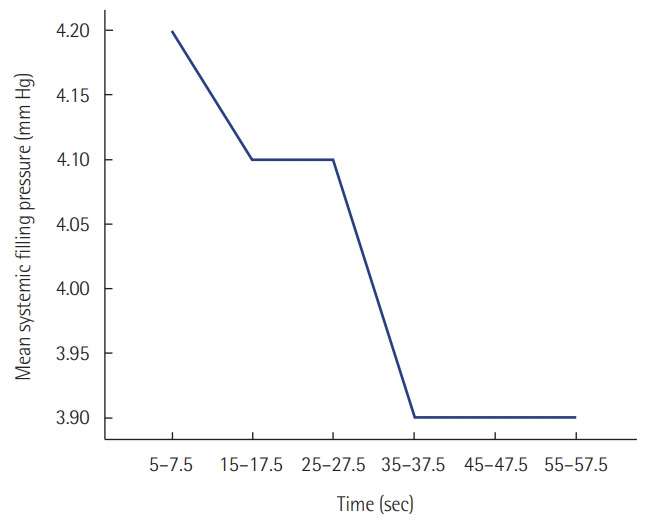
Results: The mean volume of blood removed was 860±20 ml (blood loss, ~61%) and the bleeding time was 43.2±2 minutes while all animals developed pulseless electrical activity. Mean Pmsf was 4.09±1.22 mm Hg, and no significant differences in Pmsf were found until 1 minute postcardiac arrest (4.20±0.22 mm Hg at 5-7.5 seconds and 3.72±0.23 mm Hg at 55- 57.5 seconds; P=0.102). All animals achieved return of spontaneous circulation (ROSC), with mean time to ROSC being 6.1±1.7 minutes and mean administered volume being 394±20 ml.
Conclusions: For the first time, Pmsf was estimated after severe hemorrhagic shock. In this study, Pmsf remained stable during the first minute post-arrest. All animals achieved ROSC with goal-directed fluid resuscitation and no vasopressors.
Keywords: anesthesia; hemodynamics; hemorrhagic shock; mean systemic filling pressure; resuscitation.
Conflict of interest statement
Figures
References
-
- Guyton AC, Hall JE. Cardiac output, venous return, and their regulation. In: Schmitt W, Gruliow R, editors. Textbook of medical physiology. 10th ed. Philadelphia: W.B. Saunders; 2000; 2000. pp. 210–22.
-
- Aya HD, Cecconi M. Can (and should) the venous tone be monitored at the bedside? Curr Opin Crit Care. 2015;21:240–4. - PubMed
-
- Shen T, Baker K. Venous return and clinical hemodynamics: how the body works during acute hemorrhage. Adv Physiol Educ. 2015;39:267–71. - PubMed
LinkOut - more resources
Full Text Sources