


Dreaming with hippocampal damage
- PMID: 32508305
- PMCID: PMC7279885
- DOI: 10.7554/eLife.56211
Dreaming with hippocampal damage
Abstract
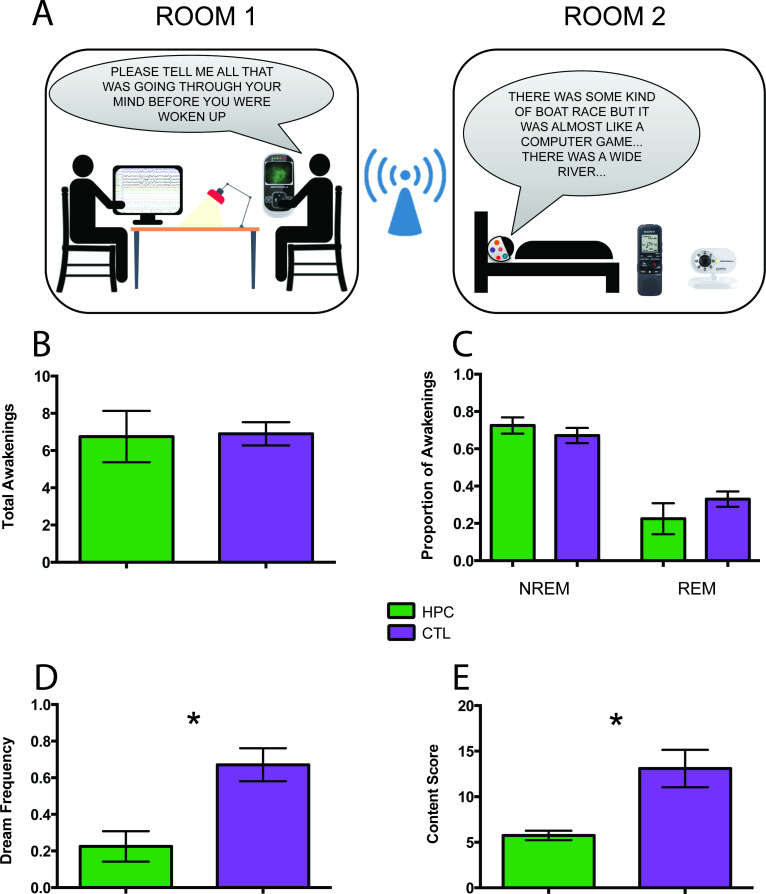
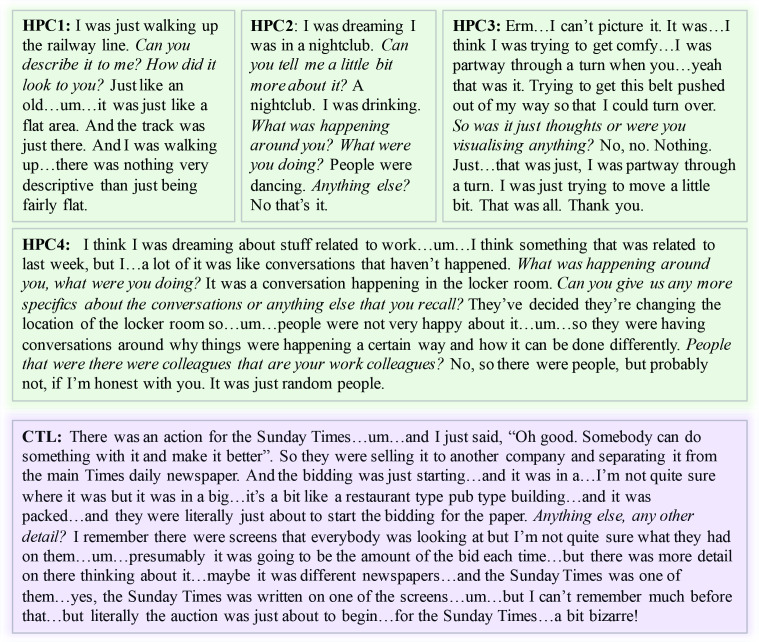
The hippocampus is linked with both sleep and memory, but there is debate about whether a salient aspect of sleep - dreaming - requires its input. To address this question, we investigated if human patients with focal bilateral hippocampal damage and amnesia engaged in dreaming. We employed a provoked awakening protocol where participants were woken up at various points throughout the night, including during non-rapid eye movement and rapid eye movement sleep, to report their thoughts in that moment. Despite being roused a similar number of times, dream frequency was reduced in the patients compared to control participants, and the few dreams they reported were less episodic-like in nature and lacked content. These results suggest that hippocampal integrity may be necessary for typical dreaming to occur, and aligns dreaming with other hippocampal-dependent processes such as episodic memory that are central to supporting our mental life.
Keywords: amnesia; dreaming; episodic memory; hippocampus; human; neuroscience; sleep.
Plain language summary
Dreaming has intrigued humans for thousands of years, but why we dream still remains somewhat of a mystery. Although dreams are not a precise replay of our memories, one idea is that dreaming helps people process past experiences as they sleep. If this is true, then part of the brain called the hippocampus that is important for memory should also be necessary for dreaming. Damage to the hippocampus can cause a condition called amnesia that prevents people from forming new memories and remembering past experiences. However, studies examining dreaming in people with amnesia have produced mixed results: some found that damage to the hippocampus had no effect on dreams, while others found it caused people to have repetitive dreams that lacked detail. One reason for these inconsistencies is that some studies asked participants about their dreams the next morning by which time most people, particularly those with amnesia, have forgotten if they dreamed. To overcome this limitation, Spanò et al. asked participants about their dreams immediately after being woken up at various points during the night. The experiment was carried out with four people who had damage to both the left and right hippocampus and ten healthy volunteers. Spanò et al. found that the people with hippocampal damage reported fewer dreams and the dreams they had were much less detailed. These findings suggest that a healthy hippocampus is necessary for both memory and dreaming, reinforcing the link between the two. Hippocampal damage is associated with a number of diseases, including dementia. If these diseases cause patients to dream less, this may worsen the memory difficulties associated with these conditions.
© 2020, Spanò et al.
Conflict of interest statement
GS, GP, CM, IC, SD, TM, JE, CR, EM No competing interests declared
Figures
Comment in
-
How the brain constructs dreams.Elife. 2020 Jun 8;9:e58874. doi: 10.7554/eLife.58874. Elife. 2020. PMID: 32508304 Free PMC article.
References
-
- Bastiaansen AEM, van Sonderen A, Titulaer MJ. Autoimmune encephalitis with anti-leucine-rich glioma-inactivated 1 or anti-contactin-associated protein-like 2 antibodies (formerly called voltage-gated potassium channel-complex antibodies) Current Opinion in Neurology. 2017;30:302–309. doi: 10.1097/WCO.0000000000000444. - DOI - PubMed
-
- Berry RB, Brooks R, Gamaldo CE, Harding SM, Lloyd RM, Marcus CL, Vaughn BV. The AASM Manual for the Scoring of Sleep and Associated Events: Rules, Terminology and Technical Specifications, Version 2.2. Darien, Illinois: Academy, American of Sleep Medicine; 2015.
MeSH terms
Grants and funding
LinkOut - more resources
Full Text Sources
Miscellaneous
