


Effects of strength training under hypoxic conditions on muscle performance, body composition and haematological variables
- PMID: 32508379
- PMCID: PMC7249800
- DOI: 10.5114/biolsport.2020.93037
Effects of strength training under hypoxic conditions on muscle performance, body composition and haematological variables
Abstract
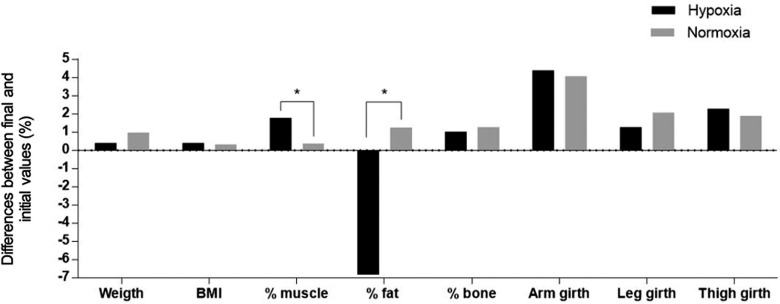
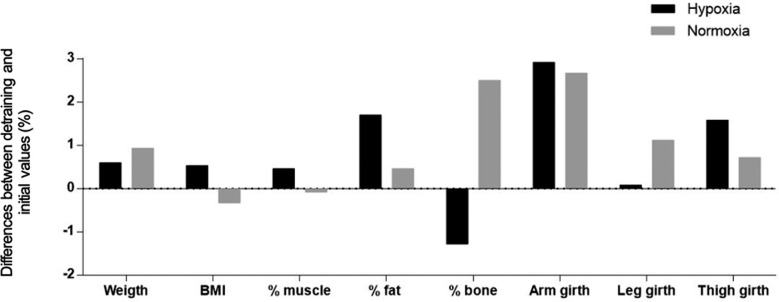
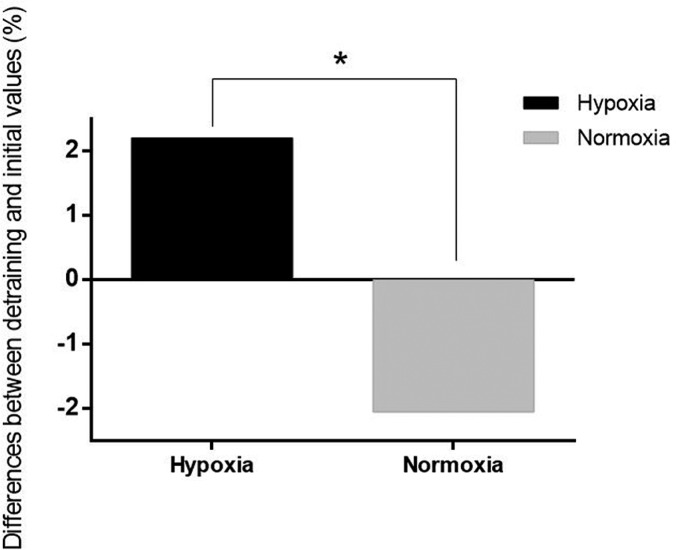
The addition of a hypoxic stimulus during resistance training is suggested to increase the metabolic responses, enhancing hypertrophy and muscle strength. The purpose of this study was to investigate the effects of resistance training performed at submaximal intensities combined with normobaric hypoxia on muscular performance, body composition and haematological parameters. Thirty-two untrained subjects participated in this study (weight: 74.68±12.89 kg; height: 175±0.08 cm; BMI: 24.28±3.80 kg/m2). They were randomized to two groups: hypoxia (FiO2 = 13%) or normoxia (FiO2 = 20.9%). The training programme lasted 7 weeks (3 d/w) and several muscle groups were exercised (3 sets x 65-80% 1RM to failure). Measurements were taken before, after the training and after a 3-week detraining period. Body composition and muscle mass were assessed through skinfolds and muscle girths. Muscle strength was evaluated by the 1RM estimated test. Finally, haemoglobin and haematocrit were taken from the antecubital vein. Both groups improved their strength performance and muscle perimeters, but the hypoxia group obtained a greater increase in muscle mass (hypoxia: +1.80% vs. normoxia: +0.38%; p<0.05) and decrease in fat mass (hypoxia: -6.83% vs. normoxia: +1.26%; p<0.05) compared to the normoxia group. Additionally, haematocrit values were also higher for the hypoxia group after the detraining period (hypoxia: +2.20% vs. normoxia: -2.22%; p<0.05). In conclusion, resistance training under hypoxic conditions could increase muscle mass and decrease fat mass more effectively than training performed in normoxia, but without contributing to greater muscle strength.
Keywords: Altitude training; Haematological variables; IHRT; Intermittent hypoxic resistance training; Normobaric hypoxia.
Copyright © Biology of Sport 2020.
Conflict of interest statement
none
Figures
References
-
- Álvarez-Herms J, Julià-Sánchez S, Corbi F, et al. Changes in heart rate recovery index after a programme of strength/endurance training in hypoxia. Apunt Med l’Esport. 2012;47:23–29.
-
- Burtscher M, Nachbauer W, Baumgartl P, et al. Benefits of training at moderate altitude versus sea level training in amateur runners. Eur J Appl Physiol Occup. Physiol. 1996;74:558–563. - PubMed
-
- Levine BD, Stray-Gundersen J. “Living high-training low”: effect of moderate-altitude acclimatization with low-altitude training on performance. J Appl Physiol. 1997;83:102–112. - PubMed
-
- Scott BR, Slattery KM, Sculley D V, et al. Hypoxia and resistance exercise: A comparison of localized and systemic methods. Sport Med. 2014;44:1037–1054. - PubMed
LinkOut - more resources
Full Text Sources
