


Running-based high-intensity interval training vs. small-sided game training programs: effects on the physical performance, psychophysiological responses and technical skills in young soccer players
- PMID: 32508384
- PMCID: PMC7249797
- DOI: 10.5114/biolsport.2020.94237
Running-based high-intensity interval training vs. small-sided game training programs: effects on the physical performance, psychophysiological responses and technical skills in young soccer players
Abstract
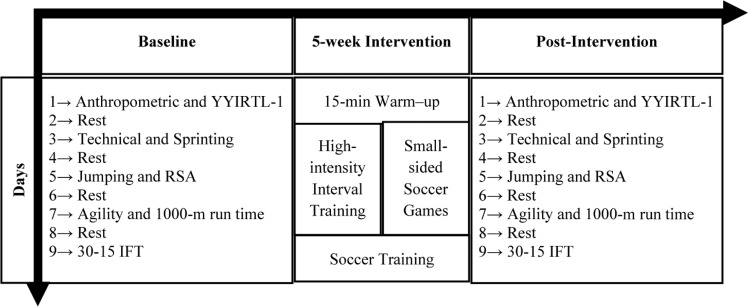
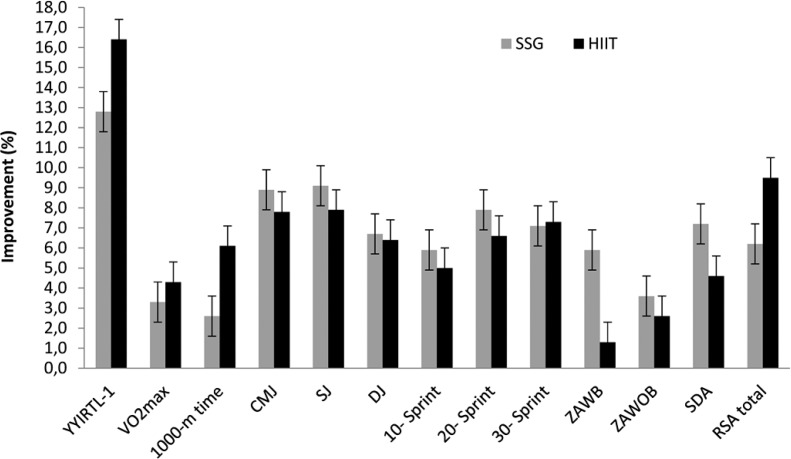
This study aimed to compare the effects of 5-week running-based high-intensity interval training (HIIT) vs. small-sided game training (SSG) on the physical performance, psychophysiological responses and technical skills in young soccer players. Twenty young male soccer players (age: 14.2±0.5 years, height: 161.8±7.9 cm) participated in this study and were assigned to two groups: the HIIT group (n=10) and SSG group (n=10). Both groups trained twice per week with a similar total training duration. The SSG consisted of two 5-9 minutes of 2-a-side with 2-minute passive rest periods, whereas the HIIT consisted of 12-20 minutes of continuous runs at intensities (90 to 95%) related to the velocity obtained in the 30-15 intermittent fitness test. Before and after the 5-week training periods the following tests were completed: maximum oxygen consumption (VO2max) from the Yo-Yo Intermittent Recovery Test level 1 (YYIRTL-1), 10-30-m sprint test, countermovement jump [CMJ], squat jump [SJ], and drop jump [DJ]), 1000-m run test, zigzag agility, repeated sprint ability, 30-15 intermittent fitness test and speed dribbling ability test. Our results revealed meaningful improvements in YYIRTL-1 performance (SSG: +12.8%, standardized effect size [d]=-1.46; HIIT: +16.4%, d=3.27 and VO2max (SSG: +3.3%, d=-1.48; HIIT: +4.3%, d=2.61). There was a meaningful greater improvement in agility and technical test performances following the SSG training compared with the HIIT (p ≤ 0.05, d=ranging from 0.92 to 1.99). By contrast, the HIIT group showed meaningfully higher performance responses in terms of the 1000-m running time and repeated sprint test ability (p ≤ 0.05, d=ranging from 0.90 to 2.06). These results confirmed that SSG training might be a more effective training regime to improve technical ability and agility with greater enjoyment, whereas HIIT might be more suitable for speed-based conditioning in young soccer players.
Keywords: Drill-based tasks; Football; Performance; Physical enjoyment; Psychophysiological responses; Technique.
Copyright © Biology of Sport 2020.
Conflict of interest statement
The authors declare no conflict of interests regarding the publication of this manuscript.
Figures
References
-
- Hill-Haas SV, Dawson B, Impellizzeri FM, Coutts AJ. Physiology of small-sided games training in football a systematic review. Sport Med. 2011;41(3):199–220. - PubMed
-
- Stølen T, Chamari K, Castagna C, Wisløff U. Physiology of soccer: an update. Sports Med. 2005;35(6):501–536. - PubMed
-
- Castagna C, Impellizzeri F, Cecchini E, Rampinini E, Alvarez JCB. Effects of intermittent-endurance fitness on match performance in young male soccer players. J Strength Cond Res. 2009;23(7):1954–1959. - PubMed
-
- Hazir T, Kose MG, Kin-Isler A. The validity of running anaerobic sprint test to assess anaerobic power in young soccer players. Isokinet Exerc Sci. 2018;26(3):201–209.
LinkOut - more resources
Full Text Sources
Medical
